

Pakistan tells OIC India strengthening control over Kashmir through ‘intimidation and fear’

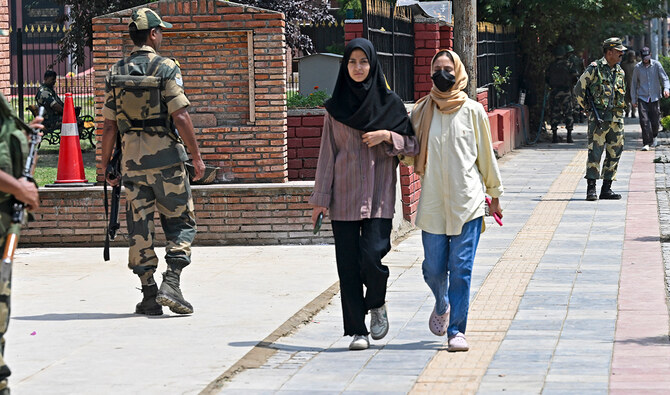
Indian Border Security Force (BSF) soldiers stand guard along a street in Srinagar on August 16, 2024. (AFP/File)
Short Url
Updated 31 August 2024
Follow

Pakistan tells OIC India strengthening control over Kashmir through ‘intimidation and fear’

  • Foreign Secretary Syrus Qazi briefs the OIC Contact Group on Kashmir on sidelines of CFM conference in Cameroon
  • Indian government plans to hold Kashmir elections in a decade after revoking the region’s special constitutional status

ISLAMABAD: Pakistan Foreign Secretary Muhammad Syrus Sajjad Qazi has informed the Organization of Islamic Cooperation (OIC) about the situation in Indian-administered Kashmir, said an official statement on Friday, noting that New Delhi was trying to strengthen control over the disputed Himalayan region by fostering an “environment of intimidation and fear.”

Qazi led his country’s delegation to the two-day OIC Council of Foreign Ministers (CFM) meeting on August 29-30 in Cameroon, where he discussed Israel’s ongoing military campaign against Palestinians while demanding an immediate ceasefire.

On the sidelines, he also briefed a meeting of the OIC Contact Group on Kashmir, chaired by Secretary General Hissein Brahim Taha, about the situation on the Indian side of Kashmir, which witnessed administrative changes in 2019 when Prime Minister Narendra Modi’s government revoked its special constitutional status, leading to heightened tensions with Pakistan.

The Muslim-majority Kashmir region is divided between nuclear-armed India and Pakistan, with both countries claiming it in its entirety.

“The foreign secretary outlined India’s attempt to consolidate its occupation of Indian-administered Kashmir in violation of the relevant Security Council resolutions including by creating an environment of intimidation and fear,” the foreign office said in a statement.

Qazi urged India to release all political prisoners and lift curbs on political parties, as he referred to some of the measures taken by New Delhi since revoking the region’s special constitutional status.

“The Contact Group also adopted a joint communique unanimously underlining that durable peace and stability in South Asia remain contingent upon the final settlement of the Jammu and Kashmir dispute per UN Security Council resolutions,” the statement said.

New Delhi decided to annul Article 370 of the Indian constitution in 2019, which granted limited autonomy to Kashmiris under the Indian Union. It also struck down Article 35A, which prohibited the purchase of property by people from outside the disputed territory.

Pakistani officials have claimed the latter step was taken to change the region’s demography.

India is now preparing to hold the first regional elections in a decade between September 18 and October 1, allowing the residents of Kashmir to elect their government, also known as a local assembly, instead of remaining under New Delhi’s direct rule.

The vote count will be held on October 4.


Pakistan opposition rallies in Khyber Pakhtunkhwa to demand release of Imran Khan

Updated 07 December 2025
Follow

Pakistan opposition rallies in Khyber Pakhtunkhwa to demand release of Imran Khan

  • PTI-led gathering calls the former PM a national hero and demands the release of all political prisoners
  • Government says the opposition failed to draw a large crowd and accuses PTI of damaging its own politics

ISLAMABAD: Pakistan’s opposition led by the Pakistan Tehreek-e-Insaf (PTI) party demanded the release of jailed former prime minister Imran Khan at a rally in the northwestern Khyber Pakhtunkhwa province on Sunday, describing him as a national hero who continues to command public support.

The gathering came days after a rare and strongly worded briefing by the military’s media chief, Lt. Gen. Ahmed Sharif Chaudhry, who dismissed Khan as “narcissistic” and “mentally ill” on Friday while responding to the former premier’s allegations that Pakistan’s chief of defense forces was responsible for undermining the constitution and rule of law.

He said that Khan was promoting an anti-state narrative which had become a national security threat.

The participants of the rally called for “civilian supremacy” and said elected representatives should be treated with respect.

“We, the people of Pakistan, regard Imran Khan as a national hero and the country’s genuinely elected prime minister, chosen by the public in the February 8, 2024 vote,” said a resolution presented at the rally in Peshawar. “We categorically reject and strongly condemn the notion that he or his colleagues pose any kind of threat to national security.”

“We demand immediate justice for Imran Khan, Bushra Bibi and all political prisoners, and call for their prompt release,” it added, referring to Khan’s wife who is also in prison. “No restrictions should be placed on Imran Khan’s meetings with his family, lawyers or political associates.”

Addressing the gathering, Sohail Afridi, the chief minister of Khyber Pakhtunkhwa, denied his administration was not serious about security issues amid increased militant activity. However, he maintained the people of his province had endured the worst of Pakistan’s conflict with militancy and urged a rethinking of long-running security policies.

The resolution asked the federal government to restore bilateral trade and diplomatic channels with Afghanistan, saying improved cross-border ties were essential for the economic stability of the region.

The trade between the two neighbors has suffered as Pakistan accuses the Taliban administration in Kabul of sheltering and facilitating armed groups that it says launch cross-border attacks to target its civilians and security forces. Afghan officials deny the claim.

The two countries have also had deadly border clashes in recent months that have killed dozens of people on both sides.

Some participants of the rally emphasized the restoration of democratic freedoms, judicial independence and space for political reconciliation, calling them necessary to stabilize the country after years of political confrontation.

Reacting to the opposition rally, Information Minister Attaullah Tarrar said the PTI and its allies could not gather enough people.

“In trying to build an anti-army narrative, they have ruined their own politics,” he said, adding that the rally’s reaction to the military’s media chief’s statement reflected “how deeply it had stung.”

“There was neither any argument nor any real response,” he added, referring to what was said by the participants of the rally.