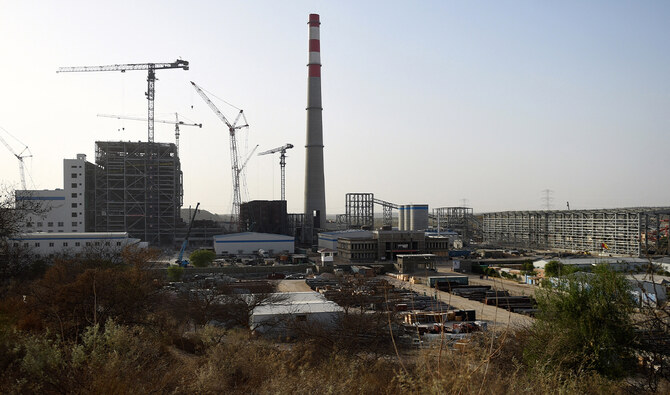

ISLAMABAD: Pakistan’s ministry for energy this week set up a four-member committee to provide recommendations so Chinese power plants operating in the country can be shifted to coal from Pakistan’s Thar region rather than imported coal.
Neighboring China has set up over $20 billion worth of energy projects in Pakistan under the China-Pakistan Economic Corridor (CPEC). Three coal-fired power plants of 1,320 megawatts each have been set up under CPEC, one in Sahiwal in 2017, another in Port Qasim in Karachi in 2018, and the third one in Balochistan’s Hub in 2019. All three run on imported coal, which costs over $1.5 billion per annum, according to a National University of Sciences & Technology study published this year.
The cost of electricity generated through imported coal stands at Rs20.02 per kilowatthour as opposed to indigenous coal at Rs14.19/kWh.
Pakistan, a country of more than 240 million people, depends chiefly on natural gas to produce electricity, but has been looking to boost coal-fired output to save costs. The country, with a total installed electricity generation capacity of approximately 41,268 megawatts, relies heavily on imported fuels, including on Regasified Liquefied Natural Gas (RLNG), coal and furnace oil, which account for nearly 47 percent of its power generation mix.
“The Federal Ministry for Energy (Power Division) has been pleased to constitute the following committee for conversion of 03 imported coal based IPPs [independent power producers] to Thar coal, developed under China-Pakistan Economic Corridor (CPEC) framework,” the ministry said in a notification dated Aug. 28.
The committee led by the additional secretary of the power division will prepare technical and financial feasibility studies for the conversion of the plants to Thar coal. It will also “look into the logistics for transportation of coal from Thar mines to projects’ sites” and provide “recommendations, way forward and implementation plan [if feasible]” to the government.
Last February, the energy ministry said Pakistan planned to quadruple its domestic coal-fired capacity to reduce power generation costs and would not build new gas-fired plants in the coming years.
The transition could save Pakistan more than Rs200 billion a year in imports, translating to a decrease of as much as Rs2.5 per unit in the price of electricity, Awais Leghari, head of the energy ministry’s Power Division, said in an interview last month. The energy ministry told Arab News it did not have updated data on coal imports.
Energy experts said while it was feasible to convert the imported coal-fired power plants, it would take two to three years due to a lack of local coal.
“The electricity cost can be reduced by half by switching the imported coal power plants to the local fuel, but this cannot be done instantly,” Farhan Mahmood, head of research at Sherman Securities in Karachi, told Arab News.
He said local coal would cost around $50 per ton while imported coal was around $120 per ton, though the imported coal was of higher grade and efficiency, with comparatively less carbon emissions.
Mahmood said Pakistan was mining around 7.6 million tons of coal per annum from Thar and planning to boost it to 11 million tons in up to three years.
“We will have to first boost our mining capacity and quantity to meet the fuel demand of the power plants,” he said. “There is a dire need to enhance our local coal share in the energy mix to bring down the electricity prices and cut the import bill.”
Exorbitant power bills have led to street protests in Pakistan in recent months and calls to review contracts with IPPs, which produce expensive electricity.
Pakistan has been trying to cut down on the use of furnace oil for power generation and to boost natural gas-fired electricity production.