Pakistan PM rules out talks with militants, urges reconciliation with ‘detracted’ Baloch youth

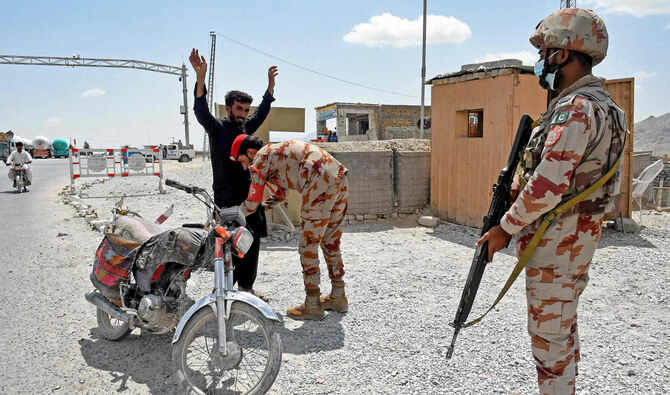
A Pakistani paramilitary ranger frisks a motorcyclist at a checkpoint a day after attacks by separatist militants on the outskirts of Quetta on August 27, 2024. (AFP)
Short Url
Updated 30 August 2024
Follow

Pakistan PM rules out talks with militants, urges reconciliation with ‘detracted’ Baloch youth

  • Sunday’s multiple attacks were the most widespread in years by ethnic militants in Balochistan, killing over 50 people
  • Interior ministry says more than one group coordinated on attacks, militants planning to ‘sabotage’ SCO summit

ISLAMABAD: Prime Minister Shehbaz Sharif on Friday ruled out talks with militants who were behind separatist attacks in Pakistan’s southwest last week, urging authorities to address the grievances of young ethnic Baloch people and bring them into the mainstream.
The premier was addressing a federal cabinet meeting a day after he visited Quetta, the provincial capital of Balochistan province where militants carried out a string of coordinated attacks on Aug 26, killing over 50, including 19 security personnel. 
The latest surge in violence comes amid protests led by young ethnic Baloch against what they describe as a pattern of enforced disappearances and other human rights abuses in Balochistan by security forces, who deny the charge. 
The insurgency and the protests continue to keep the mineral rich province of some 15 million people unstable and impoverished and have created security concerns around Pakistan’s plans to access untapped resources in Balochistan’s desert and mountainous terrain.
“One thing was sure that those who are terrorists and enemies who are against peace in Pakistan, there is no question of holding a dialogue with them,” Sharif told cabinet, giving details of his meetings with political religious and military officials in Quetta on Thursday.
“But as some political elements said, a few [ethnic Baloch] youngsters have been detracted through a different narrative, we should try to bring them to the mainstream.”
While in Quetta, the PM said he had received a detailed presentation by Balochistan Corps Commander Lt Gen Rahat Naseem on how “terrorists are sowing the seeds of hatred and also receiving help from abroad.”
On Wednesday, top Pakistani officials said militants had used the territory of neighboring Afghanistan and received support from India’s Research & Analysis Wing (RAW) spy agency to launch Sunday’s attacks. Delhi and Kabul have not commented on the allegations.
The attacks began on Sunday evening when separatist militants in the country’s largest province took control of a highway and shot dead 23 people, mostly laborers from the eastern Punjab province. They also blew up a railway bridge that connects Balochistan to the rest of Pakistan and tried to separately storm camps of the paramilitary Frontier Corps and Levies forces.
The attacks were the most widespread in years by ethnic militants fighting a decades-long insurgency to win secession of the resource-rich province, home to major China-led projects such as a port and a gold and copper mine. The Pakistani state denies it is exploiting Balochistan and says it is working for the uplift of the region through development schemes.
“SABOTAGING SCO SUMMIT”
Separately, while speaking in the upper house of parliament, Interior Minister Naqvi ruled out a military operation in Balochistan and vowed that those responsible for Sunday’s attacks would face justice.

“There is no operation,” he said. “There can be differences, we will try to address them, we have done so in the past and will keep doing it in the future also … but those who pick up weapons are terrorists and we will take care of them.”
He said the Aug. 26 attacks were carried out by at least two militant outfits who had worked together. 
“We even know that it was a planning to sabotage the SCO [Shanghai Cooperation Organization] conference,” Naqvi said about the summit which Islamabad will host on October 15-16. “They don’t want it to take place. This is a conspiracy against even that too.”
On Thursday, Sharif called the separatist attacks in Balochistan a “wicked scheme” launched by the “external enemies of Pakistan and their internal infiltrators.” On Tuesday he had said the assaults were aimed at stopping development projects in Balochistan that form part of the China-Pakistan Economic Corridor (CPEC).
CPEC, said to have development commitments worth $65 billion, is part of Chinese President Xi Jinping’s Belt and Road initiative.
Beijing has also flagged concerns about the security of its citizens working on projects in Pakistan, particularly in Balochistan. Six Chinese engineers working on a dam project were killed in March in the northwest.
Separatist militants have also targeted Balochistan’s deepwater Gwadar port, which is run by China. 
Chinese targets have previously come under attack by several Baloch militant groups, who say they have been fighting for decades for a larger share in the regional wealth of mines and minerals denied by the central government.

Pakistan’s fragile economic recovery faces risk as Iran conflict raises escalation fears

Updated 8 sec ago
Follow

Pakistan’s fragile economic recovery faces risk as Iran conflict raises escalation fears

  • KP finance chief says wider Gulf conflict could undermine $41 billion remittance target, push up energy prices
  • Economists warn oil surge would widen import bill as Iran targets neighboring countries in regional flare-up

KARACHI: Pakistan’s fragile economic recovery could come under pressure if Israel-US strikes on Iran escalate into a wider regional conflict, threatening oil supplies and remittance flows vital to the country’s balance of payments, officials and independent economists said on Saturday.

The United States and Israel struck Iran following weeks of rising tensions, while Pakistan has also faced renewed border clashes with Afghanistan in recent weeks.

Economists warn that a wider Middle East conflict could quickly destabilize Pakistan’s hard-won macroeconomic gains under a $7 billion International Monetary Fund program since the country relies heavily on Gulf states for imported fuel and worker remittances, which are projected at $41 billion this fiscal year.

Iran has already targeted several neighboring countries in an attempt to strike US military bases in the region, raising fears of a broader escalation and drawing condemnation from regional governments, including Pakistan.

“Pakistan’s western borders are in a state of war,” Muzzammil Aslam, finance minister of the country’s northwestern Khyber Pakhtunkhwa province bordering Afghanistan, told Arab News over the phone. “Given the limited trade with western borders, Pakistan exports are unlikely to be affected. However, if the war expands across the Middle East, it will definitely impact the remittances.”

Aslam warned that energy prices could also spike due to potential supply disruptions.
Pakistan’s finance adviser Khurram Schehzad and finance ministry’s spokesperson Qamar Sarwar Abbasi did not respond to questions seeking their comments on the issue.

However, the country, which is a net oil importer, has only recently posted a modest current account surplus after years of deficits, helped by import compression and higher remittances. Inflation, which peaked at 38 percent in May 2023, has eased to single digits.

Experts said a sustained surge in crude prices could reverse those gains.

“If the Iran-US conflict escalates and oil moves sharply higher, Pakistan is likely to feel it immediately,” Farrukh Saleem, an economist, said. “An increase in crude materially widens the import bill, pressures the current account and weakens the rupee.”

He said such a situation would feed inflation and limit the State Bank of Pakistan’s room to ease the policy rate which it kept unchanged at 10.5 percent in January.

“The Pakistan-Afghanistan tensions are more about security,” he continued. “They don’t move oil, but they raise country risk, delay investment, and strain fiscal space.”

In response to a question, Saleem said he did not see an immediate balance-of-payments crisis.

“Most Middle East conflicts since 2006 have followed a pattern: sharp opening strikes, controlled retaliation, backchannel de-escalation,” he said.

Former state minister for investment Haroon Sharif warned that prolonged instability would weigh on investor confidence.

“A prolonged conflict will lead to capital outflows,” he said.

Regional tensions are also affecting aviation, with Pakistan International Airlines suspending flights to the United Arab Emirates, Bahrain, Doha and Kuwait, while services to Saudi Arabia have been rerouted.

“The monetary impact of these flight suspensions can run in millions of rupees because one flight costs us as much as Rs2 million,” PIA spokesperson Abdullah Hafeez Khan told Arab News.

“Right now, we can safely say domestic carriers are expected to lose millions of rupees in view of the prevailing situation,” he added.

KP’s finance chief Aslam said Pakistan should remain diplomatically careful while dealing with the ongoing conflicts.

“Given the remittances and oil prices are correlated to the balance of payments, one can say the risk of that crisis remains,” he added.