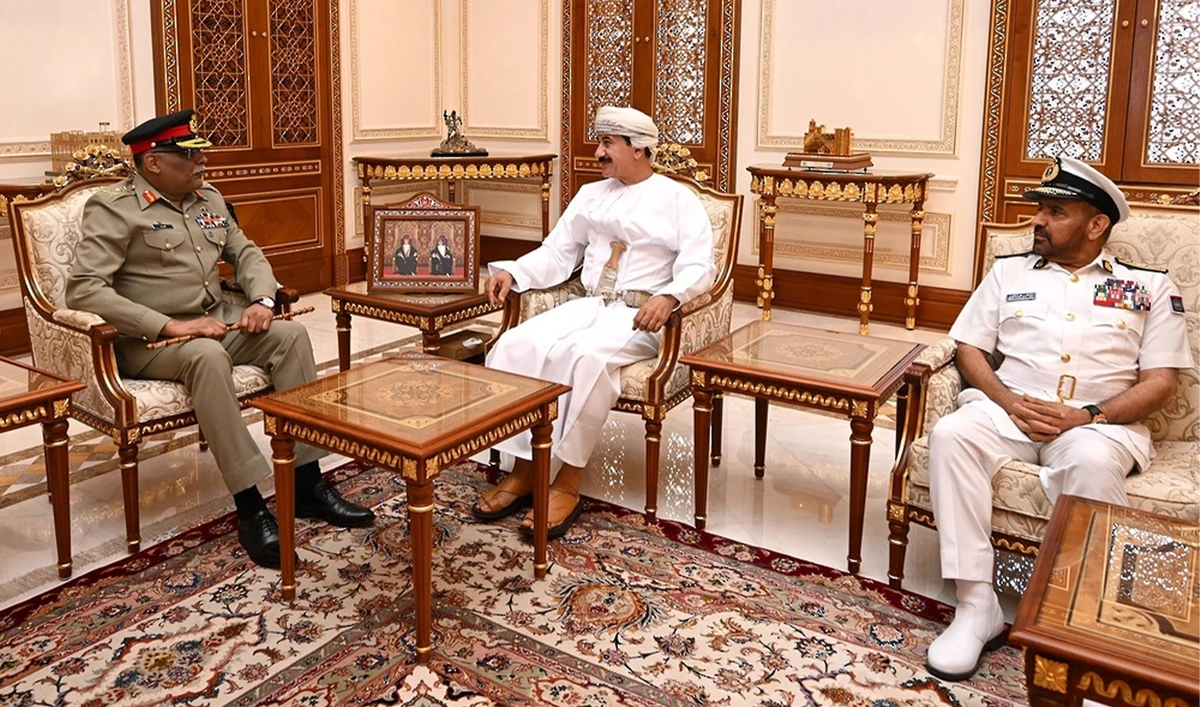
Pakistan Chairman Joint Chiefs of Staff Committee on official Oman visit

Pakistan Chairman Joint Chiefs of Staff Committee (left) calls on Gen. Sultan Mohammed Al Nu’amani (second right), Minister of the Royal Office, during his visit to Oman on August 28, 2024. (Oman News)
Short Url
Updated 29 August 2024
Follow

Pakistan Chairman Joint Chiefs of Staff Committee on official Oman visit

  • General Sahir Shamshad Mirza meets top Omani officials and discusses military cooperation 
  • Training, security, counter-terrorism, defense industry, regional security environment discussed

ISLAMABAD: General Sahir Shamshad Mirza, the Pakistani Chairman Joint Chiefs of Staff Committee (JCSC), is on an official visit to the Sultanate of Oman where he discussed military cooperation with top officials, the army’s media wing said on Thursday.

While in Oman, Mirza called on Sayyid Shihab bin Tariq bin Taimur Al-Said, Deputy Prime Minister for Defense Affairs, General Sultan bin Mohammed Al-Namani, the Minister of the Royal Office, Vice Admiral Abdullah bin Khamis Al-Raisi, the Chief of Staff Sultan Armed Forces (COSSAF), services chiefs and chairman of the Strategic and Defense Academy. 

“During separately-held meetings, both sides discussed military cooperation including training, security, counter-terrorism, defense industry and regional security environment; and acknowledged the commonality of views to expand military to military relationship and forge deeper strategic ties,” the Pakistan army said. 

“The Omani dignitaries acknowledged the sacrifices rendered by people and Armed Forces of Pakistan in the war against terrorism.”

On Tuesday, Islamabad invited Oman to invest in its agriculture, mineral and IT sectors under the Special Investment Facilitation Council (SIFC), a civil-military hybrid body set up last year to attract foreign investment in Pakistan, especially from Gulf nations.

As part of a push to seek foreign investment, Pakistan participated in the eighth session of the Pakistan-Oman Bilateral Political Consultations, held on Tuesday in Muscat, Oman.

The two sides “comprehensively” reviewed all aspects of bilateral cooperation at the conference, including political relations, trade and investment, security and defense, culture, health and consular matters. 

“The Omani side was invited to invest in agriculture, minerals and Information Technology under the Special Investment Facilitation Council,” the Pakistani foreign office said in a statement. 

“Noting the importance of Joint Ministerial Commission, the two sides agreed to hold the 8th session at an early date in Islamabad. The two sides also agreed to further elevate bilateral trade volume and to enhance investment cooperation.”

The Omani side also expressed support for the First Pakistani Business Expo to be held in Muscat on October 13-14 and welcomed Pakistan’s decision to give visas on arrival to Omani nationals, the foreign office said.

Bilateral consultations are an important dialogue mechanism between Pakistan and Oman to review bilateral relations and explore new areas of cooperation.
Pakistan FM discusses regional situation with Saudi counterpart, urges restraint and dialogue

Updated 5 sec ago
Follow

Pakistan FM discusses regional situation with Saudi counterpart, urges restraint and dialogue

  • This is the second time the two foreign ministers have spoken since the Arab Coalition targeted weapon shipments on Yemen’s Mukalla port
  • Saudi Arabia’s foreign ministry has invited factions in south Yemen to hold a dialogue in Riyadh to ‘discuss just solutions to southern cause’

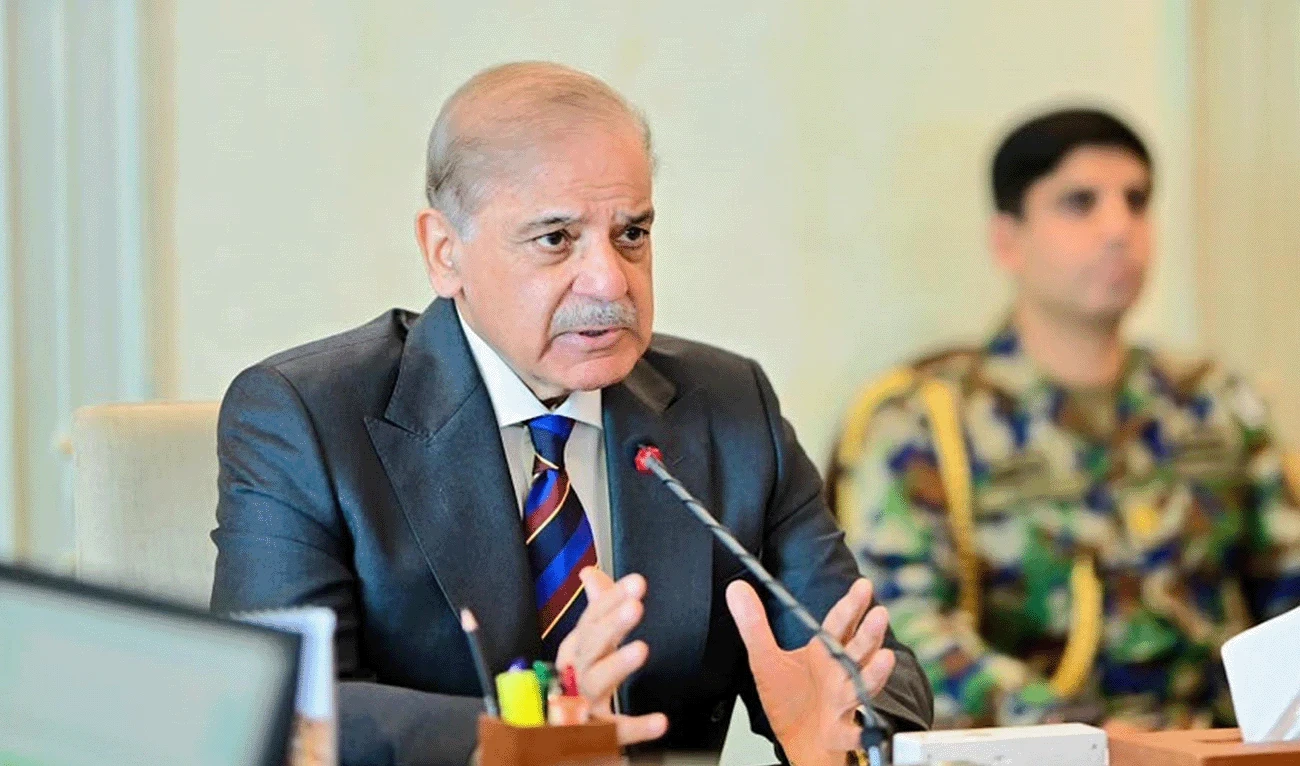
ISLAMABAD: Pakistan’s foreign minister, Ishaq Dar, discussed the regional situation with his Saudi counterpart, Prince Faisal bin Farhan, and called for restraint and dialogue to resolve issues, the Pakistani foreign office said late Friday, amid tensions prevailing over Yemen.

This is the second time the two foreign ministers have spoken this week since the Saudi Arabia-led Coalition to Support Legitimacy in Yemen carried out a “limited” airstrike on Dec. 30, targeting two shipments of smuggled weapons and military equipment sent from the Emirati port of Fujairah to Mukalla in southern Yemen.

A coalition forces spokesperson said the weapons were meant to support the Southern Transitional Council (STC) forces, backed by the United Arab Emirates (UAE), in Yemen’s Hadramaut and Al-Mahra “with the aim of fueling the conflict.” The UAE has since announced withdrawal of its remaining troops from Yemen, rejecting any actions that could threaten the Kingdom or undermine regional stability.

In their telephonic conversation late Friday, the Pakistani and Saudi foreign ministers discussed the latest situation in the region, according to the Pakistani foreign office.

“FM [Dar] stressed that all concerned in the region must avoid any escalatory move and advised to resolve the issues through dialogue and diplomacy for the sake of regional peace and stability,” it added.

Separately, Saudi Arabia’s foreign ministry invited factions in south Yemen to hold a dialogue in Riyadh to “discuss just solutions to the southern cause.”

The ministry statement said the conference in the Saudi capital had been requested by Rashad Al-Alimi, President of the Yemeni Presidential Leadership Council, and the Kingdom urged all factions to participate “to develop a comprehensive vision” that would fulfill the aspirations of the southern people.

Disregarding previous agreements with the Arab Coalition, the STC separatist group launched a sweeping military campaign early in December, seizing the governorates of Hadramaut along the Saudi border and the eastern governorate of Al-Mahra in Yemen’s border with Oman. It also took control of the strategic PetroMasila oilfields, which account for a massive portion of Yemen’s remaining oil wealth.

The advance has raised the spectre of the return of South Yemen, a separate state from 1967 to 1990, while dealing a hammer-blow to slow-moving peace negotiations with Iran-backed Houthi rebels.

Saudi Arabia said the STC action poses a direct threat to the Kingdom’s national security, and regional stability. The Kingdom has reiterated the only way to bring the southern cause to a resolution is through dialogue.

On Thursday, Pakistan’s foreign office expressed solidarity with Saudi Arabia and reaffirmed Islamabad’s commitment to the Kingdom’s security, amid rising tensions in Yemen.

“Pakistan expresses complete solidarity with the Kingdom of Saudi Arabia and reaffirms its commitment to security of the Kingdom,” Pakistani foreign office spokesperson Tahir Andrabi told reporters at a weekly news briefing.

“Pakistan maintains its firm support for the resolution of Yemen issue through dialogue and diplomacy and hopes that Yemen’s people and regional powers work together toward inclusive and enduring settlement of the issue, safeguarding regional stability.”

Pakistan and Saudi Arabia signed a landmark defense pact in September last year, according to which aggression against one country will be treated as an attack against both. The pact signaled a push by both governments to formalize long-standing military ties into a binding security commitment.