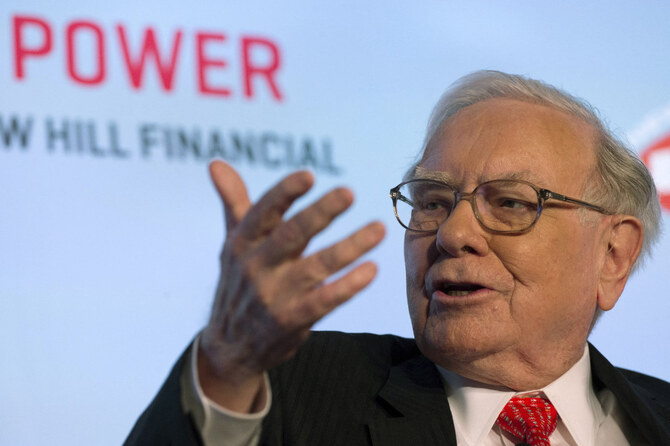
NEW YORK: Warren Buffett’s Berkshire Hathaway holding company crossed $1 trillion in market value Wednesday, making it the first non-tech firm on Wall Street to pass the milestone.
Buffett, who turns 94 on Friday, has been chair of Berkshire Hathaway since 1970, transforming it from a small textile company into one of the world’s most valuable firms, and turning him into one of the world’s richest men.
On Wednesday, Berkshire Hathaway’s market capitalization crossed $1 trillion in early trading, putting it in an exclusive club alongside tech titans like Apple, Nvidia and Microsoft.
The company’s Class A shares closed up 0.8 percent, and its Class B shares closed up 0.9 percent, leaving it with a total market value of just over $1 trillion.
It is the only publicly-traded, non-tech firm other than Saudi Arabia’s state-owned oil company, Saudi Aramco, to hit such heady heights. Electric vehicle maker Tesla, which previously hit a $1 trillion market capitalization, is considered to be a technology company by many analysts.
The Nebraska-based firm’s portfolio spans a vast array of sectors, including insurance, railroads and retail.
Buffett, who has been dubbed the “Sage of Omaha,” popularized a dispassionate, long-term approach to investing that ran counter to the short-term thinking of many market players at the time.
Buffett has been in a selling mood of late, convincing Berkshire Hathaway to dump large quantities of stock in some of its biggest holdings, including Apple and Bank of America, accumulating vast cash reserves.
The firm has plowed its growing cash pile into government bonds to such an extent that it now owns more short-term US Treasury bills than the Federal Reserve.

Buffett’s Berkshire Hathaway hits $1 trillion market value
https://arab.news/bu2pr
Buffett’s Berkshire Hathaway hits $1 trillion market value
- Berkshire Hathaway is the only publicly-traded, non-tech firm other than Saudi Aramco, to hit such heady heights
- The firm has plowed its growing cash pile into government bonds and now owns more short-term US Treasury bills than the Federal Reserve
Rohingya rue Myanmar’s election from exile
COX’S BAZAR, Bangladesh: Myanmar’s military portrays its general election as a path to democracy and peace, but the vote offers neither to a million Rohingya exiles, robbed of citizenship rights and evicted from their homeland by force.
“How can you call this an election when the inhabitants are gone and a war is raging?” said 51-year-old Kabir Ahmed in Bangladesh’s Kutupalong, the world’s largest refugee camp complex.
Heavily restricted polls are due to start Sunday in areas of Myanmar governed by the military, which snatched power in a 2021 coup that triggered civil war.
SPEEDREAD
• Heavily restricted polls are due to start Sunday in areas of Myanmar governed by the military, which snatched power in a 2021 coup that triggered civil war.
• In 2017, a military crackdown sent legions of the mostly Muslim group fleeing Myanmar’s Rakhine state to neighboring Bangladesh.
But for the Rohingya minority, violence began well before that, with a military crackdown in 2017 sending legions of the mostly Muslim group fleeing Myanmar’s Rakhine state to neighboring Muslim-majority Bangladesh.
The month-long election will be the third national poll since they were stripped of their voting rights a decade ago, but comes amid a fresh exodus fueled by the all-out war. Ahmed once served as chairman of a village of more than 8,000 Rohingya in Myanmar’s Maungdaw township, just over the border from Cox’s Bazar in Bangladesh.
After their eviction, the area is now a “wasteland,” he told AFP.
“Who will appear on the ballot?” he asked. “Who is going to vote?“
Today 1.17 million Rohingya live crammed in dilapidated camps spread over 8,000 acres in Cox’s Bazar.
The majority came in the 2017 crackdown, which is now the subject of a UN genocide court case, with allegations of rampant rape, executions and arson.
Civil war has brought fresh violence, with the Rohingya caught between the warring military and separatist group the Arakan Army, one of the many factions challenging the junta’s rule.
Both forces have committed atrocities against the Rohingya, monitors say.
Some 150,000 people fled the persecution to Bangladesh in the 18 months to July, according to UN analysis.
The UN refugee agency said it was the largest surge in arrivals since 2017.
Aged 18, Mohammad Rahim would have been eligible to vote this year — if he was back home, if his country acknowledged his citizenship, and if polling went ahead despite the war.
“I just want the war to end and for steps to be taken to send us back to Myanmar,” said Rahim, the eldest of four siblings who have all grown up in the squalid camps.
The Arakan Army controls all but three of Rakhine’s 17 townships, according to conflict monitors, meaning the military’s long-promised polls are likely to be extremely limited there.
The military has blockaded the coastal western state, driving a stark hunger and humanitarian crisis.
Rahim still craves a homecoming. “If I were a citizen, I would negotiate for my rights. I could vote,” he said.
“I would have the right to education, vote for whoever I wanted, and work toward a better future.”


