

Starmer, Scholz seek reset in British-EU ties with bilateral treaty

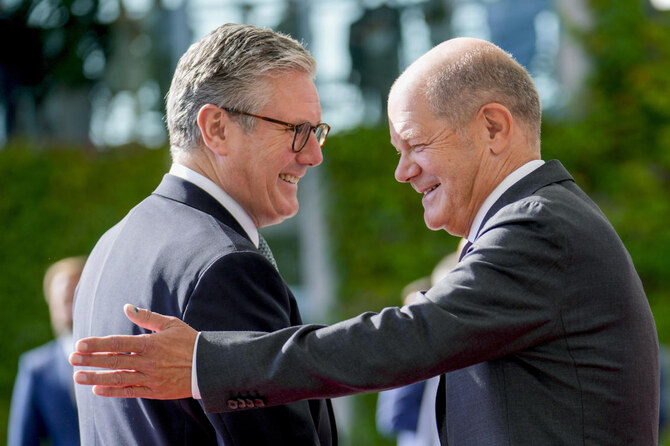
German Chancellor Olaf Scholz, right, welcomes Britain’s Prime Minister Keir Starmer in Berlin on Aug. 28, 2024. The two leaders are hoping for an unprecedented degree of bilateral military cooperation and greater collaboration in areas such as trade and energy. (AP)
Short Url
Updated 28 August 2024
Follow

Starmer, Scholz seek reset in British-EU ties with bilateral treaty

  • Starmer meets Scholz, business leaders in Berlin
  • Agree to work on cooperation treaty to help reset relations

BERLIN: Britain and Germany’s leaders agreed in Berlin on Wednesday to work on an ambitious treaty covering issues from defense to trade that would be part of a reset of British relations with the European Union.
Prime Minister Keir Starmer’s trip to the EU’s top powers, Germany and France, aims to help Britain move beyond the previous Conservative government’s fractious relations with European allies. Starmer, who took office last month, has put improved ties at the heart of his efforts to boost Britain’s economic growth.
He billed the new cooperation treaty as a “once-in-a-generation chance to deliver for working people in Britain and in Germany” as it would deepen collaboration in science, technology, business and culture while increasing trade.
Starmer said that growth was his government’s “number one mission.”
“And what we understand clearly is that building relationships with our partners here in Germany and across Europe is vital to achieving it,” he said.
Starmer, addressing a press conference alongside German Chancellor Olaf Scholz, said a reset would not mean reversing Britain’s 2020 exit from the EU under the Conservatives, or re-entering the bloc’s single market or customs union.
“But it does mean a closer relationship on a number of fronts, including the economy, including defense, including exchanges,” he said.
Scholz said Germany wanted to take this outstretched hand.
“The United Kingdom has always been an indispensable part of solving the big issues that affect the whole of Europe,” he said. “This has not changed since it left the EU.”
In a joint declaration, Britain and Germany said they hoped to sign the cooperation treaty at government consultations “by early next year.” Defense ministers were also working on a new defense agreement, they said, which would follow the signing of a joint defense declaration in July.
Stephen Hunsaker, a trade researcher at the UK in a Changing Europe think tank, said however that any efforts to properly improve trade would risk encroaching on EU rules and could only happen at the periphery.

TRUMP FACTOR
Britain and Germany, NATO allies and western Europe’s biggest defense spenders, are looking for ways to deepen defense cooperation ahead of a possible scaling back of US military support for Ukraine if former US President Donald Trump returns to the White House in January.
The Republican presidential candidate has warned that if elected, he would fundamentally rethink “NATO’s purpose and NATO’s mission.” He has also not committed to sending further aid to Ukraine and said he would not defend allies that do not increase their defense budgets. Trump is locked in a tight race with Vice President Kamala Harris in the Nov. 5 election.
Concerns that the US could curb support for Ukraine have increased since Trump picked JD Vance as his running mate. Vance has stressed his opposition to the US writing “blank checks” to help Ukraine fight Russia.
An Anglo-German defense partnership could resemble the Lancaster House pact between Britain and France agreed in 2010, according to officials, with pledges to create a joint force and share equipment and nuclear missile research centers.
Starmer also said the two countries would deepen cooperation on shared social challenges like people smugglers, agreeing to develop a joint action plan to tackle illegal migration.
Starmer will head to Paris for the Paralympics opening ceremony on Wednesday night and meet on Thursday with executives from companies including Thales, Eutelsat, Mistral AI and Sanofi. He will also have talks with President Emmanuel Macron.


Russian minister visits Cuba as Trump ramps up pressure on Havana

Updated 21 January 2026
Follow

Russian minister visits Cuba as Trump ramps up pressure on Havana

  • The Russian embassy in Havana said the minister would “hold a series of bilateral meetings” while in Cuba

HAVANA: Russia’s interior minister began a visit to ally Cuba on Tuesday, a show of solidarity after US President Donald Trump warned that the island’s longtime communist government “is ready to fall.”
Trump this month warned Havana to “make a deal,” the nature of which he did not divulge, or pay a price similar to Venezuela, whose leader Nicolas Maduro was ousted by US forces in a January 3 bombing raid that killed dozens of people.
Venezuela was a key ally of Cuba and a critical supplier of oil and money, which Trump has vowed to cut off.
“We in Russia regard this as an act of unprovoked armed aggression against Venezuela,” Russia’s Interior Minister Vladimir Kolokoltsev told Russian state TV Rossiya-1 of the US actions after landing in Cuba.
“This act cannot be justified in any way and once again proves the need to increase vigilance and consolidate all efforts to counter external factors,” he added.
The Russian embassy in Havana said the minister would “hold a series of bilateral meetings” while in Cuba.
Russia and Cuba, both under Western sanctions, have intensified their relations since 2022, with an isolated Moscow seeking new friends and trading partners since its invasion of Ukraine.
Cuba needs all the help it can get as it grapples with its worst economic crisis in decades and now added pressure from Washington.
Trump has warned that acting President Delcy Rodriguez will pay “a very big price” if she does not toe Washington’s line — specifically on access to Venezuela’s oil and loosening ties with US foes Cuba, Russia, China and Iran.
On Tuesday, Russia’s ambassador to Havana, Victor Koronelli, wrote on X that Kolokoltsev was in Cuba “to strengthen bilateral cooperation and the fight against crime.”
The US chief of mission in Cuba, Mike Hammer, meanwhile, met the head of the US Southern Command in Miami on Tuesday “to discuss the situation in Cuba and the Caribbean,” the embassy said on X.
The command is responsible for American forces operating in Central and South America that have carried out seizures of tankers transporting Venezuelan oil and strikes on alleged drug-trafficking boats.

- Soldiers killed -

Cuba has been a thorn in the side of the United States since the revolution that swept communist Fidel Castro to power in 1959.
Havana and Moscow were close communist allies during the Cold War, but that cooperation was abruptly halted in 1991 with the dissolution of the Soviet bloc.
The deployment of Soviet nuclear missile sites on the island triggered the Cuban Missile Crisis of 1962, when Washington and Moscow came close to war.
During his first presidential term, Trump walked back a detente with Cuba launched by his predecessor Barack Obama.
Thirty-two Cuban soldiers, some of them assigned to Maduro’s security detail, were killed in the US strikes that saw the Venezuelan strongman whisked away in cuffs to stand trial in New York.
Kolokoltsev attended a memorial for the fallen men on Tuesday.