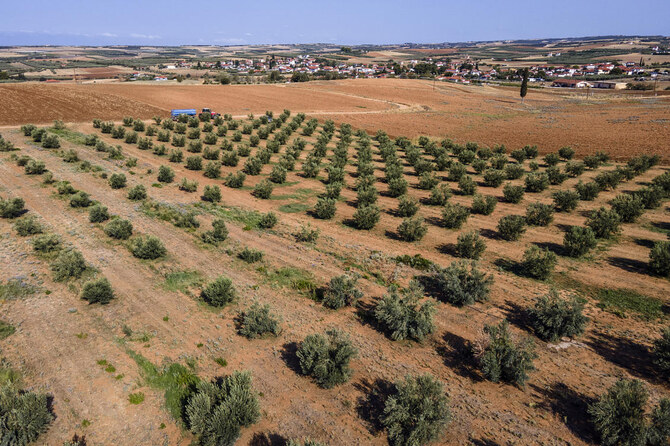
NEA SILATA: Six weeks before harvest, there’s no water left in the ground for farmer Dimitris Papadakis’ olive grove in northern Greece, so he has started a new morning routine.
Joined by his teenage son, he uses a truck to bring water from nearby areas. Using a small generator, he connects the vehicle to irrigation pipes to save what’s left of his thirsty crop.
“Our boreholes have almost dried up ... We now depend on tankers to irrigate our fields,” says Papadakis, who heads an agricultural cooperative in a village in Halkidiki, a three-fingered peninsula in northern Greece which is popular with tourists.
This summer, southern Europe has been hammered by successive heat waves, following on from below-average rainfall for up to three years. Drought spots on the map of the region have expanded. In Greece, the effects include water shortages, dried-up lakes, and even the death of wild horses.
The groundwater beneath Papadakis’ 270 olive trees is dwindling and becoming brackish, with the drought expected to cut his expected yield in half.
The water crisis has been exacerbated by a booming tourist season.
In Kassandra, the westernmost finger of the peninsula, the year-round population of 17,000 swells to 650,000 in the summer, placing unsustainable pressure on water resources.
“We’ve seen a 30-40 percent reduction in water supply following three consecutive winters with almost no rainfall,” says local mayor Anastasia Halkia.
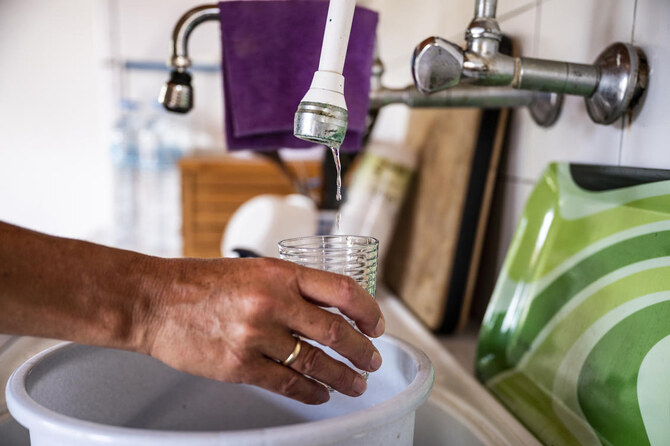
Haroula Psaropoulou owns a home in the area, in the seaside village of Nea Potidea. She says it’s hard to cope with frequent household water cuts that may last up to five days during the searing heat.
“I recycle water from the bathroom sink and from washing, and I use it for the plants,” the 60-year-old Psaropoulou says. “I’ve also carried water from the sea for the toilet.”
According to the European Union’s Emergency Management Service, acute drought conditions currently exist around the Black Sea, stretching westward into northern Greece.
Along the Evros River, which divides Greece and Turkiye, severe drought means the delta now has higher levels of seawater. The extra salt is killing the wild horses that depend on the river for drinking water.
“If the horses go without water for a week, they die,” says Nikos Mousounakis, who is leading an initiative to create freshwater drinking points for the horses. “Some of them are still in bad shape, but we hope that with continued help, they’ll recover.”
Until recently, Lake Picrolimni in northern Greece was a popular destination for mud baths, but this summer it’s a shallow basin of cracked earth, dry enough to hold the weight of a car.
“It hasn’t rained for two years now, so the lake has totally dried up,” says local municipal chairman Costas Partsis. “It used to have a lot of water. People came and bathed in the muddy water. The clay has therapeutic properties for many ailments. No one came this year.”
Nearby, Lake Doirani straddles Greece’s northern border with North Macedonia. The shoreline has receded by 300 meters (yards) in recent years. Local officials are pleading for public works to restore the river’s water supply, echoing calls from experts who argue that major changes in water management are needed to mitigate the damaging effects of climate change.
“We’re experiencing a prolonged period of drought lasting about three years now, due to lower rainfall and snowfall, a result of the climate crisis and poor water management,” says Konstantinos S. Voudouris, a professor of hydrogeology at the University of Thessaloniki. “The solution lies in three key words: conservation, storage, and reuse.”
Voudouris argues that outdated water networks are losing too much water and that infrastructure improvements must focus on collecting and storing rainwater during the wet season, as well as reusing treated wastewater for agriculture.
“These drought phenomena will return with greater intensity in the future,” Voudouris said. “We need to take action and plan ahead to minimize their impact… and we must adapt to this new reality.”

Drying lakes and thirsty trees: In drought-hit Greece, water trucks are keeping crops alive
Short Url
https://arab.news/8n7gj
Drying lakes and thirsty trees: In drought-hit Greece, water trucks are keeping crops alive
- Southern Europe has been hammered by successive heat wave
- The water crisis has been exacerbated by a booming tourist season
Cambodia says Thailand bombs casino hub on border
PHNOM PENH: Cambodia said Thailand’s military on Thursday bombed the casino town of Poipet, a major crossing between the two nations, as foreign powers pressured them to halt reignited border clashes.
Thai forces “dropped two bombs in the area of Poipet Municipality, Banteay Meanchey Province” at around 11:00 am (0400 GMT) Thursday, the Cambodian defense ministry said in a statement.
Thailand has not yet confirmed any strike on Poipet — a bustling casino hub popular with Thai gamblers.
The renewed fighting between the Southeast Asian neighbors this month has killed at least 21 people in Thailand and 17 in Cambodia, while displacing around 800,000, officials said.
The conflict stems from a territorial dispute over the colonial-era demarcation of their 800-kilometer (500-mile) border and a smattering of ancient temple ruins situated on the frontier.
Each side has blamed the other for instigating the fresh fighting and traded accusations of attacks on civilians.
Thailand said Tuesday that between 5,000 and 6,000 Thai nationals remained stranded in Poipet after Cambodia closed its land border crossings with its neighbor.
Cambodia’s interior ministry said the border closures were a “necessary measure” to reduce risks to civilians amid the ongoing combat, adding that air travel remained an option for those seeking to leave.
At least four casinos in Cambodia have been damaged by Thai strikes, the interior ministry said this week.
- ‘Shuttle-diplomacy’ -
Five days of fighting between Cambodia and Thailand in July killed dozens of people before a truce was brokered by the United States, China and Malaysia, and then broken within months.
US President Donald Trump, who has repeatedly intervened in the long-standing conflict this year, claimed last week that the two countries had agreed to a new ceasefire.
But Bangkok denied any truce had been agreed, and fighting with artillery, tanks, drones and jets has continued daily since a border skirmish earlier this month sparked the latest round of conflict.
China said it was sending its special envoy for Asian affairs to Cambodia and Thailand on Thursday for a “shuttle-diplomacy trip” to help bridge the gaps and “rebuild peace.”
“Through its own way, China has been working actively for deescalation,” Beijing’s foreign ministry said in a statement late Wednesday.
Foreign ministers from ASEAN regional bloc nations are due to meet on Monday in Malaysia for emergency talks aimed at finding a diplomatic solution.
“Our duty is to present the facts but more important is to press upon them that it is imperative for them to secure peace,” Malaysian Prime Minister Anwar Ibrahim told journalists late Wednesday.
“We are appealing to them to immediately stop this frontline offensive and if possible, an immediate ceasefire,” Anwar said at his official residence in Putrajaya, adding that he was “cautiously optimistic” about the talks.
European Commission vice president Kaja Kallas said in a statement that she had spoken with the foreign ministers of Cambodia and Thailand on Wednesday, offering the European Union’s support for ceasefire monitoring with satellite imagery.
“The conflict between Thailand and Cambodia must not be allowed to spiral further. That’s why the ceasefire needs to be immediately restored,” Kallas said.
Thai forces “dropped two bombs in the area of Poipet Municipality, Banteay Meanchey Province” at around 11:00 am (0400 GMT) Thursday, the Cambodian defense ministry said in a statement.
Thailand has not yet confirmed any strike on Poipet — a bustling casino hub popular with Thai gamblers.
The renewed fighting between the Southeast Asian neighbors this month has killed at least 21 people in Thailand and 17 in Cambodia, while displacing around 800,000, officials said.
The conflict stems from a territorial dispute over the colonial-era demarcation of their 800-kilometer (500-mile) border and a smattering of ancient temple ruins situated on the frontier.
Each side has blamed the other for instigating the fresh fighting and traded accusations of attacks on civilians.
Thailand said Tuesday that between 5,000 and 6,000 Thai nationals remained stranded in Poipet after Cambodia closed its land border crossings with its neighbor.
Cambodia’s interior ministry said the border closures were a “necessary measure” to reduce risks to civilians amid the ongoing combat, adding that air travel remained an option for those seeking to leave.
At least four casinos in Cambodia have been damaged by Thai strikes, the interior ministry said this week.
- ‘Shuttle-diplomacy’ -
Five days of fighting between Cambodia and Thailand in July killed dozens of people before a truce was brokered by the United States, China and Malaysia, and then broken within months.
US President Donald Trump, who has repeatedly intervened in the long-standing conflict this year, claimed last week that the two countries had agreed to a new ceasefire.
But Bangkok denied any truce had been agreed, and fighting with artillery, tanks, drones and jets has continued daily since a border skirmish earlier this month sparked the latest round of conflict.
China said it was sending its special envoy for Asian affairs to Cambodia and Thailand on Thursday for a “shuttle-diplomacy trip” to help bridge the gaps and “rebuild peace.”
“Through its own way, China has been working actively for deescalation,” Beijing’s foreign ministry said in a statement late Wednesday.
Foreign ministers from ASEAN regional bloc nations are due to meet on Monday in Malaysia for emergency talks aimed at finding a diplomatic solution.
“Our duty is to present the facts but more important is to press upon them that it is imperative for them to secure peace,” Malaysian Prime Minister Anwar Ibrahim told journalists late Wednesday.
“We are appealing to them to immediately stop this frontline offensive and if possible, an immediate ceasefire,” Anwar said at his official residence in Putrajaya, adding that he was “cautiously optimistic” about the talks.
European Commission vice president Kaja Kallas said in a statement that she had spoken with the foreign ministers of Cambodia and Thailand on Wednesday, offering the European Union’s support for ceasefire monitoring with satellite imagery.
“The conflict between Thailand and Cambodia must not be allowed to spiral further. That’s why the ceasefire needs to be immediately restored,” Kallas said.
© 2025 SAUDI RESEARCH & PUBLISHING COMPANY, All Rights Reserved And subject to Terms of Use Agreement.