

Biden pushed Gaza pier over warnings it would undercut other aid routes, watchdog says

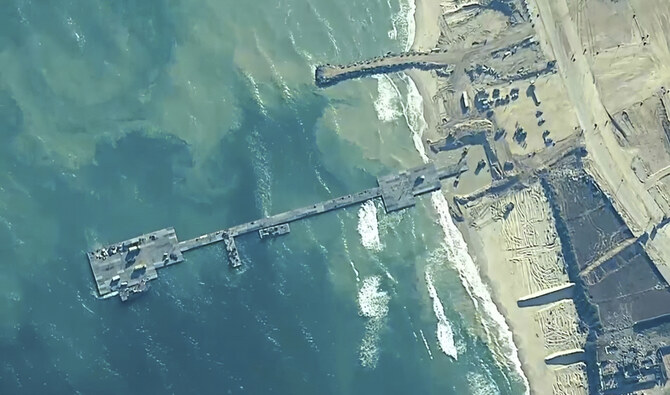
The Biden administration set a goal of the US sea route and pier providing food to feed 1.5 million of Gaza’s people for 90 days. It fell short, bringing in enough to feed about 450,000 people for a month before shutting down. (AP)
Short Url
Updated 28 August 2024
Follow

Biden pushed Gaza pier over warnings it would undercut other aid routes, watchdog says

WASHINGTON: President Joe Biden ordered the construction of a temporary pier to deliver humanitarian aid to Gaza earlier this year even as some staffers for the US Agency for International Development expressed concerns that the effort would be difficult to pull off and undercut the effort to persuade Israel to open “more efficient” land crossings to get food into the territory, according to a USAID inspector general report published Tuesday.

Biden announced plans to use the temporary pier in his State of the Union address in March to hasten the delivery of aid to the Palestinian territory besieged by war between Israel and Hamas.

But the $230 million military-run project known as the Joint Logistics Over-the-Shore system, or JLOTS, would only operate for about 20 days. Aid groups pulled out of the project by July, ending a mission plagued by repeated weather and security problems that limited how much food and other emergency supplies could get to starving Palestinians.

“Multiple USAID staff expressed concerns that the focus on using JLOTS would detract from the Agency’s advocacy for opening land crossings, which were seen as more efficient and proven methods of transporting aid into Gaza,” according to the inspector general report. “However, once the President issued the directive, the Agency’s focus was to use JLOTS as effectively as possible.”

At the time Biden announced plans for the floating pier, the United Nations was reporting virtually all of Gaza’s 2.3 million people were struggling to find food and more than a half-million were facing starvation.

The Biden administration set a goal of the US sea route and pier providing food to feed 1.5 million of Gaza’s people for 90 days. It fell short, bringing in enough to feed about 450,000 people for a month before shutting down.

High waves and bad weather repeatedly damaged the pier, and the UN World Food Program ended cooperation with the project after an Israeli rescue operation used an area nearby to whisk away hostages, raising concerns about whether its workers would be seen as neutral and independent in the conflict.

US National Security Council spokesman Sean Savett said Tuesday that the project “had a real impact” of getting food to hungry Palestinian civilians despite the obstacles.

“The bottom line is that given how dire the humanitarian situation in Gaza is, the United States has left no stone unturned in our efforts to get more aid in, and the pier played a key role at a critical time in advancing that goal,” Savett said in a statement.

The watchdog report also alleged the United States had failed to honor commitments it had made with the World Food Program to get the UN agency to agree to take part in distributing supplies from the pier into Palestinian hands.

The US agreed to conditions set by the WFP, including that the pier would be placed in north Gaza, where the need for aid was greatest, and that a UN member nation would provide security for the pier. That step was meant to safeguard WFP’s neutrality among Gaza’s warring parties, the watchdog report said.

Instead, however, the Pentagon placed the pier in central Gaza. WFP staffers told the USAID watchdog that it was their understanding the US military chose that location because it allowed better security for the pier and the military itself.

Israel’s military ultimately provided the security after the US military was unable to find a neutral country willing to do the job, the watchdog report said.


Clashes intensify in remote east Congo, challenging US mediation

Updated 4 sec ago
Follow

Clashes intensify in remote east Congo, challenging US mediation

Nurses at the general hospital in Fizi, a town ringed by steep highlands in eastern Congo’s South Kivu province, hurried the wounded ​soldier into surgery after he was brought in slumped on the back of a motorbike.
He was shot in both legs on the front line in the mountains north of town, where clashes between the army and rebel groups have surged in recent weeks. The fighting, unfolding away from urban areas and largely overlooked by international mediators, is drawing in more forces from all sides in the war in eastern Congo, with the potential to further complicate efforts by the Trump administration to bring peace and Western minerals investments to the region.

REBELS PUSH SOUTH AFTER CAPTURING KEY CITIES Earlier this week, the AFC/M23 rebel ‌group invoked the fighting ‌as justification for a drone attack on Kisangani airport, hundreds of ‌kilometers ⁠from ​the front ‌lines, calling it retaliation for government aerial attacks on South Kivu villages. Congo’s army has not commented on the drone strike or on the rebels’ claims that it attacked villages.
Meanwhile, the casualties continue to mount.
The hospital in Fizi, supported by the International Committee of the Red Cross, was caring for 115 wounded patients when a Reuters journalist visited at the end of January, more than four times its 25-bed capacity.
“Most of our patients have injuries in their upper or lower limbs, they often arrive with wounds that are already infected because ⁠of limited facilities on the frontline,” Richard Lwandja, a surgeon, said.
AFC/M23 staged a lightning advance early last year and in February 2025 seized ‌Bukavu, the capital of South Kivu, before advancing southward again in ‍December to briefly take Uvira on the border with ‍Burundi. The rebels withdrew a few days later under pressure from the United States, which brokered a ‍peace accord between Congo and Rwanda in June. The United Nations and Western powers say Rwanda backs AFC/M23, even exercising command and control over the group, though Rwanda denies this.
The recent fighting has centered on the highlands around Minembwe in Fizi territory, where the army has launched an operation against AFC/M23 and its local ally, the Twirwaneho, a group ​formed by Congolese Tutsi known as Banyamulenge.
“The highlands around Uvira are highly strategic: whoever controls them has access to major towns in the lowlands,” said Regan Miviri, an ⁠analyst at the Ebuteli research institute in Kinshasa. “And because the area is so remote, the fighting there draws less attention and less diplomatic pressure.”
The government’s priority, he said, was to secure Uvira and stop the conflict from extending toward Tanganyika and Katanga, areas that include some of Congo’s most important mining centers.

DIPLOMACY STRUGGLES TO KEEP PACE WITH FIGHTING
AFC/M23 has framed its presence in South Kivu’s highlands as an effort to protect the Banyamulenge, while Kinshasa has accused the coalition of exploiting long-running tensions between communities over land, cattle and local representation. The escalation in fighting comes as Congo and AFC/M23 agreed in Doha this week to activate a Qatari-mediated ceasefire monitoring mechanism. A UN team is expected to deploy to Uvira in the coming days.
At Fizi’s hospital, staff say the flow of wounded shows no sign of easing, and they worry they will not be able ‌to cope much longer.
“Roads are often impassable and supplies run out,” said Robert Zoubda, a Red Cross nurse. “If this continues, we’ll have to install more tents.”