

Biden pushed Gaza pier over warnings it would undercut other aid routes, watchdog says

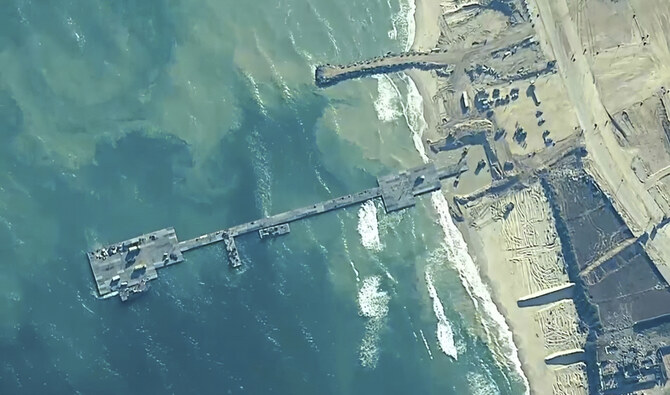
The Biden administration set a goal of the US sea route and pier providing food to feed 1.5 million of Gaza’s people for 90 days. It fell short, bringing in enough to feed about 450,000 people for a month before shutting down. (AP)
Short Url
Updated 28 August 2024
Follow

Biden pushed Gaza pier over warnings it would undercut other aid routes, watchdog says

WASHINGTON: President Joe Biden ordered the construction of a temporary pier to deliver humanitarian aid to Gaza earlier this year even as some staffers for the US Agency for International Development expressed concerns that the effort would be difficult to pull off and undercut the effort to persuade Israel to open “more efficient” land crossings to get food into the territory, according to a USAID inspector general report published Tuesday.

Biden announced plans to use the temporary pier in his State of the Union address in March to hasten the delivery of aid to the Palestinian territory besieged by war between Israel and Hamas.

But the $230 million military-run project known as the Joint Logistics Over-the-Shore system, or JLOTS, would only operate for about 20 days. Aid groups pulled out of the project by July, ending a mission plagued by repeated weather and security problems that limited how much food and other emergency supplies could get to starving Palestinians.

“Multiple USAID staff expressed concerns that the focus on using JLOTS would detract from the Agency’s advocacy for opening land crossings, which were seen as more efficient and proven methods of transporting aid into Gaza,” according to the inspector general report. “However, once the President issued the directive, the Agency’s focus was to use JLOTS as effectively as possible.”

At the time Biden announced plans for the floating pier, the United Nations was reporting virtually all of Gaza’s 2.3 million people were struggling to find food and more than a half-million were facing starvation.

The Biden administration set a goal of the US sea route and pier providing food to feed 1.5 million of Gaza’s people for 90 days. It fell short, bringing in enough to feed about 450,000 people for a month before shutting down.

High waves and bad weather repeatedly damaged the pier, and the UN World Food Program ended cooperation with the project after an Israeli rescue operation used an area nearby to whisk away hostages, raising concerns about whether its workers would be seen as neutral and independent in the conflict.

US National Security Council spokesman Sean Savett said Tuesday that the project “had a real impact” of getting food to hungry Palestinian civilians despite the obstacles.

“The bottom line is that given how dire the humanitarian situation in Gaza is, the United States has left no stone unturned in our efforts to get more aid in, and the pier played a key role at a critical time in advancing that goal,” Savett said in a statement.

The watchdog report also alleged the United States had failed to honor commitments it had made with the World Food Program to get the UN agency to agree to take part in distributing supplies from the pier into Palestinian hands.

The US agreed to conditions set by the WFP, including that the pier would be placed in north Gaza, where the need for aid was greatest, and that a UN member nation would provide security for the pier. That step was meant to safeguard WFP’s neutrality among Gaza’s warring parties, the watchdog report said.

Instead, however, the Pentagon placed the pier in central Gaza. WFP staffers told the USAID watchdog that it was their understanding the US military chose that location because it allowed better security for the pier and the military itself.

Israel’s military ultimately provided the security after the US military was unable to find a neutral country willing to do the job, the watchdog report said.


Families mourn those killed in a Congo mine landslide as some survivors prepare to return

Updated 03 February 2026
Follow

Families mourn those killed in a Congo mine landslide as some survivors prepare to return

GOMA, Congo: After a landslide last week killed at least 200 people in eastern Congo at a rebel-controlled coltan mine, families of the deceased and survivors are mourning their lost loved ones, and some survivors prepared to head back to the reopened mines.
On Wednesday, following heavy rains in eastern Congo, a network of hand-dug tunnels at the Rubaya mining complex collapsed, killing at least 200 artisanal miners and trapping an unknown number who remain missing. The mine, located around 25 miles (40 kilometers) to the west of the regional capital of Goma, has been under the control of Rwandan-backed M23 rebels since early 2024 and employs thousands of miners who work largely by hand.
Family members grieve
In the Mugunga neighborhood in Goma, the family of Bosco Nguvumali Kalabosh, 39, mourned his death Monday.
Since last Thursday, relatives, neighbors and loved ones have been gathering at the family home, sitting around a photograph of him placed up against a wall.
“He was supposed to return to Goma on Thursday,” said his older brother, Thimothée Kalabosh Nzanga.
Kalabosh had been a miner for more than 10 years. He owned his own mines on the site and came from a family where artisanal mining — mining for minerals using basic hand tools — had been passed down from generation to generation. He leaves behind a widow and four children, the eldest of whom is 5 years old.
Survivors head back to Rubaya
For survivors trickling back into town, the pressure to return to the mines is clear — despite the constant danger.
Tumaini Munguiko, a survivor of the collapse, came to offer his condolences to Kalabosh’s family. “Seeing our peers die is very painful. But despite the pain, we are forced to return to the mines to survive,” he said.
Munguiko calmly explained that he had already experienced several similar disasters. “It has almost become normal. We accept it because it is our means of survival. I was saved this time, but I lost five friends and my older brother.”
According to him, landslides are common in Rubaya, especially during the rainy season. “When it rains, the clay soils become unstable. Some take shelter, others perish, others survive, and others watch from afar,” he said.
Miners dig long tunnels, often parallel to one another, with limited support and no safe evacuation route in case of a collapse.
A former miner at the site told The Associated Press that there have been repeated landslides because the tunnels are dug by hand, poorly constructed and not maintained.
“People dig everywhere, without control or safety measures. In a single pit, there can be as many as 500 miners, and because the tunnels run parallel, one collapse can affect many pits at once,” former miner Clovis Mafare said.
“The diggers don’t have insurance,” said Mafare. Of potential compensation for families, he said: “It’s a whole legal process, and it’s very long. They might receive some money for the funerals, but that small amount isn’t compensation.”
Kalabosh’s family has not received compensation for their loss.
However, both Munguiko and Nzanga say they will return to the mines soon despite the risks.
“I have no choice. Our whole life is there,” said Munguiko.
Rare earth minerals
The Rubaya mines have been at the center of the recent fighting in eastern Congo, changing hands between the Congolese government and rebel groups. For over a year now, the site has been controlled by the M23 rebels.
The mines produce coltan — short for columbite-tantalite — an ore from which the metals tantalum and niobium are extracted. Both are considered critical raw materials by the United States, the European Union, China and Japan. Tantalum is used in mobile phones, computers and automotive electronics, as well as in aircraft engines, missile components and GPS systems. Niobium is used in pipelines, rockets and jet engines.
The mines at Rubaya are massive and attract people from across the region. Artisanal miners and workers have been flocking there for years, drawn to the site to earn a steady income in a region plagued by poverty and chronic insecurity. A disaster like this affects people across eastern Congo and the grief has spread to regional hubs like Goma.
For the last two weeks, Rubaya has been virtually cut off from the world. The mining town has no mobile network or Internet connection. Poor infrastructure, coupled with persistent conflict, means cellular service and electricity are unreliable. To communicate with the outside world, residents must pay around 5,000 Congolese francs — just over $2 — for 30 minutes of connection via a private Starlink system.
Congo’s government, in a statement on X, expressed solidarity with the victims’ families and accused the rebels of illegally and unsafely exploiting the region’s natural resources while blaming Rwanda. An M23 spokesperson accused the government of politicizing the tragedy and listed other collapses at government-controlled mines.