

Religio-political party, traders announce Pakistan-wide strike today over power bills and inflation

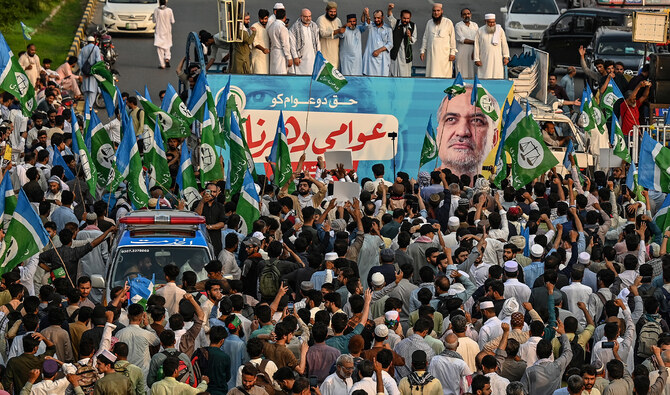
Activists and supporters of the Jamaat-e-Islami (JI) party take part in a demonstration against the country's rising inflation in Islamabad on July 26, 2024. (AFP/File)
Short Url
Updated 28 August 2024
Follow

Religio-political party, traders announce Pakistan-wide strike today over power bills and inflation

  • Jamaat-e-Islami party threatens march to Islamabad if government fails to withdraw taxes, cut power prices
  • Traders urge government to withdraw “regressive taxes” they say are scuttling economic growth and business

ISLAMABAD: A major Pakistani religio-political party, the Jamaat-e-Islami (JI), and traders have announced a nationwide strike today, Wednesday, over rising electricity prices and brisk inflation, as the country embarks on a tricky path to economic recovery.

A two-week-long sit-in by the JI in Rawalpindi, a twin city to the Pakistani capital of Islamabad, to pressure the government to cut electricity bills and retract new taxes imposed in the budget 2024-25 was called off earlier this month after the party reached an agreement with the federal government. 

As per the deal, the government promised to form a mechanism to reduce electricity prices and review contracts with independent power producers (IPPs) within 45 days. IPP agreements have come under scrutiny in recent weeks as households have received steep electricity bills. Many members of the public and independent policy analysts say Pakistan has been saddled with electricity bills it has no possibility of paying because of faulty contracts signed with IPPs, which produce expensive power. 

Tough measures that are part of a 37-month $7 billion loan program IMF bailout deal signed last month, such as raising tax on agricultural incomes and raising electricity prices, have also prompted concerns about poor and middle class Pakistanis grappling with rising inflation and the prospect of higher taxes.

“We are holding a nationwide strike tomorrow [Wednesday] to tell the government to implement the agreement and extend relief to the public as early as possible,” top JI leader Liaqat Baloch told Arab News on Tuesday.

Baloch said his party was extending support to the country’s business community, which had announced a shutter-down strike to protest inflation, high electricity prices and additional taxes on traders.

“If the government fails to listen to genuine demands of the public and extend relief, we will be left with no option to start a long march toward Islamabad,” he said.

Baloch said his party had given “ample time” to the federal government to negotiate with IPPs to bring down electricity prices and review other options to reduce inflation and cut taxes, especially on the salaried class.

“We postponed our fourteen-day sit-in in Rawalpindi following the government’s promise to extend relief to the public,” Baloch said. “If the government fails to keep the promise, we will resume our nationwide protests.”

Traders have also announced a nationwide shutter-down strike against “hefty taxes” imposed on retailers through a Tajir Dost Scheme, a voluntary tax compliance program under which businesses can declare their assets and incomes and potentially receive benefits like reduced tax rates and simplified tax compliance procedures.

“Our businesses have reduced around seventy percent in a year due to the deteriorating economy while the government is imposing heavy taxes on traders who are struggling to keep afloat,” Ajmal Baloch, President of Markazi Anjuman Tajran Pakistan, a traders’ union, told Arab News.

“We have been demanding the government to withdraw these regressive tax measures that would adversely affect the economic growth in the country.”

Ajmal said traders would march toward Islamabad if their demands were not met through the one-day shutter-down strike.

 “Every businessman in Pakistan is already paying hefty taxes,” he added, “so the government should immediately withdraw these additional tax measures.”

The government raised power prices 26 percent during the last fiscal year, which ended June 30, before tacking on another 20 percent increase on July 13. Officials say the increases were needed to meet conditions set by the International Monetary Fund for a $7 billion loan deal reached last month.

The government has also added a confusing bevy of taxes on top of the base price, adding up to a bill that has more than doubled for some Pakistanis.


Pakistan’s OGDC ramps up unconventional gas plans

Updated 4 sec ago
Follow

Pakistan’s OGDC ramps up unconventional gas plans

  • Pakistan has long been viewed as having potential in tight and shale gas but commercial output has yet to be proved
  • OGDC says has tripled tight-gas study area to 4,500 square km after new seismic, reservoir analysis indicates potential

ISLAMABAD: Pakistan’s state-run Oil & Gas Development Company is planning a major expansion of unconventional gas developments from early next year, aiming to boost production and reduce reliance on imported liquefied natural gas.

Pakistan has long been viewed as having potential in both tight and shale gas, which are trapped in rock and can only be released with specialized drilling, but commercial output has yet to be proved.

Managing Director Ahmed Lak told Reuters that OGDC had tripled its tight-gas study area to 4,500 square kilometers (1,737 square miles) after new seismic and reservoir analysis indicated larger potential. Phase two of a technical evaluation will finish by end-January, followed by full development plans.

The renewed push comes after US President Donald Trump said Pakistan held “massive” oil reserves in July, a statement analysts said lacked credible geological evidence, but which prompted Islamabad to underscore that it is pursuing its own efforts to unlock unconventional resources.

“We started with 85 wells, but the footprint has expanded massively,” Lak said, adding that OGDC’s next five-year plan would look “drastically different.”

Early results point to a “significant” resource across parts of Sindh and Balochistan, where multiple reservoirs show tight-gas characteristics, he said.

SHALE PILOT RAMPS UP

OGDC is also fast-tracking its shale program, shifting from a single test well to a five- to six-well plan in 2026–27, with expected flows of 3–4 million standard cubic feet per day (mmcfd) per well.

If successful, the development could scale to hundreds or even more than 1,000 wells, Lak said.

He said shale alone could eventually add 600 mmcfd to 1 billion standard cubic feet per day of incremental supply, though partners would be needed if the pilot proves viable.

The company is open to partners “on a reciprocal basis,” potentially exchanging acreage abroad for participation in Pakistan, he said.

A 2015 US Energy Information Administration study estimated Pakistan had 9.1 billion barrels of technically recoverable shale oil, the largest such resource outside China and the United States.

A 2022 assessment found parts of the Indus Basin geologically comparable to North American shale plays, though analysts say commercial viability still hinges on better geomechanical data, expanded fracking capacity and water availability.

OGDC plans to begin drilling a deep-water offshore well in the Indus Basin, known as the Deepal prospect, in the fourth quarter of 2026, Lak said. In October, Turkiye’s TPAO with PPL and its consortium partners, including OGDC, were awarded a block for offshore exploration.

A combination of weak gas demand, rising solar uptake and a rigid LNG import schedule has created a surplus of gas that forced OGDC to curb output and pushed Pakistan to divert cargoes from Italy’s ENI and seek revised terms with Qatar.