Pakistan says working to boost Internet accessibility amid reports of disruptions due to firewall

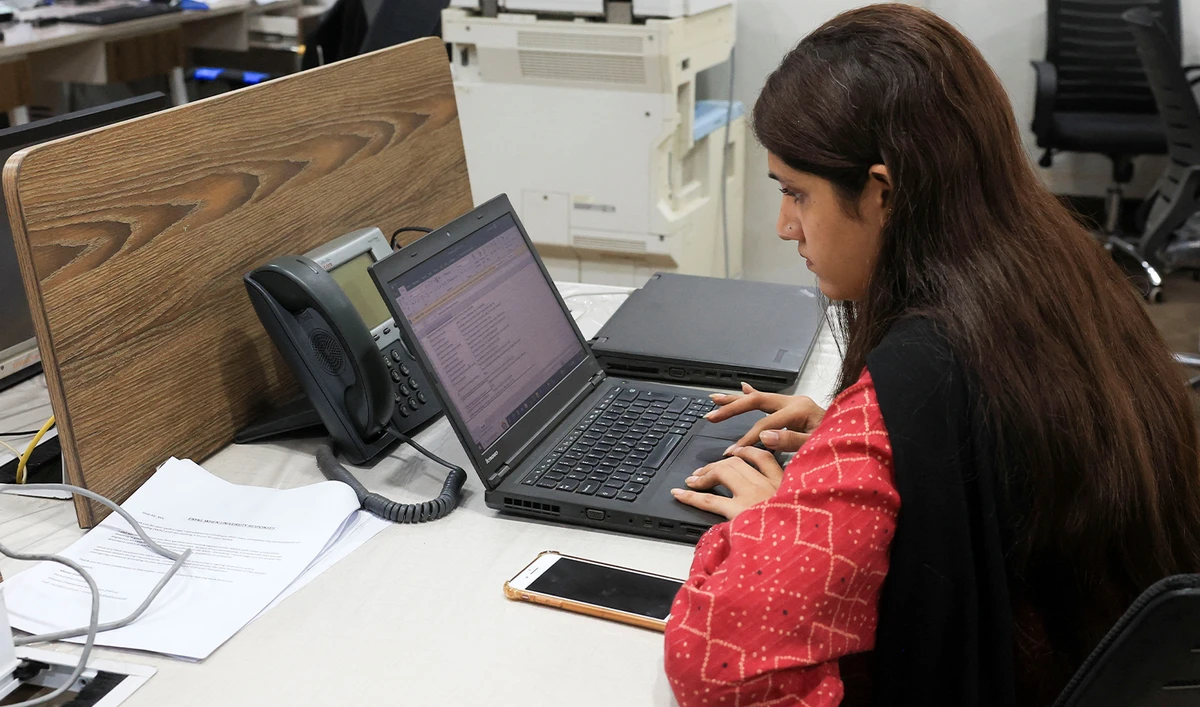
An employee works on a computer at the office of Pakistan Freelancers Association (PAFLA), a platform and support group to help freelancers, in Karachi, Pakistan on August 22, 2024. (REUTERS/File)
Short Url
Updated 27 August 2024
Follow

Pakistan says working to boost Internet accessibility amid reports of disruptions due to firewall

  • PTA has allowed six gigahertz spectrum band for the deployment of next generation Wi-Fi technologies
  • The unlocking of band has made Pakistan the 10th country in Asia Pacific to use six gigahertz for Wi-Fi

ISLAMABAD: The Pakistan Telecommunication Authority (PTA) has decided to implement a series of steps to improve Internet access for the public, state-owned media reported on Tuesday, citing the National Assembly proceedings from the previous day.

The information was shared by Federal Minister for Parliamentary Affairs Azam Nazeer Tarar during the Question Hour amid widespread discontent over slow Internet speeds across the country, which digital activists attribute to the government’s decision to install a national firewall to filter “propaganda and unwanted content” online.

However, Pakistan’s IT Minister Shaza Fatima Khawaja has rejected claims that the government is responsible for slowing or shutting down the Internet, attributing the issue instead to the widespread use of virtual private networks (VPNs) following a ban on the social media platform X since February.

“Tarar said the PTA has allowed six gigahertz spectrum band for unlicensed operation for Radio Local Area Network (RLAN) in Pakistan,” Radio Pakistan said while reporting the National Assembly proceedings.

Countries typically make such unlicensed spectrums available for general use by the public without the need for users to obtain specific authorization or licenses. These unlicensed bands are commonly used for technologies such as Wi-Fi, Bluetooth and other wireless local area networks (WLANs).

The minister said the unlocking of this spectrum had made Pakistan the 10th country in the Asia Pacific region to embrace six gigahertz for Wi-Fi.

“Currently, only sixty countries worldwide have unlocked six gigahertz for RLAN WIFI services,” he was reported as saying. “The development aims to facilitate deployment of next generation WIFI technologies across Pakistan, empowering business and individuals with high speed, low latency connectivity.”

“This initiative underscored Pakistan’s commitment to bridging the digital divide and ensuring nationwide access to advanced technologies,” he added.

Tarar said the PTA had also formulated the telecom infrastructure sharing framework for the growth and sustainability of the sector in Pakistan.


Pakistan to begin first phase of Hajj 2026 trainings from today

Updated 31 December 2025
Follow

Pakistan to begin first phase of Hajj 2026 trainings from today

  • Training programs to be held in phases across Pakistan till February, says religion ministry
  • Saudi Arabia allocated Pakistan a total quota of 179,210 pilgrims for Hajj 2026

ISLAMABAD: Pakistan’s religious affairs ministry has said that it will begin the first phase of mandatory Hajj 2026 training for pilgrims intending to perform the pilgrimage from today, Thursday.

The one-day Hajj training programs will be held in phases across the country at the tehsil level until February. The ministry directed intending pilgrims to bring their original identity cards and the computerized receipt of their Hajj application to attend the training sessions.

“Pilgrims should attend the one-day training program according to their scheduled date,” Pakistan’s Ministry of Religious Affairs (MoRA) said in a statement.

The ministry said training schedules are being shared through the government’s Pak Hajj 2026 mobile application as well as via SMS. It added that details of the schedule are also available on its website.

According to the ministry, training programs will be held in Abbottabad on Jan. 2; Ghotki, Thatta and Kotli on Jan. 3; and Tando Muhammad Khan and Khairpur on Jan. 4.

Hajj training sessions will be held in Rawalakot, Badin and Naushahro Feroze on Jan. 5, while pilgrims in Fateh Jang, Dadu and Tharparkar will receive the training on Jan. 6.

The ministry said training programs will be conducted in Umerkot and Larkana on Jan. 7, followed by sessions in Mirpurkhas, Shahdadkot and Mansehra on Jan. 8.

Pakistan’s religious affairs ministry has previously said these trainings will be conducted by experienced trainers and scholars using multimedia.

It said the training has been made mandatory to ensure that intending pilgrims are fully aware of Hajj rituals and administrative procedures.

Saudi Arabia has allocated Pakistan a quota of 179,210 pilgrims for Hajj 2026, of which around 118,000 seats have been reserved under the government scheme, while the remainder will be allocated to private tour operators.

Under Pakistan’s Hajj scheme, the estimated cost of the government package ranges from Rs1,150,000 to Rs1,250,000 ($4,049.93 to $4,236), subject to final agreements with service providers.