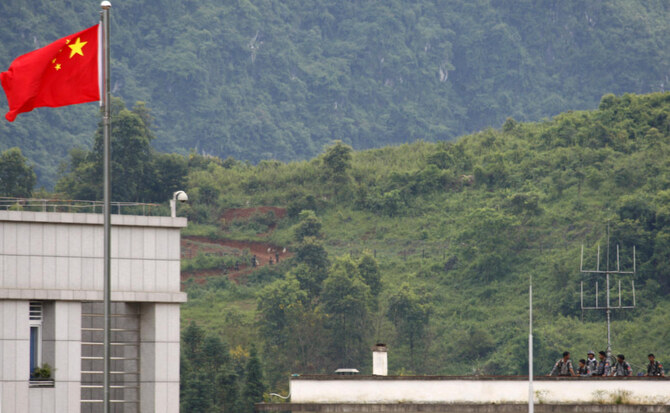
BEIJING: China’s army and air force began live-fire exercises Tuesday next to its border with Myanmar, local authorities said, following recent bilateral talks on security in the area.
Myanmar’s northern Shan state has been the site of repeated clashes since late June after ethnic rebel groups renewed an offensive against the military along a vital trade highway to China.
Beijing is a major ally and arms supplier to Myanmar’s junta, but analysts say it also maintains ties with ethnic armed groups that hold territory near its border.
Earlier this month Myanmar’s embattled junta chief hosted China’s foreign minister in Naypyidaw for talks on the “stability of the border regions.”
Shan state borders China’s Yunnan province and is a vital piece of Beijing’s Belt and Road Initiative.
Local authorities in Yunnan said the drills, held according to an “annual training plan,” would last until Thursday.
The exercises “aim to test the command’s reconnaissance, early warning, multi-dimensional control and strike capabilities,” according to a spokesperson for the People’s Liberation Army, quoted by state news agency Xinhua.
Troops involved “are prepared to handle various emergencies and are committed to safeguarding national sovereignty, border stability and the safety of people’s lives and property,” the report said.


Chinese military stages live-fire drills by Myanmar border
https://arab.news/ncydf
Chinese military stages live-fire drills by Myanmar border

- Myanmar’s northern Shan state has been the site of repeated clashes since late June


Homeless Muslims in southern Philippines observe Ramadan as month of trial
- Thousands lost their homes when parts of Bongao in Tawi-Tawi were burnt to ashes
- Many trying to fully observe the fasting month say they are grateful to be alive
Manila: As Annalexis Abdulla Dabbang was looking forward to observing the month of Ramadan with her family, just days before it began they lost everything when an enormous fire tore through whole neighborhoods of their city in the southernmost province of the Philippines.
Bongao is the capital of Tawi-Tawi, an island province, forming part of the country’s Muslim minority heartland in the Bangsamoro region. The city experienced its worst fire in years in early February, when flames swept through the coastal community, leaving more than 5,000 people homeless.
“We were swimming for our lives. We had to swim to escape from the fire ... We swam in darkness, and (even) the sea was already hot because of the fire,” Dabbang, a 27-year-old teacher, told Arab News.
“Everything we owned was gone in just a few hours — our home, our memories, the things we worked hard for, everything turned to ashes.”
Trying to save their 2-year-old daughter and themselves, she and her husband left everything behind — as did hundreds of other families that together with them have since taken shelter at the Mindanao State University gymnasium — one of the evacuation centers.
Unable to secure a tent, Dabbang’s family has been sleeping on the bleachers, sharing a single mat as their bed. When Ramadan arrived a few days after they moved to the makeshift shelter, they welcomed it in a different, more solemn way. There is no family privacy for suhoor, no room or means to welcome guests for iftar.
“Ramadan feels different now. It’s painful but at the same time more real. When we lost our home, we began to understand what sacrifice really means. When you sleep in an evacuation center, you understand hunger, discomfort in a deeper way,” Dabbang said.
“We don’t prepare special dishes. We prepare our hearts.”
While she and thousands of others have lost everything they have ever owned, she has not lost her faith.
“Our dreams may have turned to ashes, but our prayers are still alive,” she said.
“This Ramadan my prayers are more emotional than ever. I pray for strength, not just for myself, but for my family and for every neighbor who also lost their family home. I pray for healing from the trauma of fire. I pray that Allah will replace what we lost with something better. I pray for the chance to rebuild not just our house, but our sense of security.”
Juraij Dayan Hussin, a volunteer helping the Bongao fire victims, observed that many of them were traumatized and the need to cleanse the heart and mind during Ramadan was what kept many of them going, because they are “thankful that even though they lost their property, they are still alive.”
But the religious observance related to the fasting month is not easy in a cramped shelter.
“It’s hard for Muslims to perform their prayers when they do not have their proper attire because they usually have specific clothes for prayer,” he said. “Sanitation in the area is also an issue ... when you fast and when you pray, cleanliness is essential.”
For Abdulkail Jani, who is staying at a basketball court with his brother and more than 70 other families, this Ramadan will be spent apart from their parents, whom they managed to move to relatives.
“The month of Ramadan this year is a month of trial ... there will be a huge change from how we observed Ramadan in the past, but we will adjust to it and try to comfort ourselves and our family. The most important thing is that we can perform the fasting,” he told Arab News.
“Despite our situation now, despite everything, as long as we’re alive, we will observe Ramadan. We’ll try to observe it well, without missing anything.”


