MANILA: The Philippine defense chief said Tuesday that China is “the biggest disruptor” of peace in Southeast Asia and called for stronger international censure over its aggression in the South China Sea, a day after China blocked Philippine vessels from delivering food to a Coast Guard ship at the Sabina Shoal.
Defense Secretary Gilberto Teodoro Jr. spoke at an international military conference organized in Manila by the US Indo-Pacific Command amid a spike in clashes between China and the Philippines in the disputed South China Sea and in its airspace.
China is “the biggest disruptor of international peace” in Southeast Asia, Teodoro told the conference, which was attended by military officials and senior diplomats from the US and allied countries.
He later told reporters on the sidelines of the conference that international statements of concern against China’s increasingly assertive actions in the disputed waters and elsewhere were “not enough.”
“The antidote is a stronger collective multilateral action against China,” Teodoro said, adding that diplomats and defense officials should determine those stronger steps.
Pressed by reporters to be more specific, Teodoro said a UN Security Council resolution condemning and ordering a stop to Chinese acts of aggression would be a strong step but acknowledged the difficulty of pursuing that. “The world is not that perfect,” Teodoro said.
There was no immediate reaction from Chinese officials.
China, like its geopolitical rival the US, is one of the five permanent members of the UN Security Council and has power to veto such an adversarial step.
The Association of Southeast Asian Nations has paid “attention” to China’s aggressive actions but should do much more, Teodoro said. The 10-nation Southeast Asian bloc includes the Philippines, Vietnam, Malaysia and Brunei, which have South China Sea claims that overlap with each other, as well as China’s and Taiwan’s.
“ASEAN, to remain relevant and credible, cannot continue to ignore what China is doing in the South China Sea,” Teodoro said.
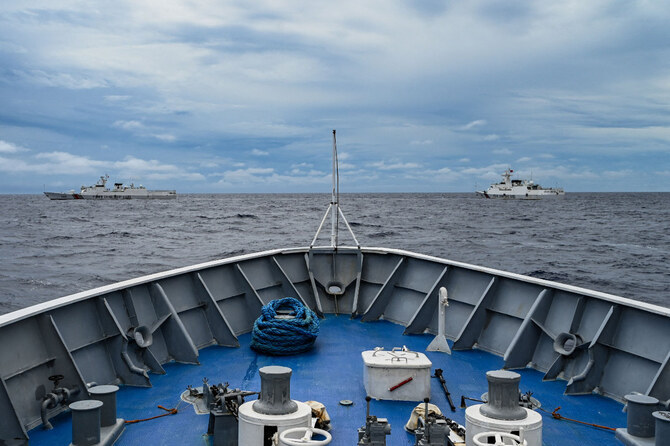
In the latest incident in the South China Sea, Philippine officials said China deployed “an excessive force” of 40 ships that blocked two Philippine vessels from delivering food and other supplies to Manila’s largest coast guard ship in the disputed Sabina Shoal in the latest flare-up of their territorial disputes in the busy sea passage.
China and the Philippines blamed each other for the confrontation on Monday in Sabina Shoal, an uninhabited atoll both countries claim that has become the latest flashpoint in the Spratlys, the most hotly disputed region of the sea passage that is a key global trade and security route.
China and the Philippines have separately deployed coast guard ships to Sabina in recent months on suspicion the other may act to take control of and build structures in the fishing atoll.
The hostilities have particularly intensified between China and the Philippines since last year and Monday’s confrontation was the sixth the two sides have reported in the high seas and in the air. The confrontations have sparked concerns of a larger conflict that could involved the United States, the longtime treaty ally of the Philippines.
Sabina is near the Second Thomas Shoal, another flashpoint where China has hampered the Philippine delivery of supplies for Filipino forces aboard a long-grounded navy ship, the BRP Sierra Madre. Last month, China and the Philippines reached an agreement to prevent increasingly hostile confrontations at the Second Thomas Shoal, allowing a Philippine vessel to deliver food supplies a week later without any hostilities.
The Philippine coast guard said Chinese coast guard and navy ships, along with 31 suspected militia vessels, illegally obstructed the delivery, which including an ice cream treat for the personnel aboard the BRP Teresa Magbanua as the Philippines marked National Heroes’ Day on Monday.
The Philippine coast guard said it “remains steadfast in our commitment to uphold national interests and ensure the safety and security of our waters” and urged “the China coast guard to abide with the international law and stop deploying maritime forces that could undermine mutual respect, a universally recognized foundation for responsible and friendly relations among coast guards.”
In Beijing, China’s coast guard said that it took control measures against two Philippine coast guard ships that “intruded” into waters near the Sabina Shoal. It said in a statement that the Philippine ships escalated the situation by repeatedly approaching a Chinese coast guard ship. The Chinese coast guard did not say what control measures it took.
China has rapidly expanded its military and has become increasingly assertive in pursuing its territorial claims in the South China Sea, which Beijing claims virtually in its entirety. The tensions have led to more frequent confrontations, primarily with the Philippines, though the longtime territorial disputes also involve other claimants, including Vietnam, Taiwan, Malaysia and Brunei.
Japan’s government also protested to Beijing on Tuesday, saying that a Chinese reconnaissance plane violated its airspace and forced it to scramble fighter jets.
Sabina Shoal lies about 140 kilometers west of the Philippine province of Palawan, in the internationally recognized exclusive economic zone of the Philippines.


![]()

Philippine defense chief says China is ‘the biggest disruptor’ of peace, seeks stronger censure
Short Url
https://arab.news/ntjp9
Philippine defense chief says China is ‘the biggest disruptor’ of peace, seeks stronger censure
- Adds statements of concern against China’s increasingly assertive actions in the disputed waters and elsewhere were ‘not enough’
- ‘ASEAN, to remain relevant and credible, cannot continue to ignore what China is doing in the South China Sea’


Latest updates


© 2026 SAUDI RESEARCH & PUBLISHING COMPANY, All Rights Reserved And subject to Terms of Use Agreement.