Pakistani sixth-grader builds AI assistant robot called Muhammad Ali 

Pakistani sixth-grader Muhammad Hasnain is seen writing a command for his AI assistant in Karachi, Pakistan on August 24, 2024. (AN photo)
Short Url
Updated 26 August 2024
Follow

Pakistani sixth-grader builds AI assistant robot called Muhammad Ali 

  • 11-year-old’s robot operates home appliances, plays films, does online searches following voice commands
  • Hasnain pursued his passion for robotics and game development at free training program at Karachi institute 

KARACHI: Muhammad Hasnain typed for a brief moment on his laptop, then asked a question out loud:

“Muhammad Ali, what is Arab News?”

A blue-eyed robot, so far a white head with a mesh of wires for hair, spoke back in a computer-generated voice:

“Arab News is a Saudi English language daily newspaper. It covers news and events in Saudi Arabia, the Middle East and around the world.”

Ask Muhammad Ali how to make biryani or fix a piping hot cup of tea and he’ll have an answer. He can also operate home appliances, play movies or do online searches following a voice command. 
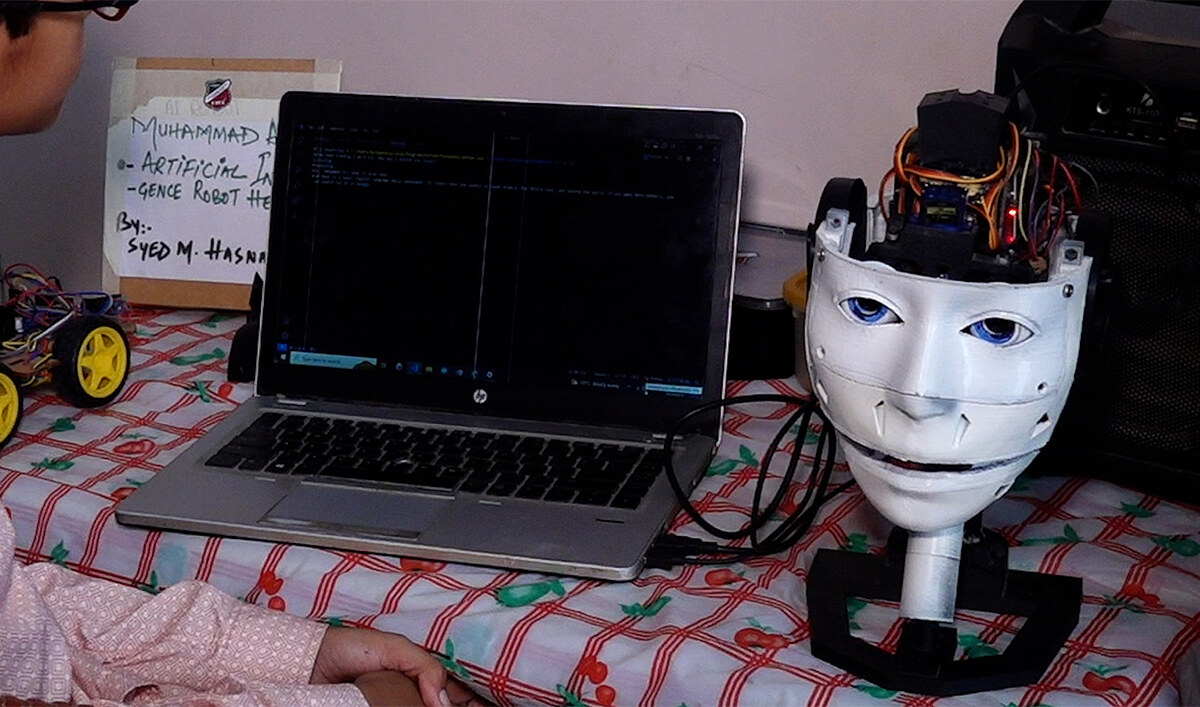


The picture taken on August 24, 2024, shows an AI assistant robot created a Pakistani sixth-grader Muhammad Hasnain in Karachi, Pakistan. (AN photo)

He was created by Hasnain, an 11-year-old who recently passed the sixth grade and built the AI assistant as part of a summer project for a free training course in robotics he attended in his hometown of Karachi. 

“This is an AI assistant robot and its name is Muhammad Ali,” Hasnain told Arab News at his home this month. “This AI has a personality [and] a face so you feel like you are talking to a person.”

“It has some extra features such as home automation through which it can control home appliances or open [search] anything on your command. Apart from that, it is also an assistant for me, so if I am making some other projects, it can be helpful there too.”

The tweener’s obsession with science and technology began when he was very young but it was in 2022 that he made a Bluetooth-powered car as a summer project, followed by a virtual reality game in 2023. 

Now, Hasnain has built Muhammad Ali, who he says is different from other AI chatbots because he has a “personality and a face.”

There is “something missing” in leading AI chatbots such as GPT, Gemini and Claude, the boy said. 

“What today’s AI lacks is personality, it looks like there is a robot stuck in your smartphone who can talk to you via texts. Some have a voice feature too. This one has a personality [and] a face.”

Hasnain says the robot is a Muslim and a Pakistani, and its main goal was to be “kind and helpful.”

“When it was under development and just the eyes were created, he knew about that too,” Hasnain said. “He knows what’s going on around him.”

Hasnain’s father Syed Faraz Haider said his child had always been inclined toward interests that were “unusual” for his age.

“He was extraordinary in terms of his learning capabilities since he was very young,” Haider told Arab News. 

“His memory was very sharp. Once you tell him something, [he will not forget it],” he added, describing how Hasnain was able to read entire chapters and write them down from memory.

Hasnain’s teacher Shakeel Abbas, who runs the institute where he enrolled in the robotics class, said he had helped him procure the equipment for the robot but the rest was all him.

“The entire idea and coding has been done by Hasnain,” Abbas said. “We initially provided the guidelines and training for the courses. He is self-sufficient now.”

In the future, Hasnain wants to pursue a career in robotics and game development, he said. He also hopes to give his robot, for now just a head full of wires, a full body. He is also planning a virtual reality project for next year. 

“I would want to add a camera to it [Ali] so he knows who he is talking to,” Hasnain said. “Or create his entire body, that will be a great task to take up.”
Pakistan to launch AI screening in January to target fake visas, agent networks

Updated 05 December 2025
Follow

Pakistan to launch AI screening in January to target fake visas, agent networks

  • New system to flag forged-document travelers before boarding and pre-verify eligibility
  • Move comes amid increasing concern over fake visas, fraudulent agents, forged papers

ISLAMABAD: Pakistan will roll out an AI-based immigration screening system in Islamabad from January to detect forged documents and prevent illegal overseas travel, the government said on Thursday. 

The move comes amid increasing concern over fake visas, fraudulent agents and forged papers, with officials warning that such activity has contributed to deportations, human smuggling and reputational damage abroad. Pakistan has also faced scrutiny over irregular migration flows and labor-market vulnerability, particularly in the Gulf region, prompting calls for more reliable pre-departure checks and digital verification.

The reforms include plans to make the protector-stamp system — the clearance required for Pakistani citizens seeking overseas employment — “foolproof”, tighten labor-visa documentation, and cancel the passports of deportees to prevent them from securing visas again. The government has sought final recommendations within seven days, signalling a rapid enforcement timeline.

“To stop illegal immigration, an AI-based app pilot project is being launched in Islamabad from January,” Interior Minister Mohsin Naqvi said following a high-level meeting chaired by him and Minister for Overseas Pakistanis Chaudhry Salik Hussain.

Naqvi said the new screening technology is intended to determine travelers’ eligibility in advance, reducing airport off-loads and closing loopholes exploited by traffickers and unregistered agents.

The interior minister added that Pakistan remains in contact with foreign governments to improve the global perception and ranking of the green passport, while a uniform international driving license will be issued through the National Police Bureau.

The meeting also approved zero-tolerance measures against fraudulent visa brokers, while the Overseas Pakistanis Ministry pledged full cooperation to streamline the emigration workflow. Minister Hussain said transparency in the protector process has become a “basic requirement,” particularly for labor-migration cases.

Pakistan’s current immigration system has long struggled with document fraud, with repeated cases of passengers grounded at airports due to forged papers or agent-facilitated travel. The launch of an AI screening layer, if implemented effectively, could shift the burden from manual counters to pre-flight verification, allowing authorities to identify risk profiles before departure rather than after arrival abroad.

The reforms also come at a moment when labor mobility is tightening globally. Gulf states have begun demanding greater documentation assurance for imported labor, while European and Asian destinations have increased scrutiny following trafficking arrests and irregular-entry routes from South Asia. For Pakistan, preventing fraudulent departures is increasingly linked to protecting genuine workers, reducing deportation cycles and stabilizing the country’s overseas employment footprint.