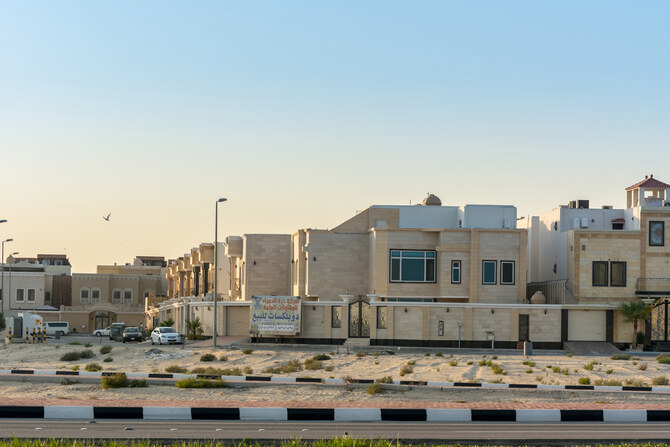

RIYADH: Saudi Arabia’s real estate market is expected to rebound in the second half of this year, driven by strong performance in both oil and non-oil sectors, a new analysis has revealed.
In its new report, Kuwait Financial Center, also known as Markaz, forecasted continued growth in the Gulf Cooperation Council’s real estate sector, with the Kingdom, Kuwait, and the UAE leading the charge.
The growth is driven by strong macroeconomic fundamentals, supportive government policies, and increasing investor interest, according to the report developed by Markaz’s MENA Real Estate team and Indian-based research firm Marmore MENA Intelligence.
This comes as Markaz’s Real Estate Macro Index Scores for the second half of 2024 are projected at 3.5 for Kuwait, 3.7 for the UAE, and 3.6 for Saudi Arabia, indicating a strong rebound in the real estate market.
While Kuwait and Saudi Arabia show improvements from their first-half scores of 2.9 and 3.55, respectively, the UAE’s stable score of 3.7 shows ongoing strength and potential for sustained growth in these key GCC markets, the report said.
For Saudi Arabia, developing the real estate sector is crucial as it aims to become a global business, tourism, and investment destination in line with Vision 2030.
“In Saudi cities Riyadh, Jeddah, and Dammam, the residential sector saw a substantial year-over-year increase in sales transactions by 77 percent, 93 percent, and 28 percent, respectively, during the first quarter of 2024,” said Markaz.
“The office sector also strengthened with rising rents in high-end and mid-range properties across these cities,” the asset management and investment banking firm added.
A recent Ministry of Investment report said that 57 international firms had established their regional headquarters in Saudi Arabia in the second quarter of this year, an 84 percent increase from the same period the previous year.
The regional HQ program introduced new tax incentives for multinational companies relocating to the Kingdom, including a 30-year exemption on corporate income tax, withholding tax related to headquarters activities, discounts, and support services.
“This increase in rents has been partly driven by the new regional headquarters initiative, a part of Saudi Arabia’s Vision 2030, which kicked off at the start of 2024,” said Markaz.
It also said that the Kingdom’s hospitality sector experienced significant growth in the first quarter of the year, with Riyadh leading a 26.8 percent increase in average daily rates.
The rise was driven by increased business travel, religious tourism from the Muslim Hajj pilgrimage and Umrah, and a vibrant slate of international and cultural events.
The Kuwaiti institution further said that Saudi Arabia’s real estate market outlook remained positive, with strong performance projected to continue in the latter half of 2024, driven by robust non-oil sector activities and substantial government infrastructure spending.
“The market is believed to be in an accelerating phase, indicative of a dynamic period of growth ahead,” added Markaz.
Citing an International Monetary Fund projection, Markaz said Saudi Arabia’s real gross domestic product is expected to grow by 2.6 percent in 2024, recovering from previous contractions, with an optimistic forecast of 8.1 percent growth next year.
“This economic recovery is mirrored in the real estate domain, where the General Authority for Statistics reports a 0.6 percent rise in the real estate price index for the first quarter of 2024, led by a 1.2 percent rise in residential land prices,” said Markaz.
UAE real estate
Markaz projected the UAE’s real estate sector will continue to grow through 2024, driven by strong demand in residential, office, and hospitality segments.
“The non-oil economy, including significant contributions from the real estate sector, is expected to sustain strong growth, buoyed by government support and favorable policies, such as the revised Golden Visa requirements, which now enhance investor eligibility,” the report said.
The analysis highlighted that the UAE real estate market remains vibrant, with record transactions and rising prices despite geopolitical uncertainties.
In the first half of the year, residential property prices in Dubai and Abu Dhabi surged 18.3 percent and 8.6 percent, respectively, reinforcing the UAE’s status as a top luxury housing market.
Markaz said that reducing the minimum downpayment for golden visas to 1 million dirhams ($272,264) is expected to attract more international investors and further boost the market.
“Office spaces in Dubai and Abu Dhabi have also seen rent increases due to high demand, particularly in higher-grade properties, reflecting a market trend toward quality,” the report said.
“The hospitality sector continues to thrive, supported by a surge in tourism and business travel, contributing to a robust performance in hotel average daily rates across major cities,” it added.
Markaz projected that the UAE real estate sector would continue its growth trajectory in the latter half of the year, though with a slight moderation in some segments and areas, such as Abu Dhabi.
The market’s resilience reflects a strong economic environment and effective policy measures, ensuring ongoing growth and investment attractiveness.
Kuwait real estate
Kuwait’s real estate sector is also demonstrating resilience and growth potential despite challenging economic conditions, with a projected GDP contraction of 1.4 percent, following a 2.2 percent decline last year, according to Markaz.
“Despite these broader economic challenges, the non-oil sectors, especially real estate, are experiencing growth supported by an expected 2 percent increase in non-oil GDP,” said Markaz. “Enhanced project activities and anticipated business reforms drive this growth.”
The analysis highlighted a revival in Kuwait’s real estate sector, marked by rising rents and land prices. This is particularly evident in the Istithmari segment, or the housing rental market, where apartment land prices have seen significant annual gains in most areas, except for the western Mahboula district.
Commercial land prices have also increased across all governorates, while rental rates for three-bedroom and 60 sq. meter apartments have remained stable, showing an uptick compared to the end of 2022, despite some exceptions in Mahboula and Khaitan area near Kuwait City.
“The sector is poised for further growth despite the decline in overall volume and value of real estate transactions — a normalization from the pent-up demand seen post-pandemic,” Markaz said.
“The Kuwaiti real estate market’s future looks promising, supported by macroeconomic stability and strategic reforms likely to drive continued recovery and expansion.”