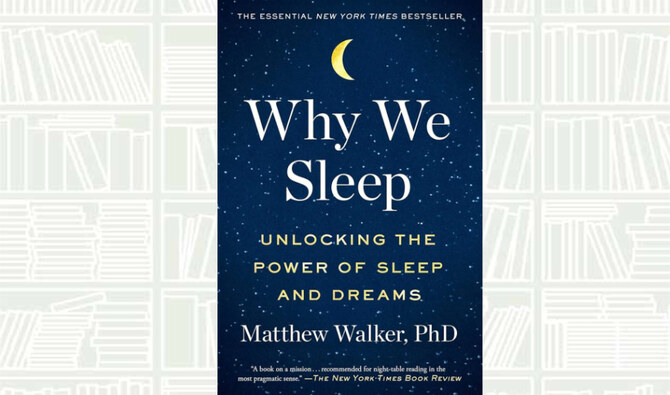
What We Are Reading Today: ‘Why We Sleep’

Photo/Supplied
Short Url
Updated 24 August 2024
Follow

What We Are Reading Today: ‘Why We Sleep’

  • He elaborates on the latest research data on sleep functions, revealing how it can enhance memory, strengthen the immune system and improve innovative thinking

Author: Matthew Walker

In “Why We Sleep,” Matthew Walker discusses the significant role of sleep in our physical and mental health.

Writing about the results of decades of research, Walker, a professor of neuroscience and psychology at the University of California and director of the San Francisco Center for Human Sleep Science, reflects on common myths about sleep and makes appealing arguments for its importance.

The spread of sleep deprivation in modern life has become alarming. Many people may not be aware of its long-term consequences, which is one of the main ideas that Walker emphasizes in this book.

He presents scientific evidence explaining how chronic sleep loss leaves devastating impacts not only on health but also our on cognitive function and longevity.

From the risk of developing serious health issues such as cancer to the lack of ability to make decisions and emotional regulation, he argues that people should not neglect the need to sleep.

Walker’s ability to translate complex concepts into understandable, compelling stories is impressive; whether explaining the complex neural mechanisms underlying sleep or the fascinating evolutionary history of the sleep-wake cycle, his writing style is clear, effective and engaging.

He also elaborates on the latest research data on sleep functions, revealing how it can enhance memory, strengthen the immune system and improve innovative thinking.

Walker also sheds light on the mysterious world of dreams, suggesting that they might play a major role in emotional processing and problem-solving.  

By emphasizing the vital importance of sleep in our lives, Walker encourages his readers to prioritize this important aspect of their health.

Whether you are a sleep-deprived student, a busy employee, or someone interested in the depth of the human mind, “Why We Sleep” is informative and helpful.


What We Are Reading Today: ‘The Bell Jar’

Photo/Supplied
Updated 20 December 2025
Follow

What We Are Reading Today: ‘The Bell Jar’

  • The bell jar — clear, enclosing, and distorting the air she breathes — becomes the perfect image of Greenwood’s entrapment. Just as telling is the fig tree she imagines, with each fig representing a possible future: writer, traveler, mother, lover

Author: Sylvia Plath

Sylvia Plath’s “The Bell Jar” (1963) is a raw and luminous portrait of a young woman standing at the edge of adulthood, grappling with ambition, doubt, and the suffocating weight of expectation. 

Through the eyes of the novel’s troubled protagonist Esther Greenwood, Plath reveals the loneliness that can lie hidden beneath achievement and the unease brought on by future expectations.  

The novel opens in New York, where Greenwood’s magazine internship seems the gateway to success. Yet the city’s glamor soon feels hollow, and the confidence around her thin and brittle. 

Her sense of direction begins to fade, and the life laid out before her starts to feel both too small and impossibly distant.  

The bell jar — clear, enclosing, and distorting the air she breathes — becomes the perfect image of Greenwood’s entrapment. Just as telling is the fig tree she imagines, with each fig representing a possible future: writer, traveler, mother, lover. 

Torn between these possibilities, she hesitates until the figs shrivel and drop. This image, perhaps more than any other, reveals how fear of choice can quietly undo a person.   

Plath’s writing is sharp and deeply humane. She exposes the subtle pressures shaping women’s lives at that time without sentiment or complaint. 

The narrative’s erratic rhythm mirrors the character’s disoriented state of mind, where thought and memory blur at the edges. 

“The Bell Jar” speaks to anyone who has felt caught between possibility and paralysis, between who they are and who they are expected to be. 

Plath writes with precision and compassion, turning confusion into clarity and despair into something almost inspiring.