

Top Indian lawyers raise alarm over Delhi’s military exports to Israel

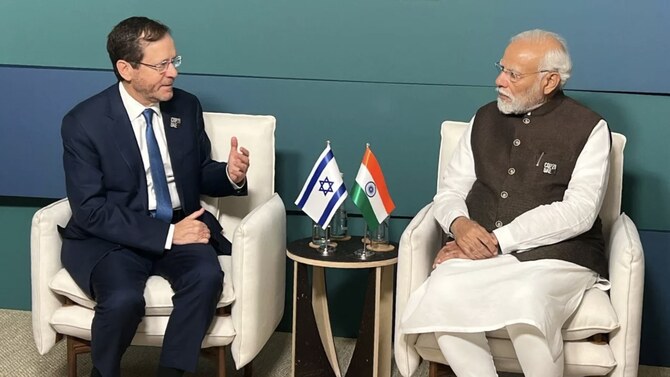
Indian PM Narendra Modi meets Israeli President Isaac Herzog during the UN Climate Change Conference in Dubai, Dec. 1, 2023. (Presidential Press Office)
Short Url
Updated 24 August 2024
Follow

Top Indian lawyers raise alarm over Delhi’s military exports to Israel

  • Indian weapon sales to Israel came into spotlight after Spain blocked Indian shipment through its ports
  • Defense Ministry spokesperson says India has not authorized any arms supplies to Israel in past months

NEW DELHI: Top lawyers are sounding the alarm over the consequences of Indian arms exports to Israel, which they say violate international conventions and the country’s own domestic law in the wake of the war on Gaza.

Indian arms sales to Israel came into the spotlight in May, when two cargo ships were prevented from docking in the Spanish port of Cartagena after reports that they were loaded with weapons.

The first vessel was en route from Chennai in southeast India to the Israeli port of Ashdod — some 30 km from Gaza — and was blocked by Spanish activists. The second was on the way from Chennai to Haifa, and was officially denied entry, with Spanish Foreign Minister Jose Manuel Albares confirming to the media that the vessel was carrying a shipment of arms to Israel.

In June, after Israel’s deadly bombing of a UN-run school sheltering thousands of displaced people in central Gaza, Palestinian reporters released a video showing the remains of a missile found in the rubble after the attack. A label on it read: “Made in India.”

The reports have triggered an uproar among Indian civil society and opposition politicians, who have requested clarification from the Ministry of Defense and the Ministry of External Affairs over the military cooperation in the wake of Israel’s deadly onslaught on Gaza and a genocide case against the country in the International Court of Justice.

A recent petition signed by Supreme Court lawyers, judges and retired foreign service officials called on Defense Minister Rajnath Singh to halt the issuance of licenses to companies supplying military equipment to Israel and cancel the existing ones, as the exports are not only “morally objectionable” and “abominable,” but also constitute a “serious violation” of law.

“It’s very clear that genocide is being committed in Palestine by Israel; the International Court of Justice has virtually said so,” Prashant Bhushan, a public interest lawyer in the Supreme Court of India, told Arab News.

“India is clearly aiding that genocide.”

A Ministry of Defense spokesperson told Arab News on Saturday that “it is the Indian government’s policy not to sell weapons to countries in conflict” and that the government “has not authorized the supply of any weapons to Israel during the last several months.” 

The spokesperson did not comment on canceling existing licenses.

At least 40,334 people — most of them children and women — have been killed and more than 93,300 wounded in Israeli military attacks on Gaza since Oct. 7, according to the Palestinian enclave’s Health Ministry estimates.

The real toll, however, is believed to be much higher as the ministry’s data does not include people buried under rubble, those who died of their injuries or who starved to death, as Israeli forces have been blocking international aid. One of the world’s leading medical journals, the Lancet, estimated last month that the actual death toll of Palestinians killed in Gaza could exceed 186,000 — or almost 10 percent of the territory’s population.

The substantial evidence of Israel breaking international humanitarian law, the genocide and war crime proceedings against its leadership in the ICJ and International Criminal Court, as well as a new case brought by Nicaragua against Germany over its support for Tel Aviv, create legal circumstances in which India can be charged with violating its own constitution and international law.

Dr. Anwar Sadat of the Indian Society of International Law said that the violations are on “several” levels, starting with international humanitarian law.

“Israel is targeting civilian population consistently. Israel is targeting hospitals, Israel is targeting supply lines, Israel is targeting the supply of humanitarian assistance to Palestinian people,” he told Arab News. “Israel is in serious violation of international humanitarian law, so you cannot support and supply, or in any way assist it.”

Sadat said that by providing military assistance to Israel, India also risks being charged with breaching the Genocide Convention and may face a similar case to the one recently initiated against Germany. Genocide and ancillary crimes of genocide, such as complicity, are subject to universal jurisdiction.

In late March, Nicaragua instituted proceedings against Germany at the ICJ under, inter alia, the Genocide Convention, concerning “alleged breaches of certain international obligations in respect of the Occupied Palestinian Territory” arising from Germany’s support and military supplies for Israel.

“If you are a party to this convention, and India is a party to the Genocide Convention, you have international legal responsibility to prevent the commission of genocide,” Sadat said.

“Any breach of international legal obligations requires reparations, compensation.”

India would not be able to absolve itself, as it is not safeguarding any essential interests by breaching the law.

“There is no such situation before India,” Sadat said. “Not providing the arms to Israel does not make India unsafe in any way, so it has no plea of necessity.”

Advocate Chander Uday Singh, a Supreme Court lawyer who was also among the petitioners demanding that India immediately stop all exports of military material to Israel, warned that India is also acting against its own domestic law.

Article 51C of the Indian Constitution says that is the state’s duty to “foster respect for international law and treaty obligations.” This includes the Genocide Convention, of which provisions are directly binding for India also on the domestic level, as it has not framed its own.

“India was the signatory to the Genocide Convention in 1949 and then thereafter it has ratified the convention in 1959, so under international law we are completely bound by the Genocide Convention, meaning we are contracting party to it,” Singh said.

“The Genocide Convention also requires contracting parties to frame national laws and give effect to the convention within the country ... the fact that we have not framed the domestic law means that that the convention itself can be looked at, and the principles of the convention can be applied by Indian courts.”


War powers resolution fails in Senate as 2 Republicans bow to Trump pressure

Updated 15 January 2026
Follow

War powers resolution fails in Senate as 2 Republicans bow to Trump pressure

WASHINGTON: Senate Republicans voted to dismiss a war powers resolution Wednesday that would have limited President Donald Trump’s ability to conduct further attacks on Venezuela after two GOP senators reversed course on supporting the legislation.
Trump put intense pressure on five Republican senators who joined with Democrats to advance the resolution last week and ultimately prevailed in heading off passage of the legislation. Two of the Republicans — Sens. Josh Hawley of Missouri and Todd Young of Indiana — flipped under the pressure.
Vice President JD Vance had to break the 50-50 deadlock in the Senate on a Republican motion to dismiss the bill.
The outcome of the high-profile vote demonstrated how Trump still has command over much of the Republican conference, yet the razor-thin vote tally also showed the growing concern on Capitol Hill over the president’s aggressive foreign policy ambitions.
Democrats forced the debate after US troops captured Venezuelan leader Nicolás Maduro in a surprise nighttime raid earlier this month
“Here we have one of the most successful attacks ever and they find a way to be against it. It’s pretty amazing. And it’s a shame,” Trump said at a speech in Michigan Tuesday. He also hurled insults at several of the Republicans who advanced the legislation, calling Sen. Rand Paul of Kentucky a “stone cold loser” and Sens. Lisa Murkowski of Alaska and Susan Collins of Maine “disasters.” Those three Republicans stuck to their support for the legislation.
Trump’s latest comments followed earlier phone calls with the senators, which they described as terse. The president’s fury underscored how the war powers vote had taken on new political significance as Trump also threatens military action to accomplish his goal of possessing Greenland.
The legislation, even if it had cleared the Senate, had virtually no chance of becoming law because it would eventually need to be signed by Trump himself. But it represented both a test of GOP loyalty to the president and a marker for how much leeway the Republican-controlled Senate is willing to give Trump to use the military abroad. Republican angst over his recent foreign policy moves — especially threats of using military force to seize Greenland from a NATO ally — is still running high in Congress.
Two Republicans reconsider
Hawley, who helped advance the war powers resolution last week, said Trump’s message during a phone call was that the legislation “really ties my hands.” The senator said he had a follow-up phone call with Secretary of State Marco Rubio Monday and was told “point blank, we’re not going to do ground troops.”
The senator added that he also received assurances that the Trump administration will follow constitutional requirements if it becomes necessary to deploy troops again to the South American country.
“We’re getting along very well with Venezuela,” Trump told reporters at a ceremony for the signing of an unrelated bill Wednesday.
As senators went to the floor for the vote Wednesday evening, Young also told reporters he was no longer in support. He said that he had extensive conversations with Rubio and received assurances that the secretary of state will appear at a public hearing before the Senate Foreign Relations Committee.
Young also shared a letter from Rubio that stated the president will “seek congressional authorization in advance (circumstances permitting)” if he engaged in “major military operations” in Venezuela.
The senators also said his efforts were also instrumental in pushing the administration to release Wednesday a 22-page Justice Department memo laying out the legal justification for the snatch-and-grab operation against Maduro.
That memo, which was heavily redacted, indicates that the administration, for now, has no plans to ramp up military operations in Venezuela.
“We were assured that there is no contingency plan to engage in any substantial and sustained operation that would amount to a constitutional war,” according to the memo signed by Assistant Attorney General Elliot Gaiser.
Trump’s shifting rationale for military intervention
Trump has used a series of legal arguments for his campaign against Maduro.
As he built up a naval force in the Caribbean and destroyed vessels that were allegedly carrying drugs from Venezuela, the Trump administration tapped wartime powers under the global war on terror by designating drug cartels as terrorist organizations.
The administration has claimed the capture of Maduro himself was actually a law enforcement operation, essentially to extradite the Venezuelan president to stand trial for charges in the US that were filed in 2020.
Paul criticized the administration for first describing its military build-up in Caribbean as a counternarcotics operation but now floating Venezuela’s vast oil reserves as a reason for maintaining pressure.
“The bait and switch has already happened,” he said.
Trump’s foreign policy worries Congress
Lawmakers, including a significant number of Republicans, have been alarmed by Trump’s recent foreign policy talk. In recent weeks, he has pledged that the US will “run” Venezuela for years to come, threatened military action to take possession of Greenland and told Iranians protesting their government that ” help is on its way.”
Senior Republicans have tried to massage the relationship between Trump and Denmark, a NATO ally that holds Greenland as a semi-autonomous territory. But Danish officials emerged from a meeting with Vance and Rubio Wednesday saying a “fundamental disagreement” over Greenland remains.
“What happened tonight is a roadmap to another endless war,” Senate Democratic leader Chuck Schumer said at a news conference following the vote.
More than half of US adults believe President Donald Trump has “gone too far” in using the US military to intervene in other countries, according to a new AP-NORC poll.
House Democrats have also filed a similar war powers resolution and can force a vote on it as soon as next week.
How Republican leaders dismissed the bill

Last week’s procedural vote on the war powers resolution was supposed to set up hours of debate and a vote on final passage. But Republican leaders began searching for a way to defuse the conflict between their members and Trump as well as move on quickly to other business.
Once Hawley and Young changed their support for the bill, Republicans were able to successfully challenge whether it was appropriate when the Trump administration has said US troops are not currently deployed in Venezuela.
“We’re not currently conducting military operations there,” said Senate Majority Leader John Thune in a floor speech. “But Democrats are taking up this bill because their anti-Trump hysteria knows no bounds.”
Democratic Sen. Tim Kaine, who has brought a series of war powers resolutions this year, accused Republicans of burying a debate about the merits of an ongoing campaign of attacks and threats against Venezuela.
“If this cause and if this legal basis were so righteous, the administration and its supporters would not be afraid to have this debate before the public and the United States Senate,” he said in a floor speech.