

Pakistani man charged over misinformation that sparked UK rioting to remain in officers’ custody

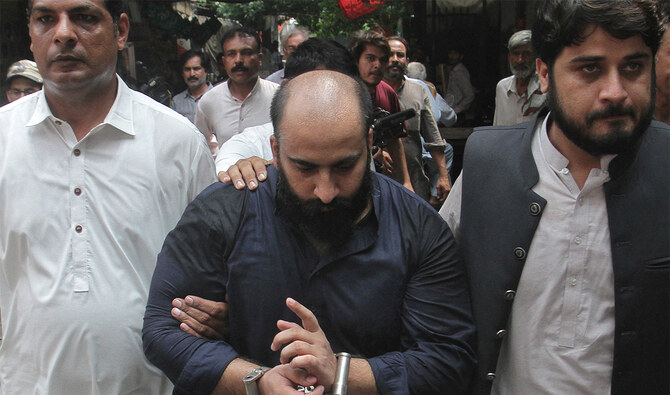
Farhan Asif, who Pakistan's Federal Investigation Agency (FIA) has charged with cybercrime offences for spreading fake online information which fueled riots in Britain, is escorted by the members of FIA outside a court in Lahore, Pakistan, on August 22, 2024. (REUTERS)
Short Url
Updated 23 August 2024
Follow

Pakistani man charged over misinformation that sparked UK rioting to remain in officers’ custody

  • Authorities have charged the suspect Farhan Asif, 32, with cyber terrorism following his arrest from his home in Lahore
  • False information claimed suspect in a stabbing was a recently arrived asylum-seeker with Muslim-sounding name 

LAHORE: A court in Pakistan on Thursday allowed investigators to question a man in their custody for four more days about his role in spreading misinformation that sparked widespread rioting in the UK earlier this month, officials said.

The court’s decision came a day after authorities charged the suspect Farhan Asif, 32, with cyber terrorism following his arrest from his home in Lahore, the capital of eastern Punjab province.

Asif, who is a freelance web developer, was produced before the court amid tight security. He was not allowed to talk to the media.

Kiran Muqeem, a prosecutor for the Federal Investigation Agency, told the court that Asif did not cooperate with officers after the same court the previous day allowed them to question him for a day. They demanded his custody for two weeks but the court said it would only allow it for four more days.

Muqeem later told reporters that Asif disseminated fake news and caused riots in England.

Asif was handcuffed and wearing blue shalwar kameez garments when brought to the court.

His lawyer Rana Rizwan told reporters that the court remanded his client into the custody of the federal agency in a hurry and without hearing him.

“We were informed by the court that the case of Asif would be taken up after lunch break. But the court took up the matter before the lunch break, and allowed FIA to keep him in their custody,” Rizwan said.

Asif is accused of spreading misinformation from YouTube and Facebook about the British teenage suspect in a stabbing attack that killed three girls and injured 10 other people on July 29 at a dance class in Northwest England.

The false information claimed that the suspect was a recently arrived asylum-seeker and had a name that suggested he was Muslim. After the misinformation led to a violent mob attacking a mosque near the site of the stabbing the next day, police took the unusual step of clarifying that the suspect was born in the UK.

British media has widely reported that his parents are from Rwanda and are said to have Christian beliefs.

Channel3 Now, an account on the X social media platform that purports to be a news channel, was one of the first outlets to report the false name, Ali Al-Shakati.

A Facebook account for the channel said it is managed by people in Pakistan and the US. But, officials say Asif was solely running the Channel3 Now, and he spread misinformation to gain more viewers.


Pakistan says responding to Afghan ‘offensive operations’ after border fire as tensions escalate

Updated 56 min 19 sec ago
Follow

Pakistan says responding to Afghan ‘offensive operations’ after border fire as tensions escalate

  • Afghan Taliban spokesperson says “large-scale offensive operations” launched against Pakistani military bases
  • Pakistan says Afghan forces opened “unprovoked” fire across multiple sectors along shared border

ISLAMABAD: Afghanistan’s Taliban authorities said on Thursday they had launched “large-scale offensive operations” against Pakistani military bases and installations, prompting Pakistan to say its forces were responding to what it described as unprovoked fire along the shared border.

The escalation follows Islamabad’s weekend airstrikes targeting what it said were Tehreek-e-Taliban Pakistan (TTP) and Daesh militant camps inside Afghanistan in response to a wave of recent bombings and attacks in Pakistan. Islamabad said the strikes killed over 100 militants, while Kabul said dozens of civilians were killed and condemned the attacks as a violation of its sovereignty.

In a post on social media platform X, Afghan government spokesperson Zabihullah Mujahid said Afghanistan had launched “large-scale offensive operations” in response to repeated violations by the Pakistani military.


Pakistan’s Ministry of Information said Afghan forces had initiated hostilities along multiple points of the frontier.

“Afghan Taliban regime unprovoked action along the Pakistan–Afghanistan border given an immediate, and effective response,” the ministry said in a statement.

The statement said Pakistani forces were targeting Taliban positions in the Chitral, Khyber, Mohmand, Kurram and Bajaur sectors, claiming heavy Afghan casualties and the destruction of multiple posts and equipment. It added that Pakistan would take all necessary measures to safeguard its territorial integrity and the security of its citizens.


Separately, security officials said Pakistani forces had carried out counterattacks in several border sectors.

“Pakistan’s security forces are giving a befitting reply to the unprovoked Afghan aggression with full force,” a security official said, declining to be named. 

“The Pakistani security forces’ counter-attack destroyed Taliban’s hideouts and the Khawarij fled,” they added, referring to TTP militants. 

The claims from both sides could not be independently verified.

Cross-border violence has intensified in recent weeks, with Pakistan blaming a surge in suicide bombings and militant attacks on militants it says are based in Afghanistan. Kabul denies providing safe havens to anti-Pakistan militant groups.

The clashes mark the third major escalation between the neighbors in less than a year. Similar Pakistani strikes last year triggered weeklong clashes before Qatar, Türkiye and other regional actors mediated a ceasefire in October.

The 2,600-kilometer (1,600-mile) frontier, a key trade and transit corridor linking Pakistan to landlocked Afghanistan and onward to Central Asia, has faced repeated closures amid tensions, disrupting commerce and humanitarian movement. Trade between the two nations has remained closed since October 2025.