

Pakistani man charged over misinformation that sparked UK rioting to remain in officers’ custody

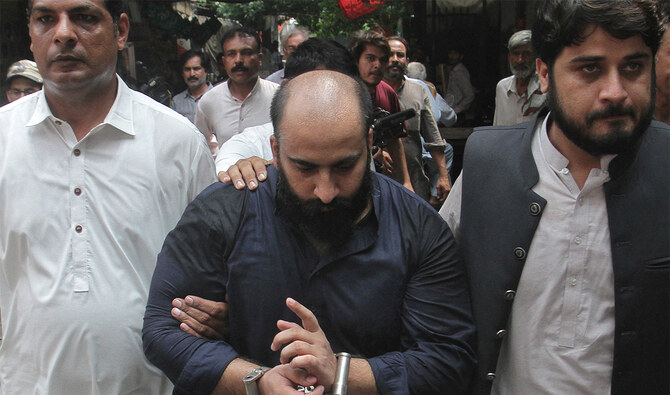
Farhan Asif, who Pakistan's Federal Investigation Agency (FIA) has charged with cybercrime offences for spreading fake online information which fueled riots in Britain, is escorted by the members of FIA outside a court in Lahore, Pakistan, on August 22, 2024. (REUTERS)
Short Url
Updated 23 August 2024
Follow

Pakistani man charged over misinformation that sparked UK rioting to remain in officers’ custody

  • Authorities have charged the suspect Farhan Asif, 32, with cyber terrorism following his arrest from his home in Lahore
  • False information claimed suspect in a stabbing was a recently arrived asylum-seeker with Muslim-sounding name 

LAHORE: A court in Pakistan on Thursday allowed investigators to question a man in their custody for four more days about his role in spreading misinformation that sparked widespread rioting in the UK earlier this month, officials said.

The court’s decision came a day after authorities charged the suspect Farhan Asif, 32, with cyber terrorism following his arrest from his home in Lahore, the capital of eastern Punjab province.

Asif, who is a freelance web developer, was produced before the court amid tight security. He was not allowed to talk to the media.

Kiran Muqeem, a prosecutor for the Federal Investigation Agency, told the court that Asif did not cooperate with officers after the same court the previous day allowed them to question him for a day. They demanded his custody for two weeks but the court said it would only allow it for four more days.

Muqeem later told reporters that Asif disseminated fake news and caused riots in England.

Asif was handcuffed and wearing blue shalwar kameez garments when brought to the court.

His lawyer Rana Rizwan told reporters that the court remanded his client into the custody of the federal agency in a hurry and without hearing him.

“We were informed by the court that the case of Asif would be taken up after lunch break. But the court took up the matter before the lunch break, and allowed FIA to keep him in their custody,” Rizwan said.

Asif is accused of spreading misinformation from YouTube and Facebook about the British teenage suspect in a stabbing attack that killed three girls and injured 10 other people on July 29 at a dance class in Northwest England.

The false information claimed that the suspect was a recently arrived asylum-seeker and had a name that suggested he was Muslim. After the misinformation led to a violent mob attacking a mosque near the site of the stabbing the next day, police took the unusual step of clarifying that the suspect was born in the UK.

British media has widely reported that his parents are from Rwanda and are said to have Christian beliefs.

Channel3 Now, an account on the X social media platform that purports to be a news channel, was one of the first outlets to report the false name, Ali Al-Shakati.

A Facebook account for the channel said it is managed by people in Pakistan and the US. But, officials say Asif was solely running the Channel3 Now, and he spread misinformation to gain more viewers.


Economists flag high production costs, low exports as key risks for Pakistan in 2026

Updated 6 sec ago
Follow

Economists flag high production costs, low exports as key risks for Pakistan in 2026

  • Financial experts urge government to address high interest and taxation rates to attract more foreign direct investment this year
  • Economists note strong performance by Pakistan’s stock market, reduced inflation as key macroeconomic gains in the last year

KARACHI: Pakistani economists and business leaders urged the government on Wednesday to cut high production costs, arrest inflation and increase exports to capitalize on macroeconomic gains in 2025 as the country prepared to ring in the new year.

Prime Minister Shehbaz Sharif this week highlighted his government’s economic achievements over the past two years, saying that inflation had fallen from 29.2 percent to 4.5 percent, while foreign exchange reserves had more than doubled from $9.2 billion to $21.2 billion.

While Pakistan reported some economic gains during the year, such as comparatively low inflation, a $100 million current account surplus in November and a strong performance by the stock market, economist Sana Tawfik said deeper reforms were still needed to address pressing economic issues.

“When we talk about stability and growth, we cannot deny that there are challenges in the economy,” Tawfik, head of research at Arif Habib Limited, told Arab News. “High energy tariffs, interest rates and the broader cost of doing business need to be addressed if Pakistan wants to sustain growth, boost exports and attract foreign investment.”

Pakistan reported consumer inflation at 6.1 percent in November, saying it was projected to remain within the moderate 5.5-6.5 percent range in December.

Muhammad Rehan Hanif, president of the Karachi Chamber of Commerce and Industry (KCCI), agreed that high power tariffs were eroding the effectiveness of Pakistan’s exports.

“Our interest rate is still 10.5 percent, while the region is at six or seven percent,” Hanif lamented. “[While] electricity costs around 12 cents per unit here, compared to about nine cents in Bangladesh.”

The KCCI president also pointed to the country’s poor infrastructure, particularly that of its commercial capital Karachi, as a major challenge for the year ahead.

He said dilapidated roads, poor drainage and poor industrial conditions were damaging Pakistan’s image for visiting buyers and diplomats, discouraging investment.

“Infrastructure is the biggest challenge the industrialists in Karachi are facing,” he explained.

‘EXPORTS ARE OUR LIFELINE’

More troubling for Pakistan is the fact that foreign direct investment (FDI) inflows fell by more than 25 percent to $927 million during the July-November period, as per data from the central bank. Pakistan’s FDI inflows have never surged beyond $3 billion in nearly 20 years.

Economists say high energy costs along with interest and taxation rates are responsible for low FDI in the country.

Hanif stressed the importance of increasing Pakistan’s exports to ensure macroeconomic gains in 2026.

“Exports are our lifeline,” he said. “When 7 to 8 million Pakistanis abroad can generate $37 billion [in remittances], why are 250 million people here exporting only $32 billion?“

Tawfik agreed, saying that shifting to an export-driven economic model was essential for long-term sustainability.

“It is about time that we move from an import-driven economy to an export-driven one,” she said, adding that macroeconomic stability was a prerequisite for restoring investor confidence and attracting FDI.

Meeting the International Monetary Fund’s benchmarks, ensuring timely inflows from creditors and continuing reforms such as privatization of state-owned enterprises (SOEs) will also be critical in 2026, she added.

‘YEAR OF MACROECONOMIC STABILITY’

Despite these challenges, financial experts recognized that 2025 marked a clear improvement for Pakistan compared to the previous two years.

“The year 2025 can be described as a year of macroeconomic stability and overall, we saw some improvement in different macroeconomic indicators,” Tawfik said.

She noted that inflation, which had surged to a record 38 percent in May 2023, had been reduced to single-digit figures in 2025.

Pakistan’s Finance Adviser Khurram Schehzad said this week the Pakistan Stock Exchange has delivered 50 percent-plus returns in US dollar terms since January 2025, making it one of the “best markets in Asia.”

Tawfik said 2026 could see “positive” developments if the government maintains macroeconomic stability.

The economist said she expected growth at around 3.7 percent, inflation to remain within the central bank’s five to seven percent target range and a relatively stable exchange rate with modest depreciation.

However, she cautioned that without addressing high energy costs, easing business conditions and boosting exports, the government could risk squandering its hard-won macroeconomic gains.

“It is important to take all stakeholders on the same page and work in the same direction for overall economic betterment.”