

Polls show Republicans are more likely than Democrats to have a favorable opinion of Robert F. Kennedy Jr.

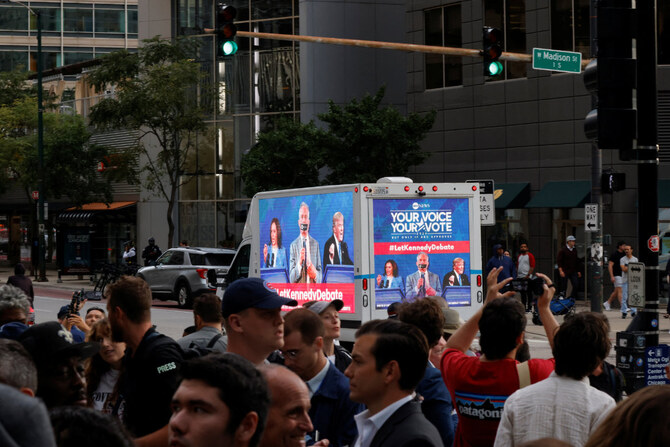
A bus demanding Robert F. Kennedy's participation in a debate drives past a protest near the Israeli consulate, as the Democratic National Convention is held, in Chicago, Illinois, on August 20, 2024. (REUTERS)
Short Url
Updated 23 August 2024
Follow

Polls show Republicans are more likely than Democrats to have a favorable opinion of Robert F. Kennedy Jr.

  • While some polls earlier in the year put Kennedy’s support in the double digits, support now hovers in the mid-single digits in most recent polls
  • Kennedy is scheduled to speak in Phoenix on Friday, just days after his running mate openly discussed the possibility that he could drop out and endorse Trump

WASHINGTON: Republicans are more likely than Democrats to have a favorable opinion of Robert F. Kennedy Jr., recent polls show, as allies of Donald Trump urge the independent presidential candidate to drop out and endorse the former Republican president.
Kennedy’s support appears to have declined in recent polls as he struggles to find his political lane in a race reshaped by the departure of Democratic President Joe Biden and Vice President Kamala Harris’ nomination in his place. The developments have left relatively narrow room for Kennedy’s presence — or potential departure — to make a difference in the election outcome. Recent polls don’t give a clear indication that Kennedy’s presence in the race has an outsized impact on support for either major-party candidate.
While some polls earlier in the year put Kennedy’s support in the double digits, support now hovers in the mid-single digits in most recent polls. It’s unclear if Kennedy would get even that level of support in the general election, since third-party candidates frequently don’t live up to their early poll numbers when voters actually cast their ballots.
Kennedy is scheduled to speak in Phoenix on Friday “about the present historical moment and his path forward,” just days after his running mate openly discussed the possibility that he could drop out and endorse Trump.
Partisan appeal
In recent months, Americans overall have been split in their views of Kennedy, 70, the son of former US Attorney General Robert F. Kennedy.
About as many people had a favorable as unfavorable view of Kennedy, according to a July AP-NORC poll that was conducted before Biden dropped out of the presidential race last month. That marks a decline from February, when more had a positive than negative view of Kennedy, and about 3 in 10 did not have an opinion.
In the most recent poll, about 2 in 10 US adults didn’t know enough about Kennedy to give an opinion.

Republicans were significantly more likely than Democrats and independents to have a favorable view of Kennedy. And those with a positive impression of Kennedy were more likely to also have a favorable view of Trump (52 percent) than Harris (37 percent).
Kennedy also struggled to endear himself to political independents. Although he is running as an independent presidential candidate, polling shows about 4 in 10 independents did not know enough to form an opinion. Those who did were divided equally between favorable and unfavorable opinions.
The base of support
Kennedy’s appeal largely rested on being an alternative to the match-up many Americans dreaded when Biden was facing Trump in a rematch of the 2020 election won by Biden. A Pew Research Center poll from July found that about half of voters who were supporting Kennedy said the main reason they backed him was because he was neither Biden nor Trump, compared with about 3 in 10 who listed Kennedy’s characteristics or policies.
Harris’ move to the top of the Democratic ticket may have further harmed Kennedy’s prospects. An August Pew poll suggested that Harris has gained support at Kennedy’s expense. She appears to have received the support of some women and non-white voters who previously were considering Kennedy.
About that family name
Kennedy’s initial appeal was largely focused on his family name and his relation to other famed Kennedys, including his father and his uncle, former President John F. Kennedy. CNN polling conducted last summer when RFK Jr. was running for the Democratic nomination found that many Democrats said they’d consider supporting him because of the Kennedy name or his family connections. Many members of the Kennedy family endorsed Biden before he withdrew from the race.
John F. Kennedy remains the most highly rated former president in Gallup’s retrospective approval ratings, and his appeal crosses party lines. Nine in 10 Americans approve of how Kennedy, a Democrat, handled his job as president, according to data from last summer, with Democrats, independents and Republicans in agreement.

News of Robert Kennedy’s potential withdrawal comes a little over a week since a New York judge ruled that he should not appear on the ballot in the state because he listed a “sham” address on nominating petitions. Kennedy has appealed, but has faced several similar challenges around the country.


US will respond to Rwanda’s violation of peace pact, says Rubio

Secretary of State Marco Rubio. (AP file photo)
Updated 4 sec ago
Follow

US will respond to Rwanda’s violation of peace pact, says Rubio

  • Waltz told the Security Council meeting that the US “is deeply concerned and increasingly disappointed” by this resurgence of violence

WASHINGTON: Top US diplomat Marco Rubio said on Saturday that Rwanda had clearly violated the peace agreement it signed with the Democratic Republic of Congo in Washington last week and vowed unspecified “action” in response.
The Rwandan-backed M23 armed group advanced in eastern DRC and seized the key border city of Uvira, just days after the leaders signed the “Washington Accords” on Dec. 4.
“Rwanda’s actions in eastern DRC are a clear violation of the Washington Accords, and the US will take action to ensure promises made to the President are kept,” Secretary of State Rubio wrote on X.

FASTFACT

UN peacekeeping chief Jean-Pierre Lacroix warned the new offensive ‘has revived the specter of a regional conflagration with incalculable consequences.’

The capture of Uvira, along the border with Burundi, has raised fears that the conflict could escalate into a regional war.
As part of an offensive launched at the beginning of December in South Kivu province, the armed group’s takeover follows its earlier this year capture of Goma and Bukavu, other major cities in the DRC’s mineral-rich east.

Mike Waltz, US ambassador to the UN. (REUTERS)

On Friday, US Ambassador to the UN Mike Waltz accused Rwanda of “leading the region toward more instability and toward war.”
“The Rwandan defense forces have provided materiel, logistics, and training support to M23 as well as fighting alongside M23 in DRC with roughly 5,000 to 7,000 troops,” not including possible reinforcements during the latest offensive, Waltz told the UN Security Council.
The Rwandan firepower has included surface-to-air missiles, drones, and artillery, he added.
Since taking up arms again in 2021, the M23 has seized swaths of territory, displacing tens of thousands and leading to a spiraling humanitarian crisis.
Earlier this month, UN experts said Rwanda’s army and the M23 had carried out summary executions and forced mass displacements of people in the region.
Waltz told the Security Council meeting that the US “is deeply concerned and increasingly disappointed” by this resurgence of violence. 
The envoy denounced “the scale and sophistication” of Rwanda’s involvement in eastern DRC.
UN peacekeeping chief Jean-Pierre Lacroix warned the new offensive “has revived the specter of a regional conflagration with incalculable consequences.”
“Recent developments pose a serious risk of the progressive fragmentation of the Democratic Republic of Congo, particularly its eastern part,” he said.
Burundi on Friday accused Rwanda of bombing its territory, and its ambassador, Zephyrin Maniratanga, told the council it “reserves the right to use self-defense.”
He warned that if the attacks continue, it would be extremely difficult to avoid an escalation between the two African countries.
“Rwanda is not waging war against the Republic of Burundi and has no intention of doing that,” Ambassador Martin Ngoga said.
Meanwhile, Congolese Foreign Minister Therese Kayikwamba Wagner criticized the Security Council for its “lack of action” and called for sanctions against Rwanda.

Despite a resolution adopted in February demanding the withdrawal of Rwandan troops and a ceasefire, “the situation is undeniable: another city has fallen, a parallel administration has consolidated itself, thousands more families have fled, and others have been killed, raped, and terrorized,” she said.