

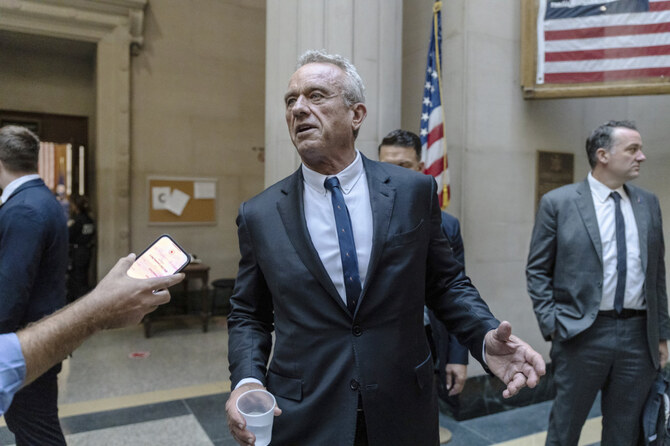

MINEOLA, New York: Robert F. Kennedy Jr. faced questions in a New York court Thursday about how his presidential campaign handled revelations that some people gathering signatures to get him on the state ballot concealed his name on the petitions and used other deceptive methods.
Kennedy’s virtual appearance from an office in California came a day after his campaign announced that he will speak Friday about “his path forward.” The announcement fueled speculation that he could drop out of the race and support former President Donald Trump, the Republican nominee.
Testifying in a trial over a lawsuit backed by the Democratic National Committee that seeks to keep Kennedy off New York’s ballot, he acknowledged that his campaign submitted thousands of signatures gathered by a subcontractor despite knowing that some of its canvassers used deceptive tactics.
The lawsuit alleges, among other claims of fraud, that the top of some petition sheets had been folded down, so the names of Kennedy and his vice presidential running mate, Nicole Shanahan, could not be seen, and only their little-known electors were visible.
“I suppose I’m ultimately responsible for everything that happens in the campaign,” Kennedy said on the witness stand, pointing out that he wasn’t abreast of every detail involved in the subcontractor’s balloting efforts.
When asked if he was ultimately responsible for the decision to submit the signatures, he said “Yes.”
New York requires independent candidates to gather petitions with 45,000 signatures from potential voters to get on the ballot in the general election. Kennedy’s campaign ultimately managed to gather nearly three times that many on top of those gathered by the subcontractor. But an April complaint from a voter and a May New York Times article raised concerns about whether some people signing the petitions knew which candidate they had been asked to support.
Kennedy’s staff was concerned, too. The day after the Times article was published, Kennedy’s campaign manager and daughter-in-law, Amaryllis Kennedy, said in an email to other staff that the questionable petitions gathered by the contractor should not be used.
“We’re obviously pulling all of the petitions they’ve submitted and won’t use any of them as they are likely rife with other hidden errors, buried there to disqualify us once submitted,” she wrote.
According to court documents, the campaign sued the subcontractor, arguing it had to pay them even though none of the signatures were usable. Kennedy said in news interviews at the time that no petitions from the subcontractor were submitted.
But he acknowledged during his testimony that that’s not what actually happened.
Instead, the campaign weeded out around 800 pages — containing 8,000 signatures — with visible creases indicating they’d been folded, putting them in two bankers boxes labeled “fraud box.”
The campaign created an affidavit intended to “cure” the remaining petitions by having the canvassers affirm in writing that they hadn’t committed fraud and submitted over 12,000 signatures from the subcontractor as evidence of New York voters wanting to see him on the ballot.
Lawyers for the plaintiffs however produced at least one example of a creased page that was submitted to the state instead of ending up in the “fraud box.” They also argued, and Kennedy acknowledged, that some canvassers had also verbally misrepresented what the signatures were for — for example, increasing candidate ballot access generally.
The subcontractor did not immediately respond to a phone message and an email request for comment.
A judge in a separate legal challenge has already barred Kennedy from appearing on New York’s ballot, though he has appealed. That suit had argued that Kennedy’s petitions were invalid because they listed him as living in New York when he actually resides in California with his wife, “Curb Your Enthusiasm” actor Cheryl Hines. An appeals court is scheduled to hear arguments next week in that case.
Kennedy is facing similar ballot challenges in several other states from Democrats and their allies.


