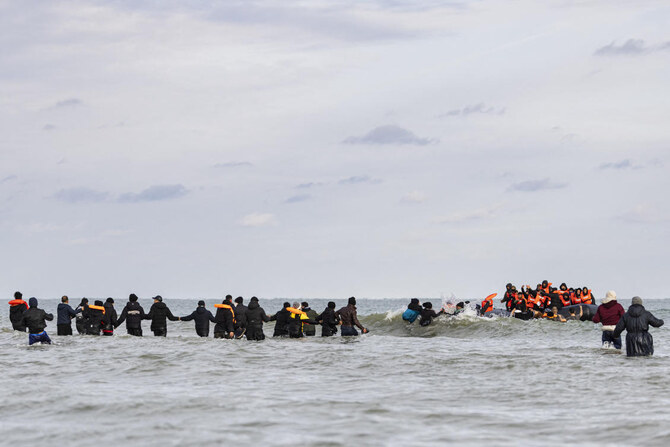
LONDON: The number of migrants arriving in Britain by crossing the Channel on boats hit a record in the first half of 2024, but regular immigration by health workers and students fell, official data showed Thursday.
The UK processed 13,489 so-called small boat migrants in the six months, an 18 percent jump year-on-year and the highest figure ever for that period, according to the interior ministry statistics.
That compared to 11,433 migrants making the perilous journey — across one of the world’s busiest shipping lanes — from January to June in 2023.
The figures are a reminder of the challenge facing the UK’s new Labour government as it tries to reduce the cross-Channel arrivals amid public unease over the issue.
The data came in the wake of more than a week of disorder — dubbed anti-immigration riots — across England and in Northern Ireland which saw some rampaging mobs chant “stop the boats.”
The phrase was an unfulfilled pledge from Conservative former premier Rishi Sunak, who lost last month’s general election to Labour’s Keir Starmer.
The disturbances, which hit more than a dozen English towns and cities, followed a deadly knife attack on a group of children, an attack wrongly blamed on a Muslim asylum seeker.
However, the number of arrivals of health sector and other workers as well as students and their dependents dropped in the most recent quarter, and year to June.
It coincided with tighter visa regulations announced by Sunak’s government last December and imposed in April aimed at lowering record immigration levels.
Visas issued for health and care workers, a sector suffering from staffing shortfalls, fell by four-fifths from April to June compared to the same period in 2023.
Student visas granted reduced 13 percent in the year to June, and those issued to students’ dependants dropped 81 percent year-on-year in the first half of 2024.
Various industry and higher education lobby groups have voiced concerns at the new restrictions, which prevented some dependents from coming to the UK and hiked minimum salary requirements for some workers.
On Channel crossings, the latest figures showed 81 percent of arrivals by people without legal permission to enter the UK in the year to June were on small boats from mainland Europe.
UK officials began counting these “irregular” arrivals in 2018, when there were just 11 in the first half of the year.
Since then, more than 133,000 have arrived — 70 percent of them men and around a fifth under-18s, according to the data.
Afghans comprised 18 percent of the arrivals in the year to June — the single largest nationality cohort — followed by Iranians (13 percent), Vietnamese (10 percent), Turkish (10 percent) and Syrians (nine percent).
The new statistics revealed the average numbers in each boat had increased again, from 10 in the year ending June 2019, 44 in the year ending June 2023 to 51 people in the latest corresponding period.
UK authorities have repeatedly warned that smuggling gangs organizing the crossings are adapting their methods, using bigger boats and packing more people in.
Starmer has vowed to “smash the gangs” as the centerpiece of his strategy to tackle the issue, after scrapping contentious Conservative plans to deport thousands of migrants to Rwanda.

UK sees record Channel migrant arrivals in 2024 as regular immigration falls
Short Url
https://arab.news/9u8vu
UK sees record Channel migrant arrivals in 2024 as regular immigration falls
- The figures are a reminder of the challenge facing the UK’s new Labour government as it tries to reduce the cross-Channel arrivals amid public unease over the issue
Cambodia-Thailand border clashes enter second week
BANTEAY MEANCHEY: Renewed border clashes between Cambodia and Thailand entered a second week Sunday after Bangkok denied US President Donald Trump’s claim that a truce had been agreed to halt the deadly fighting.
The conflict, rooted in a colonial-era demarcation dispute along their 800-kilometer (500-mile) border, has displaced around 800,000 people, officials said.
“I have been here for six days and I feel sad that the fighting continues,” 63-year-old Sean Leap told AFP at an evacuation center in Cambodia’s border province of Banteay Meanchey on Sunday.
“I want it to stop,” he said, adding he was worried about his home and livestock.
At least 25 people have been killed, including 14 Thai soldiers and 11 Cambodian civilians, officials said.
Each side blames the other for instigating the clashes, claiming self-defense and trading accusations of attacks on civilians.
Trump, who earlier backed a truce and follow-on agreement, said Friday the Southeast Asian neighbors had agreed to halt fighting.
But Thai leaders later said no ceasefire deal was made, and both governments said Sunday morning clashes were ongoing.
Thai defense ministry spokesman Surasant Kongsiri said Cambodia shelled and bombed several border provinces overnight.
Thai defense ministry spokesman Surasant Kongsiri said Cambodia shelled and bombed several border provinces overnight and into Sunday.
Cambodia’s defense ministry spokeswoman Maly Socheata, meanwhile, said Thailand continued to fire mortars and bombs into border areas since midnight.
- Closed border crossings -
After Trump’s promised truce did not come to pass, Cambodia shut its border crossings with Thailand on Saturday, leaving migrant workers stranded.
Under a makeshift tent at an evacuation site in Cambodia’s Banteay Meanchey, Cheav Sokun told AFP her husband in Thailand wanted to return home.
She and her son left Thailand alongside tens of thousands of other Cambodian migrant workers during July’s deadly clashes, but her spouse stayed to work as a gardener with his “good Thai boss.”
“He asked me to return first. After that, the border was closed so he cannot come back,” the 38-year-old said.
“I worry about him, but I tell him not to go around... We are afraid that if they know that we are Cambodians, they would attack us,” she said.
Across the border in Thailand’s Surin province, music teacher Watthanachai Kamngam, 38, told AFP he watched several rockets trail across the dark, early morning sky on Sunday before hearing explosions in the distance.
Watthanachai has been painting colorful scenes of tanks, Thai flags and soldiers carrying the wounded on the walls of concrete bunkers since the July clashes which killed dozens.
“As I live through the fighting, I just want to record this moment — to show that this is really our reality,” he told AFP last week.
Amid the fighting, the Thai military has imposed an overnight curfew from 7:00 p.m. to 5:00 am (1200 to 2200 GMT) in parts of Sa Kaeo and Trat provinces.
The United States, China and Malaysia, as chair of the regional bloc ASEAN, brokered a ceasefire in July.
In October, Trump backed a follow-on joint declaration between Thailand and Cambodia, touting new trade deals after they agreed to prolong their truce.
But Thailand suspended the agreement the following month after Thai soldiers were wounded by land mines at the border.
Trump last week pledged he would “make a couple of phone calls” to get the earlier brokered truce back on track.
But Thai Prime Minister Anutin Charnvirakul told journalists on Saturday that Trump “didn’t mention whether we should make a ceasefire” during their Friday phone call.
Anutin said there were “no signs” Trump would connect further US-Thailand trade talks with the border conflict, but also said the US president had guaranteed Thailand would get “better benefits than other countries.”
The conflict, rooted in a colonial-era demarcation dispute along their 800-kilometer (500-mile) border, has displaced around 800,000 people, officials said.
“I have been here for six days and I feel sad that the fighting continues,” 63-year-old Sean Leap told AFP at an evacuation center in Cambodia’s border province of Banteay Meanchey on Sunday.
“I want it to stop,” he said, adding he was worried about his home and livestock.
At least 25 people have been killed, including 14 Thai soldiers and 11 Cambodian civilians, officials said.
Each side blames the other for instigating the clashes, claiming self-defense and trading accusations of attacks on civilians.
Trump, who earlier backed a truce and follow-on agreement, said Friday the Southeast Asian neighbors had agreed to halt fighting.
But Thai leaders later said no ceasefire deal was made, and both governments said Sunday morning clashes were ongoing.
Thai defense ministry spokesman Surasant Kongsiri said Cambodia shelled and bombed several border provinces overnight.
Thai defense ministry spokesman Surasant Kongsiri said Cambodia shelled and bombed several border provinces overnight and into Sunday.
Cambodia’s defense ministry spokeswoman Maly Socheata, meanwhile, said Thailand continued to fire mortars and bombs into border areas since midnight.
- Closed border crossings -
After Trump’s promised truce did not come to pass, Cambodia shut its border crossings with Thailand on Saturday, leaving migrant workers stranded.
Under a makeshift tent at an evacuation site in Cambodia’s Banteay Meanchey, Cheav Sokun told AFP her husband in Thailand wanted to return home.
She and her son left Thailand alongside tens of thousands of other Cambodian migrant workers during July’s deadly clashes, but her spouse stayed to work as a gardener with his “good Thai boss.”
“He asked me to return first. After that, the border was closed so he cannot come back,” the 38-year-old said.
“I worry about him, but I tell him not to go around... We are afraid that if they know that we are Cambodians, they would attack us,” she said.
Across the border in Thailand’s Surin province, music teacher Watthanachai Kamngam, 38, told AFP he watched several rockets trail across the dark, early morning sky on Sunday before hearing explosions in the distance.
Watthanachai has been painting colorful scenes of tanks, Thai flags and soldiers carrying the wounded on the walls of concrete bunkers since the July clashes which killed dozens.
“As I live through the fighting, I just want to record this moment — to show that this is really our reality,” he told AFP last week.
Amid the fighting, the Thai military has imposed an overnight curfew from 7:00 p.m. to 5:00 am (1200 to 2200 GMT) in parts of Sa Kaeo and Trat provinces.
The United States, China and Malaysia, as chair of the regional bloc ASEAN, brokered a ceasefire in July.
In October, Trump backed a follow-on joint declaration between Thailand and Cambodia, touting new trade deals after they agreed to prolong their truce.
But Thailand suspended the agreement the following month after Thai soldiers were wounded by land mines at the border.
Trump last week pledged he would “make a couple of phone calls” to get the earlier brokered truce back on track.
But Thai Prime Minister Anutin Charnvirakul told journalists on Saturday that Trump “didn’t mention whether we should make a ceasefire” during their Friday phone call.
Anutin said there were “no signs” Trump would connect further US-Thailand trade talks with the border conflict, but also said the US president had guaranteed Thailand would get “better benefits than other countries.”
© 2025 SAUDI RESEARCH & PUBLISHING COMPANY, All Rights Reserved And subject to Terms of Use Agreement.


