

UN team in Dhaka to set up probe of student protest killings

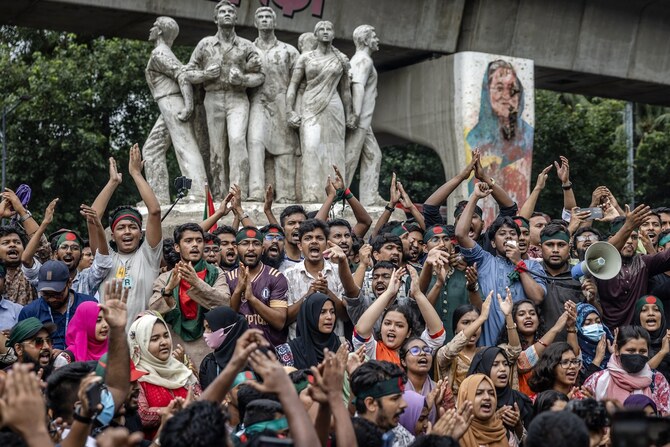
Students chant slogans as they protest to demand accountability and trial against Bangladesh's ousted Prime Minister Sheikh Hasina, near Dhaka University in the capital on August 12, 2024. (AFP)
Short Url
Updated 22 August 2024
Follow

UN team in Dhaka to set up probe of student protest killings

  • New interim administration has pledged to cooperate with UN investigators
  • Preliminary analysis suggests more than 600 people were killed, thousands injured

DHAKA: UN investigators arrived in Dhaka on Thursday to set up a probe of hundreds of deaths during Bangladesh’s recent student-led protests, which led its longtime prime minister to step down.

Initially peaceful demonstrations started in early July, triggered by the reinstatement of a quota system for the allocation of civil service positions. Two weeks later, they were met with a violent crackdown by security forces and a communications blackout.

In early August, as protesters defied nationwide curfew rules and stormed government buildings, former Prime Minister Sheikh Hasina resigned and fled the country, ending 15 years in power.

The new interim administration, led by the Nobel-winning economist Muhammad Yunus, has pledged to cooperate with the Office of the UN High Commissioner for Human Rights to deliver justice and accountability for all the violence committed during the month-long uprising.

Rory Mungoven, chief of the Asia Pacific region at the OHCHR, is leading the three-member team, which met Foreign Secretary Masud Bin Momen after arrival in Dhaka.

He said the visit aimed at holding “preliminary discussions” with the government.

“It’s really an exploratory visit to discuss with the interim government, with the advisors, with some of the ministries, with the civil society, with this broad section of Bangladesh society, to hear your priorities, your needs going forward and explore some areas where the office of the high commissioner could assist, including in the area of fact-finding and investigation,” Mungoven told reporters.

“The High Commissioner for Human Rights Volker Turk is really inspired by the courage and commitment to democracy and human rights of the Bangladesh people, particularly the students and particularly the youth. And he sees this as a historic opportunity for the country in restoring democracy, renewing institutions, advancing human rights.”

According to the OHCHR’s preliminary analysis of the recent unrest in Bangladesh, which was published on Aug. 16, there are “strong indications” that the security forces used “unnecessary and disproportionate force” in their response to the student-led protests.

“Alleged violations included extrajudicial killings, arbitrary arrests and detention, enforced disappearances, torture and ill-treatment, and severe restrictions on the exercise of freedoms of expression and peaceful assembly,” the report reads.

“According to available public reports by media and the protest movement itself, between 16 July and 11 August, more than 600 people were killed … Thousands of protesters and bystanders have been injured, with hospitals overwhelmed by the influx of patients. The reported death toll is likely an underestimate.”

The majority of deaths and injuries have been attributed to the security forces and the student wing affiliated with the then-ruling Awami League party.

The casualties, the report said, resulted from “the use of live ammunition and other force against protesters who while acting violently reportedly were not armed, or only lightly armed,” as well as “from instances of security forces unlawfully using lethal force against protesters posing no apparent threat, unarmed protesters, and bystanders, including at least 4 journalists and at least 32 children.”

Most victims have been among student demonstrators, whose colleagues are hoping for justice and accountability.

“We want to believe that we will have a proper investigation,” Umama Fatema, coordinator of Students Against Discrimination, the main protest organizing group, told Arab News.

“We wanted the International Criminal Court and the UN to intervene in this situation from the very beginning. We just want a proper investigation, and we want to get a proper report. We want to see a proper report on the whole massacre that happened in Bangladesh.”


Agonizing wait as Switzerland works to identify New Year’s fire victims

Updated 12 min 45 sec ago
Follow

Agonizing wait as Switzerland works to identify New Year’s fire victims

  • Authorities begin moving bodies from burned-out bar in luxury ski resor Crans-Montana
  • At least 40 people were killed in one of Switzerland's worst tragedies

CRANS-MONTANA, Switzerland: Families endured an agonizing wait for news of their loved ones Friday as Swiss investigators rushed to identify victims of a ski resort fire at a New Year’s celebration that killed at least 40 people.
Authorities began moving bodies from the burned-out bar in the luxury ski resort town Crans-Montana late Friday morning, with the first silver-colored hearse rolling into the funeral center in nearby Sion shortly after 11:00 am (1000 GMT), AFP journalists saw.
Around 115 people were also injured in the fire, many of them critical condition.
As the scope of the tragedy — one of Switzerland’s worst — began to sink in, Crans-Montana appeared enveloped in a stunned silence.

Mathias Reynard, president of the Council of State of Valais Canton, with Italy's Foreign Minister Antonio Tajani outside "Le Constellation" bar in Crans-Montana where a fire and explosion on New Year's Eve killed more than 40 people. (Reuters)

“The atmosphere is heavy,” Dejan Bajic, a 56-year-old tourist from Geneva who has been coming to the resort since 1974, told AFP.
“It’s like a small village; everyone knows someone who knows someone who’s been affected,” he said.
It is not yet clear what set off the blaze at Le Constellation, a bar popular with young tourists, at around 1:30 am (0030 GMT) Thursday.
Bystanders described scenes of panic and chaos as people tried to break the windows to escape and others, covered in burns, poured into the street.

‘Screaming in pain’

Edmond Cocquyt, a Belgian tourist, told AFP he had seen “bodies lying here, ... covered with a white sheet,” and “young people, totally burned, who were still alive... Screaming in pain.”
The exact death toll was still being established.
And it could rise, with canton president Mathias Reynard telling the regional newspaper Wallizer Bote that at least 80 of the 115 injured were in critical condition.
Swiss authorities warned it could take days to identify everyone who perished, an agonizing wait for family and friends.
Condolences poured in from around the world, including from Pope Leo XIV, who offered “compassion and solidarity” to victims’ families.
Online, desperate appeals abound to find the missing.
“We’ve tried to reach our friends. We took loads of photos and posted them on Instagram, Facebook, all possible social networks to try to find them,” said Eleonore, 17. “But there’s nothing. No response.”

‘The apocalypse’

The exact number of people who were at the bar when it went up in flames remains unclear.
Le Constellation had a capacity of 300 people, plus another 40 people on its terrace, according to the Crans-Montana website.
Swiss President Guy Parmelin, who took office on Thursday, called the fire “a calamity of unprecedented, terrifying proportions” and announced that flags would be flown at half-mast for five days.
“We thought it was just a small fire — but when we got there, it was war,” Mathys, from the neighboring village of Chermignon-d’en-Bas, told AFP. “That’s the only word I can use to describe it: the apocalypse.”

Authorities have declined to speculate on what caused the tragedy, saying only that it was not an attack.
Several witness accounts, broadcast by various media, pointed to sparklers mounted on champagne bottles and held aloft by restaurant staff as part of a regular “show” for patrons.

‘Dramatic’

Pictures and videos shared on social media also showed sparklers on champagne bottles held into the air, as an orange glow began spreading across the ceiling.
One video showed the flames advancing quickly as revellers initially continued to dance.
One young man playfully attempted to extinguish the flames with a large white cloth, but the scene became panic-stricken as people scrambled and screamed in the dark against a backdrop of smoke and flames.
The canton’s chief prosecutor, Beatrice Pilloud, said investigators would examine whether the bar met safety standards.
Red and white caution tape, flowers and candles adorned the street outside, while police shielded the site with white screens.
Italian Foreign Minister Antonio Tajani, who said 13 Italians had been injured in the fire, and six remained missing, was among those to lay flowers at the site.
The French foreign ministry said nine French citizens figured among the injured, and eight others remained unaccounted for.
After emergency units at local hospitals filled, many of the injured were transported across Switzerland and beyond.
Patients are being treated in Italy, France and Germany, and Polish Prime Minister Donald Tusk said his country was ready to provide “specialized medical care to 14 injured.”
Multiple sources told AFP the bar owners were French nationals: a couple originally from Corsica who, according to a relative, are safe, but have been unreachable since the tragedy.