

Foreign office launches crisis management cell as Pakistani pilgrim bus overturns in Iran

1 / 2
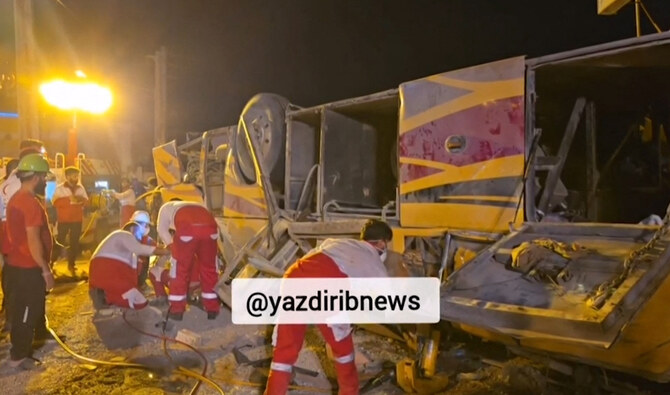
Rescuers work at the scene of a bus accident at Yazd province, Iran, in this still image taken from a video, August 21, 2024. (Reuters)
2 / 2
An image grab from footage obtained from Iranian State TV IRIB on August 21, 2024, shows Iranian first responders at the site of a bus crash in Iran's central Yazd province. (AFP / HO / IRIB NEWS)
Short Url
Updated 21 August 2024
Follow

Foreign office launches crisis management cell as Pakistani pilgrim bus overturns in Iran

  • Bus carrying Pakistanis overturned after a technical defect in the braking system, killing at least 35 and injuring 15
  • Bus was passing through Iran and full of pilgrims enroute to Iraq's Karbala Governorate for the Arbaeen pilgrimage

ISLAMABAD: The Pakistani foreign office activated a crisis management cell on Wednesday evening after at least 35 Pakistani religious tourists were killed in a bus accident near the Iranian city of Yazd. 

Pakistan’s state-run Radio Pakistan said the accident happened when the bus carrying Pakistani nationals overturned after a technical defect in the braking system, killing at least 35 and injuring 15. 

Millions of Shiite Muslims are currently partaking in the Arbaeen pilgrimage in Iraq’s Karbala Governorate. The event marks the 40th mourning following the martyrdom of Imam Hussein bin Ali, a central figure in Shiite Islam and the grandson of Prophet Muhammad. The bus carrying Pakistani pilgrims was also passing through Iran en route to Iraq. 

“The Ministry of Foreign Affairs has activated its Crisis Management Unit in view of the unfortunate road accident involving the deaths of Pakistani Zaireen [pilgrims] at Yazd in Iran,” Radio Pakistan reported. 

The contact details of the CMU are as: telephone: 051-9207887 and email: cmu1mofa.gov.pk . 

The Foreign Affairs Liaison Office in Karachi can also be contacted on 0300-9310095, 0332-7556633 and 0313-8957541, the foreign office said. 

Prime Minister Shehbaz Sharif meanwhile directed Pakistan’s mission in Tehran to extend all possible assistance to the affected families while President Asif Ali Zardari instructed the ministry of foreign affairs to arrange the repatriation of bodies and ensure timely assistance for the injured.

Iranian media said over 25,000 Pakistanis had entered Iran for an onward journey to Karbala. 

Every year, thousands of Pakistanis travel to Iran, Iraq and Syria to visit shrines and religious sites there. 


Pakistan opens real-time digital payment system to exchange companies as reserves edge up

Updated 5 sec ago
Follow

Pakistan opens real-time digital payment system to exchange companies as reserves edge up

  • Raast enables low-cost transfers between banks, microfinance firms and electronic money wallets
  • Pakistan’s overall foreign reserves stand at $21.25 billion as central bank holdings rise $16 million

KARACHI: Pakistan’s central bank on Thursday allowed exchange companies to route home remittances through its instant payment system, Raast, saying the move aims to promote digital transactions and improve the efficiency of inflows, as the country’s foreign exchange reserves rose modestly in the latest week.

The State Bank of Pakistan (SBP) said in a statement that the country's total liquid foreign reserves stood at $21.25 billion as of Jan. 9, while the central bank’s own reserves rose $16 million to $16.07 billion.

The statement said the decision to extend Raast to exchange companies forms part of the central bank’s broader push to strengthen digital payments infrastructure and support a shift toward a cashless economy.

“Building an innovative and inclusive digital financial services ecosystem is one of the key objectives of State Bank of Pakistan under its Strategic Plan 2023-2028,” the SBP said.

“In furtherance of this vision, SBP has now allowed Exchange Companies (ECs) to utilize ‘Raast,’ a state-of-the-art payment system launched by SBP in 2021, to facilitate remitters and beneficiaries of home remittances,” it added.

Raast, a real-time digital payment system, allows instant and low-cost transfers between banks, microfinance institutions and electronic money wallets.

“Through this enablement, the beneficiaries receiving remittances through ECs can receive their funds in their accounts and wallets ... in a safe and efficient manner,” the statement said.

Pakistan relies heavily on workers’ remittances from abroad and has been seeking to channel more inflows through formal banking systems by strengthening digital and regulated payment networks, as authorities try to curb informal mechanisms such as hawala and hundi, underground value transfer systems that move money outside the banking sector.