Pakistan’s Bank Alfalah in final stages to acquire Saudi shares in Samba Bank — Bloomberg

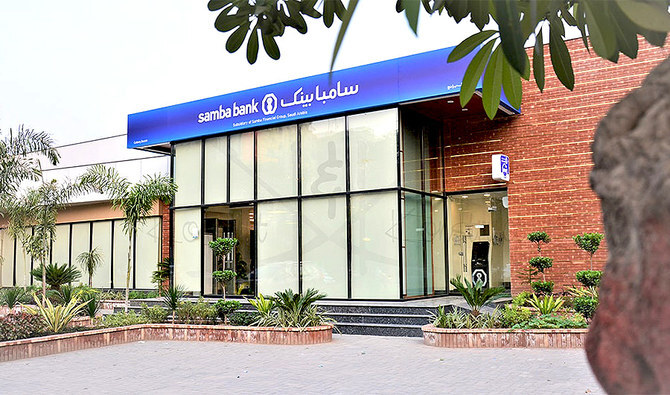
This undated photo shows regional branch of Samba Bank in Lahore, Pakistan. (Photo courtesy: Social media)
Short Url
Updated 20 August 2024
Follow

Pakistan’s Bank Alfalah in final stages to acquire Saudi shares in Samba Bank — Bloomberg

  • Bank Alfalah is Pakistan’s fourth largest lender by assets and is owned by UAE-headquartered Abu Dhabi Group
  • It has seen second fastest deposit growth in past five years among Pakistani banks, according to data from Bloomberg

ISLAMABAD: Pakistan’s Bank Alfalah Ltd. is open to further acquisitions to boost growth as the South Asian nation tries to emerge from a chronic economic crisis, Bloomberg reported this week, with the lender entering the final stages of reaching an agreement to acquire Saudi National Bank’s majority stake in Samba Bank Ltd.
Closing that deal should make Bank Alfalah a contender for future assets that go up for sale, Chief Executive Officer Atif Aslam Bajwa said in an interview to Bloomberg. 
“One-off opportunities will come by, and we want to be in play for that,” Bajwa said. “We’re looking for organic and inorganic growth.”
Bank Alfalah is Pakistan’s fourth largest lender by assets and is owned by United Arab Emirates-headquartered Abu Dhabi Group. It has seen the second fastest deposit growth in the past five years among Pakistani banks, according to data compiled by Bloomberg. 
That growth has come as its home country has been lurching from one loan to another from the International Monetary Fund to keep up with its debt payments that stand at about $26 billion for the year starting July. The nation expects the IMF’s executive board to approve a new $7 billion loan program later this month.
Pakistan has also asked China to “reprofile” some of its debts by extending the payment period to create more breathing room.
“The IMF program is paramount for the country to achieve because that will help in giving confidence to the rest of the world,” Bajwa said.
Pakistan’s central bank cut the policy rate by a cumulative 250 basis points in June and July from a record 22 percent. Inflation slumped from a record 38 percent in May 2023 to 11 percent in July.
The central bank’s efforts have been supportive to Pakistan’s equity markets, Bajwa said, noting that he expects interest rates to fall to single digits by 2025.
“The equity markets have been responding quite nicely,” he said. 
The benchmark KSE-100 Index has rallied 71 percent in dollar terms in the past year, making it the best performing stock market globally:
“Some foreign funds have started coming back into the market to give it some support.”


IMF Executive Board to review $1.2 billion loan disbursement for Pakistan today

Updated 4 sec ago
Follow

IMF Executive Board to review $1.2 billion loan disbursement for Pakistan today

  • Pakistan, IMF reached a Staff-Level Agreement in October for second review of $7 billion Extended Fund, climate fund program
  • Economists view IMF bailout packages as essential for cash-strapped Pakistan grappling with a prolonged macroeconomic crisis

ISLAMABAD: The Executive Board of the International Monetary Fund (IMF) is set to meet in Washington today to review a $1.2 billion loan disbursement for Pakistan, state media reported on Monday.

Pakistan and the IMF reached a Staff-Level Agreement (SLA) in October for the second review of a $7 billion Extended Fund Facility (EFF) and the first review of its $1.4 billion Resilience and Sustainability Facility (RSF). 

The agreement between the two sides took place after an IMF mission, led by the international lender’s representative Iva Petrova, held discussions with Pakistani authorities during a Sept. 24–Oct. 8 visit to Karachi, Islamabad and Washington D.C.

“The International Monetary Fund’s (IMF) Executive Board is set to meet in Washington today to review and approve $1.2 billion in loan for Pakistan,” state broadcaster Pakistan TV reported. 

Pakistan has been grappling with a prolonged macroeconomic crisis that has drained its financial resources and triggered a balance of payments crisis for the past couple of years. Islamabad, however, has reported some financial gains since 2022, which include recording a surplus in its current account and bringing inflation down considerably.

Economists view the IMF’s bailout packages as crucial for cash-strapped Pakistan, which has relied heavily on financing from bilateral partners such as Saudi Arabia, China and the United Arab Emirates, as well as multilateral lenders including the IMF, World Bank, Asian Development Bank and Islamic Development Bank. 

Speaking to Arab News last month, Pakistan’s former finance adviser Khaqan Najeeb said the $1.2 billion disbursement will further stabilize Pakistan’s near-term external position and unlock additional official inflows.

“Continued engagement also reinforces macro stability, as reflected in recent improvements in inflation, the current account, and reserve buffers,” Najeeb said.

Pakistan came close to sovereign default in mid-2023, when foreign exchange reserves fell below three weeks of import cover, inflation surged to a record 38% in May, and the country struggled to secure external financing after delays in its IMF program. Fuel shortages, import restrictions, and a rapidly depreciating rupee added to the pressure, while ratings agencies downgraded Pakistan’s debt and warned of heightened default risk.

The crisis eased only after Pakistan reached a last-minute Stand-By Arrangement with the IMF in June 2023, unlocking emergency support and preventing an immediate default.