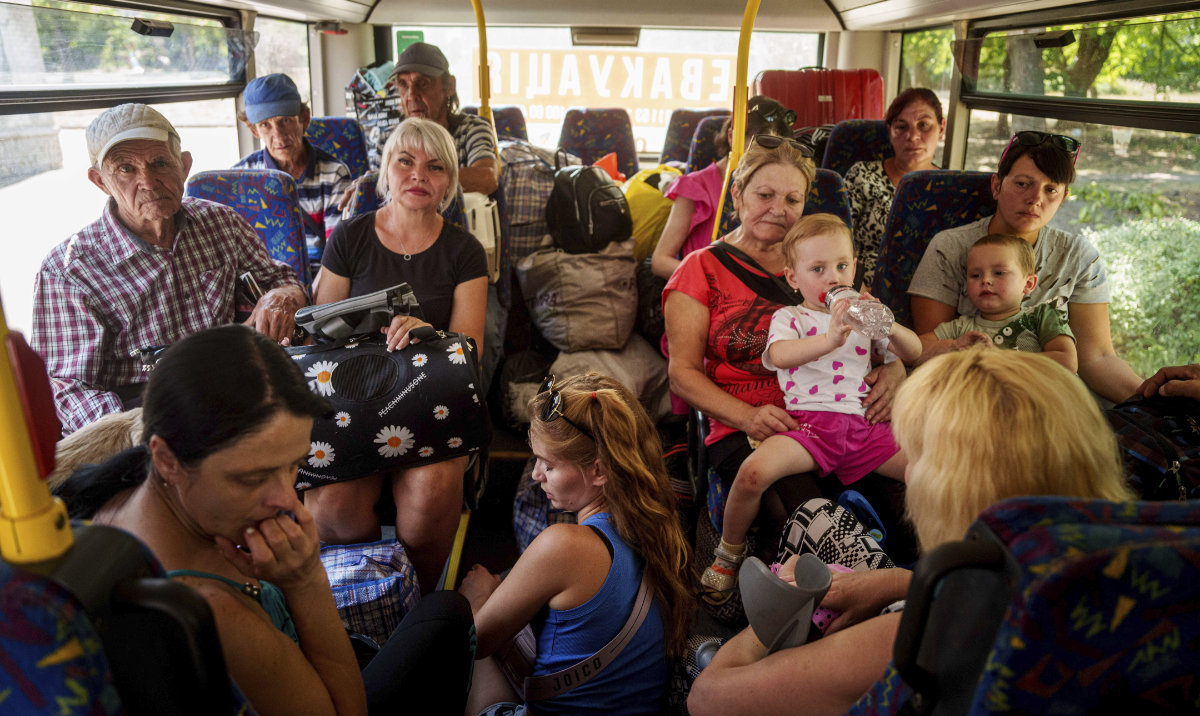
POKROVSK, Ukraine: Civilians with small children in their arms and lugging heavy suitcases fled Monday from Ukraine’s eastern city of Pokrovsk, where the Russian army was bearing down fast despite a lightning Ukrainian incursion into Russia’s Kursk region.
Local authorities said Russian forces were advancing so quickly that families were under orders to leave the city and other nearby towns and villages starting Tuesday. Around 53,000 people still live in Pokrovsk, officials said, and some of them decided to get out immediately.
People of all ages boarded trains and buses with the belongings they could carry. Some wept as they waited to depart. Soldiers helped the elderly with their bags, and volunteers helped people with disabilities. Rail workers wore bulletproof vests.
Natalya Ivaniuk said the noise of explosions from Russian bombardments filled the air while she and her daughters, age 7 and 9, fled their home in the nearby village of Myrnohrad, which is less than 10 kilometers (6 miles) from the front line.
“It was terrifyingly scary,” she told The Associated Press. “We barely got out.”
Pokrovsk is one of Ukraine’s main defensive strongholds and a key logistics hub in the Donetsk region. Its capture would compromise Ukraine’s defensive abilities and supply routes and would bring Russia closer to its stated aim of capturing the entire Donetsk region.
One of Kyiv’s attempts to ease the pressure on its eastern front was the unexpected Aug. 6 incursion into Russia’s Kursk region, which among other goals aimed to unnerve the Kremlin and compel it to split its military resources.
Ukrainian President Volodymyr Zelensky said Sunday the daring incursion is trying to create a buffer zone that might prevent further attacks by Moscow across the border, especially with long-range artillery, missiles and glide bombs.
In a social media statement, Zelensky said Monday evening that Ukraine currently controlled 1,250 square kilometers (about 480 square miles) and 92 settlements inside the Kursk region.
“The Russian border area opposite our Sumy region has been mostly cleared of Russian military presence,” he said. “Now, our warriors’ real success speaks for itself. Our defensive actions across the border, as well as Putin’s inability to defend his territory, are telling. Our proactive defense is the most effective counter to Russian terror, causing significant difficulties for the aggressor.”
Russia’s relentless six-month slog across Ukraine’s Donetsk region following the capture of Avdiivka has cost it heavily in troops and armor. However, the onslaught has gradually paid dividends as Ukrainian defenders have no choice but to pull back from positions blown to pieces by Russian artillery, missiles and bombs.
“There is a lot of destruction around us, so it becomes more and more scary to stay,” said Tetiana Myronenko, 57, who came from Selydove just 5 kilometers (3 miles) from the front line.
She sat next to her husband in the car of a train waiting to leave Pokrovsk. It was bound for Lviv, hundreds of kilometers (miles) away in western Ukraine.
Russia wants control of all parts of Donetsk and neighboring Luhansk, which together make up the Donbas industrial region.
Officials warned last week that Russian forces were rapidly advancing and were just 10 kilometers (6 miles) from the outskirts of Pokrovsk.
Oleksandr Syrskyi, Ukraine’s Commander-in-Chief, said Monday that “heavy battles” were taking place in the Pokrovsk area.
The nearby town of Toretsk, whose capture would open the door for a Russian advance on the key stronghold of Chasiv Yar from the south, is also under heavy pressure, he said.
The Institute for the Study of War said Russian forces have been advancing roughly two square kilometers (0.8 square miles) per day in the Pokrovsk region over the past six months.
They have relied on frontal infantry assaults from village to village, notching incremental progress as they make their manpower and materiel advantages tell, the Washington-based think tank said late Sunday.
Pokrovsk officials were meeting with residents to provide them with logistical details on the evacuation. People were offered shelter in western Ukraine, where they will be hosted in dormitories and separate houses prepared for them.
In other developments:
A pregnant woman was killed and 10 others were wounded by Ukrainian shelling in the Russian-occupied city of Donetsk, the region’s Moscow-installed head Denis Pushilin said on social media. Two children were among the injured, he said.
In the Russian city of Proletarsk, about 270 kilometers (170 miles) from the Ukraine border, 41 firefighters needed medical attention, and 18 of them were hospitalized, in a fire at a warehouse that was started by debris from an intercepted drone, regional Gov. Vasily Golubev said.
Civilians flee Pokrovsk as Russia’s army bears down on the key eastern Ukraine city