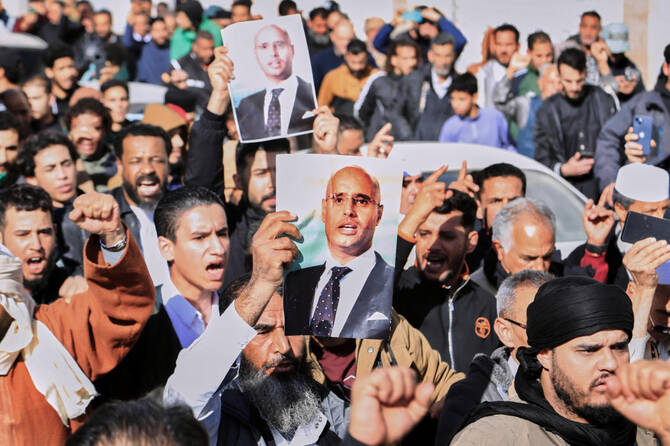
BANI WALID, Libya: Thousands converged on Friday in northwestern Libya for the funeral of Seif Al-Islam Qaddafi, the son and one-time heir apparent of Libya’s late leader Muammar Qaddafi, who was killed earlier this week when four masked assailants stormed into his home and fatally shot him.
Mourners carried his coffin in the town of Bani Walid, 146 kilometers (91 miles) southeast of the capital, Tripoli, as well as large photographs of both Seif Al-Islam, who was known mostly by his first name, and his father.
The crowd also waved plain green flags, Libya’s official flag from 1977 to 2011 under Qaddafi, who ruled the country for more than 40 years before being toppled in a NATO-backed popular uprising in 2011. Qaddafi was killed later that year in his hometown of Sirte as fighting in Libya escalated into a full-blown civil war.
As the funeral procession got underway and the crowds swelled, a small group of supporters took Seif Al-Islam’s coffin away and later performed the funeral prayers and buried him.
Attackers at his home
Seif Al-Islam, 53, was killed on Tuesday inside his home in the town of Zintan, 136 kilometers (85 miles) southwest of the capital, Tripoli, according to Libyan’s chief prosecutor’s office.
Authorities said an initial investigation found that he was shot to death but did not provide further details. Seif Al-Islam’s political team later released a statement saying “four masked men” had stormed his house and killed him in a “cowardly and treacherous assassination,” after disabling security cameras.
Seif Al-Islam was captured by fighters in Zintan late in 2011 while trying to flee to neighboring Niger. The fighters released him in June 2017, after one of Libya’s rival governments granted him amnesty.
“The pain of loss weighs heavily on my heart, and it intensifies because I can’t bid him farewell from within my homeland — a pain that words can’t ease,” Seif Al-Islam’s brother Mohamed Qaddafi, who lives in exile outside Libya though his current whereabouts are unknown, wrote on Facebook on Friday.
“But my solace lies in the fact that the loyal sons of the nation are fulfilling their duty and will give him a farewell befitting his stature,” the brother wrote.
Since the uprising that toppled Qaddafi, Libya plunged into chaos during which the oil-rich North African country split, with rival administrations now in the east and west, backed by various armed groups and foreign governments.
Qaddafi’s heir-apparent
Seif Al-Islam was Qaddafi’s second-born son and was seen as the reformist face of the Qaddafi regime — someone with diplomatic outreach who had worked to improve Libya’s relations with Western countries up until the 2011 uprising.
The United Nations imposed sanctions on Seif Al-Islam that included a travel ban and an assets freeze for his inflammatory public statements encouraging violence against anti-Qaddafi protesters during the 2011 uprising. The International Criminal Court later charged him with crimes against humanity related to the 2011 uprising.
In July 2021, Seif Al-Islam told the New York Times that he’s considering returning to Libya’s political scene after a decade of absence during which he observed Middle East politics and reportedly reorganized his father’s political supporters.
He condemned the country’s new leaders. “There’s no life here. Go to the gas station — there’s no diesel,″ Seif Al-Islam told the Times.
In November 2021, he announced his candidacy in the country’s presidential election in a controversial move that was met with outcry from anti-Qaddafi political forces in western and eastern Libya.
The country’s High National Elections Committee disqualified him, but the election wasn’t held over disputes between rival administrations and armed groups.

Thousands of Libyans gather for the funeral of Qaddafi’s son who was shot and killed this week
Short Url
https://arab.news/8ejs9
Thousands of Libyans gather for the funeral of Qaddafi’s son who was shot and killed this week
- As the funeral procession got underway and the crowds swelled, a small group of supporters took Seif Al-Islam’s coffin away and later performed the funeral prayers and buried him
- Authorities said an initial investigation found that he was shot to death but did not provide further details
Palestinians in the West Bank struggle to get by as Israel severely limits work permits
- Many Palestinians in the occupied West Bank are struggling to get by after losing their permits to work inside Israel
- Israel revoked around 100,000 permits after Hamas’ Oct. 7, 2023, attack ignited the war in the Gaza Strip
TULKAREM, West Bank: Hanadi Abu Zant hasn’t been able to pay rent on her apartment in the occupied West Bank for nearly a year after losing her permit to work inside Israel. When her landlord calls the police on her, she hides in a mosque.
“My biggest fear is being kicked out of my home. Where will we sleep, on the street?” she said, wiping tears from her cheeks.
She is among some 100,000 Palestinians whose work permits were revoked after Hamas’ Oct. 7, 2023, attack ignited the war in the Gaza Strip. Confined to the occupied territory, where jobs are scarce and wages far lower, they face dwindling and dangerous options as the economic crisis deepens.
Some have sold their belongings or gone into debt as they try to pay for food, electricity and school expenses for their children. Others have paid steep fees for black-market permits or tried to sneak into Israel, risking arrest or worse if they are mistaken for militants.
Israel, which has controlled the West Bank for nearly six decades, says it is under no obligation to allow Palestinians to enter for work and makes such decisions based on security considerations. Thousands of Palestinians are still allowed to work in scores of Jewish settlements across the West Bank, built on land they want for a future state.
Risk of collapse
The World Bank has warned that the West Bank economy is at risk of collapse because of Israel’s restrictions. By the end of last year, unemployment had surged to nearly 30 percent compared with around 12 percent before the war, according to the Palestinian Central Bureau of Statistics.
Before the war, tens of thousands of Palestinians worked inside Israel, mainly in construction and service jobs. Wages can be more than double those in the landlocked West Bank, where decades of Israeli checkpoints, land seizures and other restrictions have weighed heavily on the economy. Palestinians also blame the Palestinian Authority, which exercises limited self-rule in parts of the territory, for not doing enough to create jobs.
About 100,000 Palestinians had work permits that were revoked after the outbreak of the war. Israel has since reinstated fewer than 10,000, according to Gisha, an Israeli group advocating for Palestinian freedom of movement.
Wages earned in Israel injected some $4 billion into the Palestinian economy in 2022, according to the Institute for National Security Studies, an Israeli think tank. That’s equivalent to about two-thirds of the Palestinian Authority’s budget that year.
An Israeli official said Palestinians do not have an inherent right to enter Israel, and that permits are subject to security considerations. The official spoke on condition of anonymity in line with regulations.
Israel seized the West Bank, Gaza and east Jerusalem in the 1967 Mideast war, territories the Palestinians want for a future state. Some 3 million Palestinians live in the West Bank, along with over 500,000 Israeli settlers who can come and go freely.
The war in Gaza has brought a spike in Palestinian attacks on Israelis as well as settler violence. Military operations that Israel says are aimed at dismantling militant groups have caused heavy damage in the West Bank and displaced tens of thousands of Palestinians.
‘My refrigerator, it’s empty’
After her husband left her five years ago, Abu Zant secured a job at a food-packing plant in Israel that paid around $1,400 a month, enough to support her four children. When the war erupted, she thought the ban would only last a few months. She baked pastries for friends to scrape by.
Hasan Joma, who ran a business in Tulkarem before the war helping people find work in Israel, said Palestinian brokers are charging more than triple the price for a permit.
While there are no definite figures, tens of thousands of Palestinians are believed to be working illegally in Israel, according to Esteban Klor, professor of economics at Israel’s Hebrew University and a senior researcher at the INSS. Some risk their lives trying to cross Israel’s separation barrier, which consists of 9-meter high (30-foot) concrete walls, fences and closed military roads.
Shuhrat Barghouthi’s husband has spent five months in prison for trying to climb the barrier to enter Israel for work, she said. Before the war, the couple worked in Israel earning a combined $5,700 a month. Now they are both unemployed and around $14,000 in debt.
“Come and see my refrigerator, it’s empty, there’s nothing to feed my children,” she said. She can’t afford to heat her apartment, where she hasn’t paid rent in two years. She says her children are often sick and frequently go to bed hungry.
Sometimes she returns home to see her belongings strewn in the street by the landlord, who has been trying to evict them.
Forced to work in settlements
Of the roughly 48,000 Palestinians who worked in Israeli settlements before the war, more than 65 percent have kept their permits, according to Gisha. The Palestinians and most of the international community view the settlements, which have rapidly expanded in recent years, as illegal.
Israeli officials did not respond to questions about why more Palestinians are permitted to work in the settlements.
Palestinians employed in the settlements, speaking on condition of anonymity for fear of retribution, say their employers have beefed up security since the start of the war and are far more willing to fire anyone stepping out of line, knowing there are plenty more desperate for work.
Two Palestinians working in the Mishor Adumim settlement said security guards look through workers’ phones and revoke their permits arbitrarily.
Israelis have turned to foreign workers to fill jobs held by Palestinians, but some say it’s a poor substitute because they cost more and do not know the language. Palestinians speak Arabic, but those who work in Israel are often fluent in Hebrew.
Raphael Dadush, an Israeli developer, said the permit crackdown has resulted in costly delays.
Before the war, Palestinians made up more than half his workforce. He’s tried to replace them with Chinese workers but says it’s not exactly the same. He understands the government’s decision, but says it’s time to find a way for Palestinians to return that ensures Israel’s security.
Assaf Adiv, the executive director of an Israeli group advocating for Palestinian labor rights, says there has to be some economic integration or there will be “chaos.”
“The alternative to work in Israel is starvation and desperation,” he said.
“My biggest fear is being kicked out of my home. Where will we sleep, on the street?” she said, wiping tears from her cheeks.
She is among some 100,000 Palestinians whose work permits were revoked after Hamas’ Oct. 7, 2023, attack ignited the war in the Gaza Strip. Confined to the occupied territory, where jobs are scarce and wages far lower, they face dwindling and dangerous options as the economic crisis deepens.
Some have sold their belongings or gone into debt as they try to pay for food, electricity and school expenses for their children. Others have paid steep fees for black-market permits or tried to sneak into Israel, risking arrest or worse if they are mistaken for militants.
Israel, which has controlled the West Bank for nearly six decades, says it is under no obligation to allow Palestinians to enter for work and makes such decisions based on security considerations. Thousands of Palestinians are still allowed to work in scores of Jewish settlements across the West Bank, built on land they want for a future state.
Risk of collapse
The World Bank has warned that the West Bank economy is at risk of collapse because of Israel’s restrictions. By the end of last year, unemployment had surged to nearly 30 percent compared with around 12 percent before the war, according to the Palestinian Central Bureau of Statistics.
Before the war, tens of thousands of Palestinians worked inside Israel, mainly in construction and service jobs. Wages can be more than double those in the landlocked West Bank, where decades of Israeli checkpoints, land seizures and other restrictions have weighed heavily on the economy. Palestinians also blame the Palestinian Authority, which exercises limited self-rule in parts of the territory, for not doing enough to create jobs.
About 100,000 Palestinians had work permits that were revoked after the outbreak of the war. Israel has since reinstated fewer than 10,000, according to Gisha, an Israeli group advocating for Palestinian freedom of movement.
Wages earned in Israel injected some $4 billion into the Palestinian economy in 2022, according to the Institute for National Security Studies, an Israeli think tank. That’s equivalent to about two-thirds of the Palestinian Authority’s budget that year.
An Israeli official said Palestinians do not have an inherent right to enter Israel, and that permits are subject to security considerations. The official spoke on condition of anonymity in line with regulations.
Israel seized the West Bank, Gaza and east Jerusalem in the 1967 Mideast war, territories the Palestinians want for a future state. Some 3 million Palestinians live in the West Bank, along with over 500,000 Israeli settlers who can come and go freely.
The war in Gaza has brought a spike in Palestinian attacks on Israelis as well as settler violence. Military operations that Israel says are aimed at dismantling militant groups have caused heavy damage in the West Bank and displaced tens of thousands of Palestinians.
‘My refrigerator, it’s empty’
After her husband left her five years ago, Abu Zant secured a job at a food-packing plant in Israel that paid around $1,400 a month, enough to support her four children. When the war erupted, she thought the ban would only last a few months. She baked pastries for friends to scrape by.
Hasan Joma, who ran a business in Tulkarem before the war helping people find work in Israel, said Palestinian brokers are charging more than triple the price for a permit.
While there are no definite figures, tens of thousands of Palestinians are believed to be working illegally in Israel, according to Esteban Klor, professor of economics at Israel’s Hebrew University and a senior researcher at the INSS. Some risk their lives trying to cross Israel’s separation barrier, which consists of 9-meter high (30-foot) concrete walls, fences and closed military roads.
Shuhrat Barghouthi’s husband has spent five months in prison for trying to climb the barrier to enter Israel for work, she said. Before the war, the couple worked in Israel earning a combined $5,700 a month. Now they are both unemployed and around $14,000 in debt.
“Come and see my refrigerator, it’s empty, there’s nothing to feed my children,” she said. She can’t afford to heat her apartment, where she hasn’t paid rent in two years. She says her children are often sick and frequently go to bed hungry.
Sometimes she returns home to see her belongings strewn in the street by the landlord, who has been trying to evict them.
Forced to work in settlements
Of the roughly 48,000 Palestinians who worked in Israeli settlements before the war, more than 65 percent have kept their permits, according to Gisha. The Palestinians and most of the international community view the settlements, which have rapidly expanded in recent years, as illegal.
Israeli officials did not respond to questions about why more Palestinians are permitted to work in the settlements.
Palestinians employed in the settlements, speaking on condition of anonymity for fear of retribution, say their employers have beefed up security since the start of the war and are far more willing to fire anyone stepping out of line, knowing there are plenty more desperate for work.
Two Palestinians working in the Mishor Adumim settlement said security guards look through workers’ phones and revoke their permits arbitrarily.
Israelis have turned to foreign workers to fill jobs held by Palestinians, but some say it’s a poor substitute because they cost more and do not know the language. Palestinians speak Arabic, but those who work in Israel are often fluent in Hebrew.
Raphael Dadush, an Israeli developer, said the permit crackdown has resulted in costly delays.
Before the war, Palestinians made up more than half his workforce. He’s tried to replace them with Chinese workers but says it’s not exactly the same. He understands the government’s decision, but says it’s time to find a way for Palestinians to return that ensures Israel’s security.
Assaf Adiv, the executive director of an Israeli group advocating for Palestinian labor rights, says there has to be some economic integration or there will be “chaos.”
“The alternative to work in Israel is starvation and desperation,” he said.
© 2026 SAUDI RESEARCH & PUBLISHING COMPANY, All Rights Reserved And subject to Terms of Use Agreement.


