CHICAGO: Police arrested 13 people and added additional security fences at a Chicago park where protesters clashed with officers near the site of the Democratic National Convention ahead of a second day of planned protests Tuesday, including one outside the Israeli Consulate.
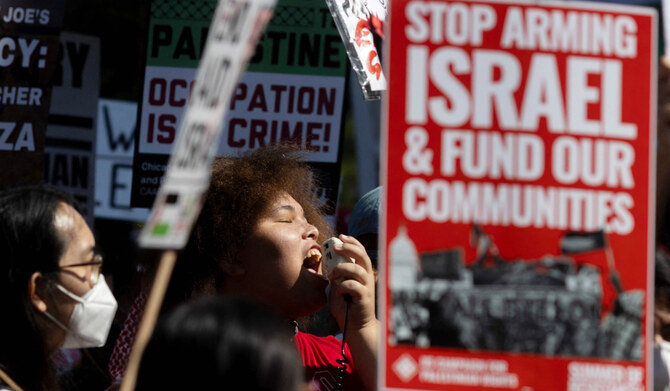
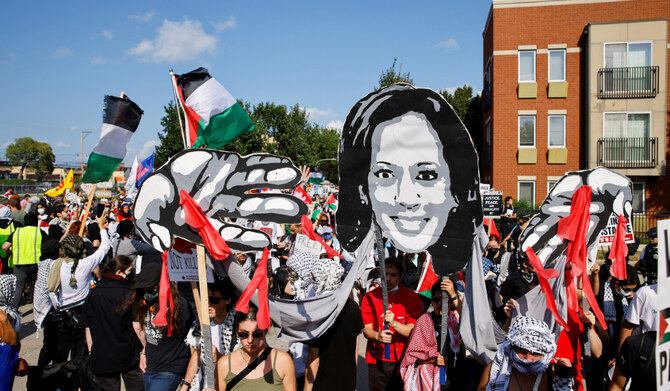
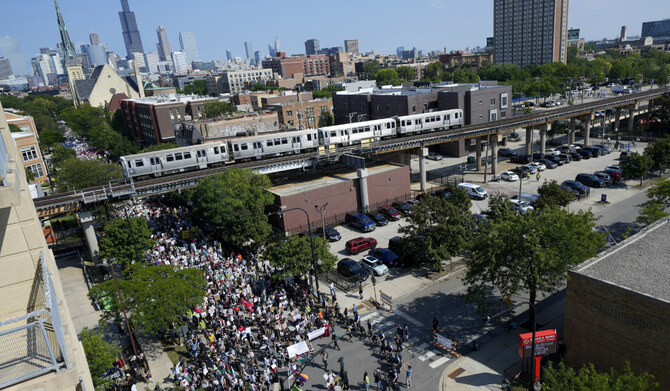
The park, located a block from the convention arena, served as a destination point for a march of thousands calling for a ceasefire in the Israel-Hamas war. Several dozen activists broke off from the main group, breached the fencing, and were pushed back by police.
The 13 people arrested during Monday’s protest were detained on charges ranging from criminal trespass and resisting and obstructing an arrest to aggravated battery of police officers, Chicago Police Superintendent Larry Snelling said at a news conference Tuesday.
At least 10 of them were arrested in connection with the fence, he said.
Snelling said he did not connect the “brief breach” of security fencing “within sight and sound of the United Center” with the entirety of the march. He said the vast majority of participants were peaceful, and he praised his officers’ conduct in the moment.
“Our officers showed great restraint,” he said. “We’re not going to tolerate vandalism and violence in our city. ... We’re going to continue to protect the city.”
Snelling said some protesters used pepper spray against officers at the site where they broke through the fence. He said officers did not use any chemical sprays.
The Chicago chapter of the National Lawyers Guild said two of the people arrested were hospitalized. Snelling said they were taken to the hospital to ensure they would receive medication they were taking.
Two people were also arrested on misdemeanor property damage and resisting arrest charges during a protest march Sunday night.
Authorities said the inner security perimeter surrounding the United Center was not breached and there was no threat to those attending the convention.
On Tuesday morning, an extra line of fencing was installed at the park, and the tall metal barriers were reinforced to prevent protesters from lifting and removing the panels in the future. No police officers or protesters were present at the park early Tuesday.
Organizers had hoped at least 20,000 people would take part in Monday’s rally and march, but Snelling said about 3,500 people participated.
Snelling said more protests are expected as the week goes on, and his department is prepared to de-escalate situations whenever possible.
“Again, we’re up to the challenge,” he said. “The city is up to the challenge.”
Closer to downtown Chicago, security was tighter than usual — including law enforcement officers with weapons slung across their bodies — outside the office building that houses the Israeli Consulate and a major city transportation hub. Metal barricades were set up, and an officer said they were preparing for a 7 p.m. demonstration.
The consulate, located about two miles from the United Center, has been the site of numerous demonstrations since the war in Gaza began in October. It is in a building connected to the Ogilvie Transportation Center, a major commuter rail station.
Most of the largest demonstrations have been organized by the Coalition to March on the DNC, which has focused on calling for a ceasefire in Gaza. But smaller protests have popped up around the city, including disruptions at the convention’s welcome party at Navy Pier.


![]()
![]()
![]()
![]()
![]()


13 protesters arrested during first day of Democratic National Convention in Chicago


Short Url
https://arab.news/vabk9
13 protesters arrested during first day of Democratic National Convention in Chicago
- Organizers had hoped at least 20,000 people would take part in Monday’s rally and march, but Snelling said about 3,500 people participated


Rubio to lead US delegation to Munich Security Conference, chairman says
- More than 50 members of the US Congress are also expected, alongside the governors of Michigan and California, former diplomat and conference chairman Wolfgang Ischinger
BERLIN: US Secretary of State Marco Rubio will lead “a sizeable delegation” of US officials to the Munich Security Conference this weekend, the head of the annual gathering of security experts and policymakers said on Monday.
More than 50 members of the US Congress are also expected, alongside the governors of Michigan and California, former diplomat and conference chairman Wolfgang Ischinger told a news conference in Berlin.
“At the moment, transatlantic relations are, in my view, in a considerable crisis of trust and credibility,” he said. “That is why it is particularly gratifying that the American side is showing such strong interest in Munich.”
More than 50 members of the US Congress are also expected, alongside the governors of Michigan and California, former diplomat and conference chairman Wolfgang Ischinger told a news conference in Berlin.
“At the moment, transatlantic relations are, in my view, in a considerable crisis of trust and credibility,” he said. “That is why it is particularly gratifying that the American side is showing such strong interest in Munich.”
Latest updates


Recommended


© 2026 SAUDI RESEARCH & PUBLISHING COMPANY, All Rights Reserved And subject to Terms of Use Agreement.