PIA reduces fares for Karachi to Jeddah and Madinah flights by 30 percent

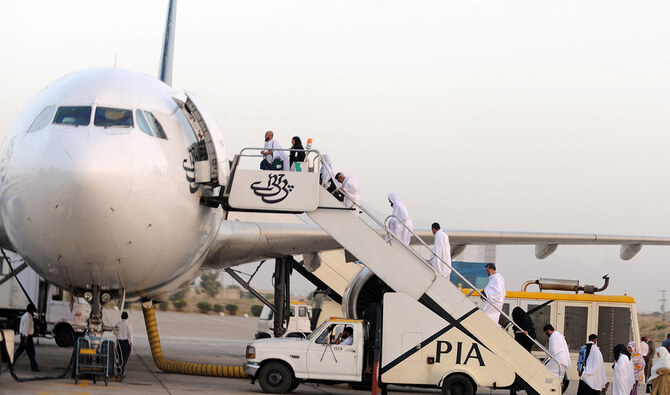
Pakistani Muslims board a Pakistan International Airlines (PIA) aircraft to Mecca in Saudi Arabia, for the annual Hajj pilgrimage from Quetta International airport in Quetta on September 30, 2011. (AFP/File)
Short Url
Updated 19 August 2024
Follow

PIA reduces fares for Karachi to Jeddah and Madinah flights by 30 percent

  • The announcement comes amid an ongoing Umrah pilgrimage season which began in July
  • Thousands of Pakistanis travel to Saudi Arabia each month to perform the Umrah pilgrimage

ISLAMABAD: The Pakistan International Airlines (PIA) has reduced fares for its flights from Karachi to the Saudi cities of Jeddah and Madinah by 30 percent, a PIA spokesperson said on Monday.
After the reduction, a one-way ticket from Karachi to Jeddah or Madinah will cost Rs56,000 ($201), including tax, according to the PIA spokesperson.
A return ticket from Karachi to any of the two Saudi cities will cost Rs88,000 ($316), inclusive of tax. The new fares have already taken effect.
“Discounted fare tickets can be issued till August 31,” the spokesperson said. “Travel on discounted fare is limited till September 30.”
The announcement comes amid an ongoing Umrah season, which began in July. Umrah is a voluntary Islamic pilgrimage to the Islamic sites in Saudi Arabia. A shorter version of the Hajj, it is voluntary and can be performed throughout the year.
Thousands of Pakistanis travel to Saudi Arabia each month to visit the holy sites in Makkah and Madinah for the Umrah pilgrimage.
Last month, Pakistan’s national flag carrier announced direct Umrah flights to Jeddah from the Pakistani cities of Quetta and Faisalabad in a bid to facilitate pilgrims. The flights began on August 6.


Pakistan terms climate change, demographic pressures as ‘pressing existential risks’

Updated 06 December 2025
Follow

Pakistan terms climate change, demographic pressures as ‘pressing existential risks’

  • Pakistan has suffered frequent climate change-induced disasters, including floods this year that killed over 1,000
  • Pakistan finmin highlights stabilization measures at Doha Forum, discusses economic cooperation with Qatar 

ISLAMABAD: Pakistan’s Finance Minister Muhammad Aurangzeb on Saturday described climate change and demographic pressures as “pressing existential risks” facing the country, calling for urgent climate financing. 

The finance minister was speaking as a member of a high-level panel at the 23rd edition of the Doha Forum, which is being held from Dec. 6–7 in the Qatari capital. Aurangzeb was invited as a speaker on the discussion titled: ‘Global Trade Tensions: Economic Impact and Policy Responses in MENA.’

“He reaffirmed that while Pakistan remained vigilant in the face of geopolitical uncertainty, the more pressing existential risks were climate change and demographic pressures,” the Finance Division said. 

Pakistan has suffered repeated climate disasters in recent years, most notably the 2022 super-floods that submerged one-third of the country, displaced millions and caused an estimated $30 billion in losses. 

This year’s floods killed over 1,000 people and caused at least $2.9 billion in damages to agriculture and infrastructure. Scientists say Pakistan remains among the world’s most climate-vulnerable nations despite contributing less than 1 percent of global greenhouse-gas emissions.

Aurangzeb has previously said climate change and Pakistan’s fast-rising population are the only two factors that can hinder the South Asian country’s efforts to become a $3 trillion economy in the future. 

The finance minister noted that this year’s floods in Pakistan had shaved at least 0.5 percent off GDP growth, calling for urgent climate financing and investment in resilient infrastructure. 

When asked about Pakistan’s fiscal resilience and capability to absorb external shocks, Aurangzeb said Islamabad had rebuilt fiscal buffers. He pointed out that both the primary fiscal balance and current account had returned to surplus, supported significantly by strong remittance inflows of $18–20 billion annually from the Middle East and North Africa (MENA) and Gulf Cooperation Council (GCC) regions. 

Separately, Aurangzeb met his Qatari counterpart Ali Bin Ahmed Al Kuwari to discuss bilateral cooperation. 

“Both sides reaffirmed their commitment to strengthening economic ties, particularly by maximizing opportunities created through the newly concluded GCC–Pakistan Free Trade Agreement, expanding trade flows, and deepening energy cooperation, including long-term LNG collaboration,” the finance ministry said. 

The two also discussed collaboration on digital infrastructure, skills development and regulatory reform. They agreed to establish structured mechanisms to continue joint work in trade diversification, technology, climate resilience, and investment facilitation, the finance ministry said.