Libya’s central bank resumes operations after abducted official’s release

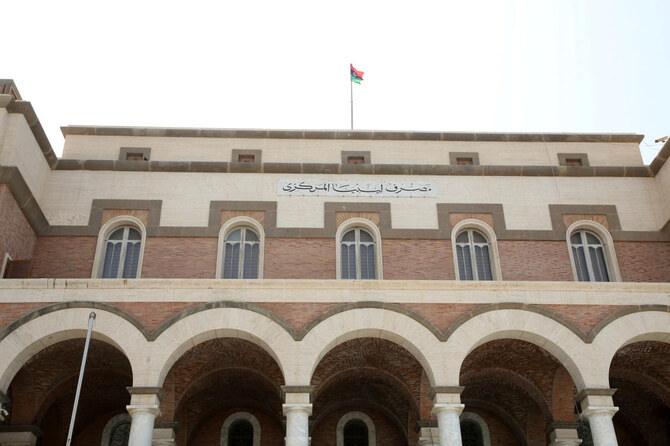
A view of the Central Bank of Libya in Tripoli, Libya September 1, 2021. (Reuters)
Short Url
Updated 19 August 2024
Follow

Libya’s central bank resumes operations after abducted official’s release

  • Central Bank is the repository for billions of dollars annually in oil revenue as well as foreign reserves

TRIPOLI: Libya’s central bank said on Monday it was resuming its operations following the release of a bank official who had been abducted earlier.
The Central Bank of Libya stated that it was “resuming operations” after the release of Musab Msallem, its head of information technology, “and his safe return.”
Msallem was abducted from his house on Sunday morning by an “unidentified group,” the bank had said, adding it would “suspend all operations” until his release.
The bank had also called for an “end to these practices” and blamed “unlawful parties” that “threaten the safety of its employees and the continuity of the banking sector’s work.”

BACKGROUND

Musab Msallem’s abduction came a week after the central bank’s headquarters in Tripoli was besieged by armed men before they dispersed.

Msallem’s abduction came a week after the central bank’s headquarters in Tripoli was besieged by armed men before they dispersed, according to reports.
Local media said they did so to force the resignation of the bank’s governor, Seddik Al-Kabir.


Seddik Al-Kabir. (Supplied)

Since 2012, Al-Kabir has faced criticism — including from figures close to Prime Minister Abdul Hamid Dbeibah — over the management of Libya’s oil resources and the state budget.
During a meeting last week in Tunisia with US Ambassador to Libya Richard Norland, Al-Kabir said there were “growing threats to the security” of the bank and its employees.
In a post on X, Norland later said that attempts to oust Al-Kabir were “unacceptable” and warned that replacing him “by force can result in Libya losing access to international financial markets.”
Norland said the confrontation in Tripoli “highlights the ongoing risks posed by the political stalemate in Libya.”
Home to 6.8 million people, Libya has struggled to recover from years of conflict after the 2011 uprising.
It remains divided between a UN-recognized government based in the capital, Tripoli, and led by Dbeibah, and a rival administration in the east, backed by military leader Khalifa Haftar.
Although relative calm has returned in recent years, clashes still periodically break out between Libya’s myriad armed groups.
Msallem’s abduction came as rising tensions between rival factions have stirred fears of a broader escalation in recent weeks.


Slain son of former Libya ruler Qaddafi to be buried near capital

Updated 9 sec ago
Follow

Slain son of former Libya ruler Qaddafi to be buried near capital

TRIPOLI: The slain son of former Libyan ruler Muammar Qaddafi will be buried in a town south of the capital that remains loyal to the family, relatives said Thursday.
Seif Al-Islam Qaddafi, once seen by some as Libya’s heir apparent, was shot dead on Tuesday in the northwestern city of Zintan.
The burial will be held on Friday in the town of Bani Walid some 175 kilometers south of Tripoli, two of his brothers said.
“The date and location of his burial have been decided by mutual agreement among the family,” half-brother Mohamed Qaddafi said in a Facebook post.
Mohamed said the plan reflected “our respect” for the town, which has remained loyal to the elder Qaddafi years after he was toppled and killed in the 2011 Arab Spring uprisings.
Each year, the town of about 100,000 celebrates the anniversary of a 1969 coup that brought Muammar to power, parading through the streets holding the ex-leader’s portrait.
Saadi Qaddafi, a younger brother, said his dead sibling will be “buried among the Werfalla,” an influential local tribe, in a grave next to his brother Khamis Qaddafi, who died during the 2011 unrest.
Marcel Ceccaldi, a French lawyer who had been representing Seif Al-Islam, told AFP he was killed by an unidentified “four-man commando” who stormed his house on Tuesday.
Seif Al-Islam had long been widely seen as his father’s heir. Under the elder Qaddafi’s iron-fisted 40-year rule, he was described as the de facto prime minister, cultivating an image of moderation and reform despite holding no official position.
But that reputation soon collapsed when he promised “rivers of blood” in retaliation for the 2011 uprising.
He was arrested that year on a warrant issued by the International Criminal Court for alleged crimes against humanity, and a Tripoli court later sentenced him to death, although he was later granted amnesty.
In 2021 he announced he would run for president but the elections were indefinitely postponed.
He is survived by four out of six siblings: Mohamed, Saadi, Aicha and Hannibal, who was recently released from a Lebanese prison on bail.
Libya has struggled to recover from chaos that erupted after the 2011 uprising. It remains split between a UN-backed government based in Tripoli and an eastern administration backed by Khalifa Haftar.