TRIPOLI: Reemerging bloodshed and power struggles in Libya have raised fears of a broader escalation, threatening to deal a fatal blow to the UN-brokered political transition and push the war-torn country deeper into turmoil.
The vast North African country of 6.8 million people has struggled to recover from years of conflict after the 2011 NATO-backed uprising that overthrew longtime dictator Muammar Qaddafi.
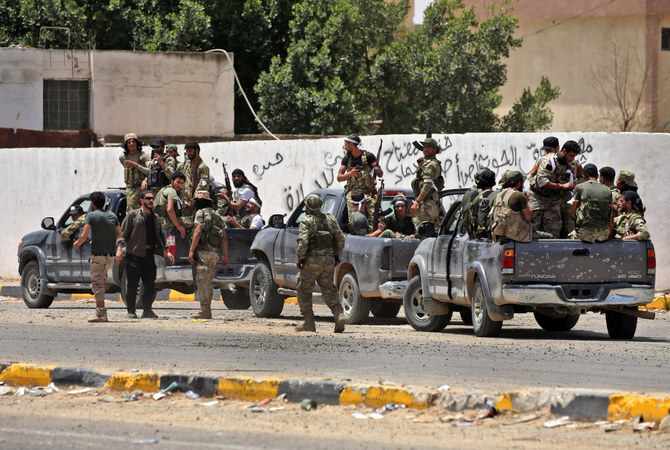
Libya remains divided between a UN-recognized government based in the capital Tripoli and a rival administration in the east, backed by military strongman Khalifa Haftar.
Although relative calm has returned in recent years, clashes still periodically break out between Libya’s myriad armed groups.
Earlier this month, nine people were killed and dozens wounded in fighting east of Tripoli between two groups, both affiliated with the UN-recognized government of Abdulhamid Dbeibah.
On Sunday, a group of men, some of them armed, briefly besieged the Central Bank of Libya headquarters in the capital, local media reported, in what they said was an attempt to force the resignation of its governor, Seddik Al-Kabir.
US ambassador Richard Norland said attempts to oust Kabir were “unacceptable,” warning that replacing him “by force can result in Libya losing access to international financial markets.”
In office since 2012, Kabir has faced criticism over the management of oil resources and the state budget, including from figures close to Dbeibah.
Norland, in a post on social media platform X, said the confrontation in Tripoli “highlights the ongoing risks posed by the political stalemate in Libya.”
And recent moves by the eastern parliament have signalled that “certain parties aim to pressure the international community into reaching a new agreement” on the country’s governance, said Khaled Al-Montasser, a professor of international relations at the University of Tripoli.
The parliament in the eastern city of Tobruk said on Tuesday that the government in Tripoli was “illegitimate,” also moving to strip the Presidential Council — formed under the 2021 UN transition agreement — from its role as high commander of the Libyan armed forces.
Haftar and his sons who hold key posts in the eastern administration have similarly questioned the legitimacy of the UN-recognized government.
Montasser told AFP that Tuesday’s decision was a “message directed at the international community rather than the Libyan people” to force new negotiations.
The 2021 agreement, he added, was a “complete political failure caused by all involved parties, both Libyan and foreign.”
The Tripoli-based government said the moves by parliament “did not change the reality at all” and were motivated by the eastern administration’s wish to extend its power “for the longest possible period.”
Between April 2019 and June 2020, forces aligned with Haftar attempted to seize Tripoli but failed after bloody battles.
Following a ceasefire, the UN-brokered agreement signed in Geneva sought to establish interim institutions as parliamentary and presidential elections were planned.
Initially scheduled for December 2021, the vote has been postponed indefinitely over disagreements on its legal framework.
Tensions have recently been compounded by fears of renewed fighting, after media reports and analysts said troops from the east were moving toward southwestern Libya, a region under the Tripoli government’s control, prompting international alarm.
The army led by Saddam Haftar, the marshal’s youngest son, said it was only aiming to “secure the country’s southern borders and enhance stability” in areas it already controls.
The United Nations Support Mission in Libya said it was following “with concern” moves that “increase tension, undermine trust and further entrench institutional divisions and discord among Libyans.”
Libyan political analyst Abdallah Al-Rayes said the reported military advance was “a trial balloon to gauge international reactions and the military preparedness” of the Tripoli-based authorities.
“If dialogue and political mediation fail, the military option will once again target Tripoli, and it will be an open war.”


![]()

Libya UN-brokered deal at risk as escalation fears mount
Short Url
https://arab.news/rx8yc
Libya UN-brokered deal at risk as escalation fears mount
- Libya remains divided between a UN-recognized government based in the capital Tripoli and a rival administration in the east, backed by military strongman Khalifa Haftar
- US ambassador Richard Norland said attempts to oust Kabir were “unacceptable“


Latest updates



Recommended


© 2026 SAUDI RESEARCH & PUBLISHING COMPANY, All Rights Reserved And subject to Terms of Use Agreement.