

Hezbollah repels Israeli ‘infiltration’ as border tensions rise

1 / 2
A man walks on rubble of a damaged site in the aftermath of an Israeli airstrike in Al-Kfour, Nabatieh, southern Lebanon. (Reuters)
2 / 2
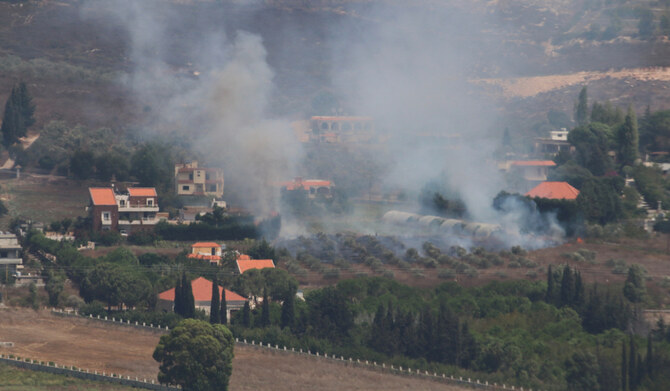
Smoke rises from Khiam, amid cross-border hostilities between Hezbollah and Israeli forces, as pictured from Marjayoun, near the border with Israel, Lebanon August 17, 2024. (REUTERS)
Short Url
Updated 19 August 2024
Follow

Hezbollah repels Israeli ‘infiltration’ as border tensions rise

  • Israeli soldier, Hezbollah members killed amid exchanges of fire, drone attacks
  • Israeli planes break sound barrier over Beirut once again as MP warns war will destroy Lebanon

BEIRUT: An Israeli soldier and several Hezbollah fighters were killed in clashes along the Israeli-Lebanese border on Monday.

The Israeli sergeant was killed in a drone attack in Western Galilee, the Israeli military said, as the situation in southern Lebanon continued to deteriorate.

Hezbollah said on Monday it had detected “the infiltration of a contingent of Israeli soldiers into the vicinity of the border town of Aita Al-Shaab at dawn.”

The group said its rocket fire and artillery shelling forced the Israelis to retreat.

Later that day Israeli warplanes broke the sound barrier over southern Lebanon, extending to Chouf, Beirut, and its southern suburbs.

FASTFACT

According to the UN’s International Organization for Migration, the violence since October has displaced more than 110,000 people in southern Lebanon.

Israel said its aircraft “attacked Hezbollah military buildings in Aita A-Shaab, Beit Lif, and Houla, and targeted the towns of Hanin and Tyre Harfa in southern Lebanon on Monday.”

The Israeli military also used heavy machine guns in a night operation near the Blue Line on the outskirts of the towns of Naqoura, Jabal Al-Labouneh, and Jabal Al-Alam.

Phosphorous bombs fired by the Israelis in the Tal Nahas area, meanwhile, caused a fire near a UNIFIL post.

An Israeli raid on the outskirts of the town of Yarin on Sunday resulted in injuries to three soldiers from the Ghanaian peacekeeping contingent serving under UNIFIL, whose patrol happened to pass near the area.

The Public Health Emergency Operations Center in Lebanon said two people were killed in an Israeli attack on the town of Houla. Hezbollah announced the deaths of two of its members, Abbas Melhem, aged 34, from Majdal Selm, and Mohammed Qadouh, aged 19, from Ghandouriya in southern Lebanon.

On Monday, Israeli media reported that sirens sounded in the settlements of Zar’it and Shtula in Upper Galilee, in areas surrounding the city of Acre and the settlement of Nahariya, and later in Hanita in Western Galilee.

It followed the explosion of drones launched from southern Lebanon toward the settlement of Ya’ara in Western Galilee near the Lebanese border.

Israeli media reported that the attacks left at least one person dead and six injured.

One report said that “at least three (injured people), one of which (was) in (a) critical condition, were transported to the medical center in Nahariya.”

Hezbollah claimed responsibility for the drone attack, saying it came “in response to Israeli attacks on southern Lebanon in the past two days.”

The party said in statements that it launched “a coordinated aerial attack with a squadron of assault drones on the Israeli Ya’ara barracks — the headquarters of the Western Brigade 300 — and the Saint Jean base — the logistical base for the Northern Command.”

Hezbollah said it also targeted the Zarit Barracks and a group of soldiers in its vicinity with rockets and artillery shells, setting it on fire. It also reported targeting the Bayad Blida site with a Burkan rocket, “achieving a direct hit.”

Israeli media said three drones and 10 rockets were launched from Lebanon toward the Western Galilee.

On Sunday, Israel intensified its operations by targeting the town of Batoulyeh near the city of Tyre, the village of Dhayrah, and the town of Shebaa in the far south, which left one Hezbollah member, Fady Qassem Kanaan, dead.

Hezbollah carried out 10 operations on Sunday including against the Zebdine and Zarit barracks, the Ruwaysat Al-Alam, Al-Malikiyah, Al-Marj, Ruwaysat Al-Qarn, and Jal Al-Alam sites, and buildings used by soldiers in the settlements of Shtula and Misgav Am.

The operations also targeted the headquarters of Al-Sahl Battalion in the Beit Hillel barracks “in response to the targeting of the town of Shebaa.”

MP Ghayath Yazbek of the Lebanese Forces parliamentary bloc emphasized the need to implement UN Resolution 1701.

“It is best to implement it with the least possible damage,” said the MP. “Nothing will save Lebanon except the immediate implementation of UN Resolution 1701 because it will be implemented sooner or later.”

He added: “We are facing a long war of attrition between Israel and Hamas.”

Yazbek also warned that though Israel would suffer if the war expands, it would also destroy Lebanon.

He added that Hezbollah “is dealing with us, those who chose the state model, as if we were an insurance company.

“It decides and fights wars, and we compensate for the states of madness it goes through.”

He added: “Hezbollah knows well that it cannot win a war against Israel, but it is telling the Lebanese that ‘I do not care if I win or not.’”


‘Saudi Arabia’s principled stance is a source of strength for the Palestinian cause,’ Palestinian ambassador to Japan tells Arab News

Updated 5 sec ago
Follow

‘Saudi Arabia’s principled stance is a source of strength for the Palestinian cause,’ Palestinian ambassador to Japan tells Arab News

  • Waleed Siam wants reconstruction of Gaza under President Trump’s Board of Peace to “be clearly linked to Palestinian aspirations for statehood”
  • Says Kingdom’s rejection of normalization of ties with Israel without statehood has become “a key pillar of the Palestinian diplomatic pathway”

TOKYO: When US President Donald Trump unveiled the charter of his Board of Peace in the Swiss city of Davos, he launched a new and uncertain experiment in postwar governance for the Gaza Strip.

The board is intended to oversee the war-ravaged Palestinian territory’s transitional administration and reconstruction as a fragile ceasefire moves into its second phase. The announcement has prompted cautious reactions from Palestinian officials, who say any plan imposed without Palestinian leadership risks failure.

Speaking to Arab News, Palestinian Authority Ambassador to Japan Waleed Ali Siam said international initiatives for Gaza and the West Bank must prioritize Palestinian rights, international law and a clear path to an independent Palestinian state.

“Achieving sustainable peace will be difficult without direct and active Palestinian involvement and a political horizon,” Siam said. “The reconstruction of Gaza must be underpinned by Palestinian representation, and it should be clearly linked to our political aspirations for statehood.”

He added: “We require reconstruction that holds true significance, not mere temporary measures or dreams of resorts.”

Despite a US-brokered truce entering its second phase, sporadic violence in Gaza has continued, with both Israel and Hamas accusing each other of violating the agreement.

The Board of Peace is an international body chaired by Trump. Its charter was formally ratified on Jan. 22 at the World Economic Forum’s annual meeting in Davos.

It was established under UN Security Council Resolution 2803 to oversee Gaza’s transitional governance, demilitarization and reconstruction following a US-brokered ceasefire tied to a 20-point peace plan introduced in 2025.

Several Arab countries, including Saudi Arabia, Jordan and Bahrain, are among the board’s founding members.

Saudi Arabia’s Cabinet reaffirmed the Kingdom’s support for the initiative on Jan. 27, describing it as a transitional mechanism to help end the conflict and facilitate Gaza’s rebuilding.

Siam described Saudi Arabia’s role as “critically important in both Gaza and the West Bank.”

“We deeply appreciate that Saudi Arabia has consistently provided humanitarian and diplomatic support to our people and the legitimate aspirations of our nation since the onset of the war,” he said.

Since early January, Saudi Arabia has intensified air, sea and land relief routes to Gaza through the Saudi Popular Campaign to Aid the Palestinian People, responding to the worsening humanitarian crisis.

Saudi Arabia has established an air and sea “bridge” through the King Salman Humanitarian Aid and Relief Center, delivering aid via 77 aircraft and eight ships carrying more than 7,699 tons of food, medical supplies and shelter materials, according to official figures.

Siam said Saudi Arabia’s longstanding stance against normalization without Palestinian statehood has become “a key pillar of the Palestinian diplomatic pathway.”

The Saudi leadership has “reaffirmed that no normalization will occur without a Palestinian state,” he said.

“This emphasizes that true regional stability and normalization are closely linked to the realization of Palestinian statehood.”

Indeed, Saudi Arabia has repeatedly rejected normalization with Israel without a Palestinian state since October 2023, when Israeli launched its military onslaught in Gaza following a deadly Hamas-led attack.

Saudi Arabia suspended normalization talks soon afterward, with Crown Prince Mohammed bin Salman later stating clearly that any resumption of ties was contingent on the establishment of an independent Palestinian state with East Jerusalem as its capital

Most recently, Saudi Foreign Minister Prince Faisal bin Farhan reiterated on Jan. 28 that the Kingdom would not establish relations with Israel before Palestinian statehood.

Siam said the Palestinian leadership sees Saudi Arabia as “a leading country in the Arab and Islamic worlds, representing a strong shield for the legitimate rights of Palestinians.”

The Kingdom’s “historically principled position has always been a source of strength for the Palestinian cause, as it rejected settlements at the expense of the historical rights of the Palestinian people,” he added.

“Saudi Arabia has become a regional, global, and religious center for protecting the historical rights of Palestinians, reflecting the depth of the support we cherish in our struggle to restore our rights.”

Riyadh took a prominent diplomatic role in advancing a two-state solution during the conflict and in postwar planning.

In August last year, Prince Faisal bin Farhan conducted urgent diplomatic phone calls with counterparts in Turkiye, Egypt, France, Germany and the EU, urging international action to halt Israel’s Gaza operations.

In July, the Kingdom co-hosted a conference with France in New York aimed at rallying support for Palestinian state recognition and a negotiated two-state framework. Saudi Arabia later endorsed Trump’s phase-one ceasefire in late 2025, backing the multilateral disarmament of Hamas and strengthening of the Palestinian Authority.

Siam said that the top priority in Gaza today remains “an urgent and permanent ceasefire.”

“Israel has already occupied over 65 percent of Gaza and continues to destroy and kill,” he said. “The blockage of humanitarian aid and refusal to allow the opening of borders at Rafah endanger thousands of households.”

On Saturday, the Israeli military launched air strikes reportedly killing 32 people including children in Gaza, claiming that it was responding to a Hamas ceasefire violation.

Since October 2023, Israeli bombardment and raids have killed more than 71,600 Palestinians in Gaza, according to local health authorities.

“The humanitarian situation and crisis in Gaza is far from being over,” Olga Cherevko from UN aid coordination office OCHA said on Jan. 17. “For the Palestinians in Gaza, their lives continue to be defined by displacement, trauma, uncertainty, and deprivation.”

She added that severe winter storms have compounded suffering, destroying shelters and contributing to civilian deaths, including vulnerable children.

On Jan. 30, Israeli authorities said the Rafah Crossing would reopen in both directions on Feb. 1 for “a limited movement of people,” subject to Israeli security clearance, according to OCHA. 

Siam stressed the need for “the complete withdrawal of occupying Israeli forces to ensure sustainable humanitarian aid and the protection of all Palestinian citizens.”

Last May, Israeli forces declared roughly 70 percent of Gaza either a military “red zone” or under evacuation orders, forcing hundreds of thousands into increasingly confined areas, according to the UN.

While the Israeli military says such orders allow civilians to flee fighting, Palestinians reportedly say they often are forced to evacuate under fire.

Conditions in the West Bank are also worsening. Rights groups report record levels of settler violence over the past year, along with expanded Israeli raids, in what they warn amounts to de facto annexation.

“The situation in the West Bank is also perilous,” Siam said. “Quiet annexation is occurring in the West Bank, with the expansion of settlements, forced migration, house demolitions, and strict movement restrictions systematically undermining the viability of a genuine Palestinian state.” 

He warned that rhetoric from Israeli leaders denying Palestinian statehood is gaining international acceptance.

“The narrative from Israeli leaders that ‘there is no Palestinian state, an independent Palestinian state does not exist; Palestinians should leave’ is dangerous and the world seems to be accepting this narrative,” he said.

He added: “It sidelines the Palestinian Authority in the future of Gaza. We are concerned, and the Palestinian Authority and the PLO represent the legitimate representation of the Palestinian people and play an essential role in a reliable unified future for Gaza.”

Siam said growing international recognition of Palestinian statehood has helped build momentum for a two-state solution. Last year, several Western governments — including the UK, France, Canada, Australia and Portugal — announced formal recognition of Palestine.

But he cautioned that recognition alone is insufficient.

“To generate real momentum, concrete actions are required to end Israeli military occupation, stop the expansion of illegal settlements, and achieve a political resolution,” he said.

“What is needed is action based on international law, not proposals labeled X, Y and Z. International law should be enforced, and it should not be conducted under attempts to alter international laws on someone's desk by the law of the jungle.

“Justice and peace in Gaza must mean the end of the Israeli occupation within a year, complete reconstruction, accountability for Israeli crimes, and for all residents to live in dignity and safety within a free and independent state.”

He added: “A clearly internationally guaranteed political horizon is essential. What we seek is a sincere and reversible pathway to end the occupation and establish our own independent sovereign state.”

Turning to Japan, Siam expressed gratitude for Tokyo’s continued support for Palestinian development and Gaza reconstruction.

“We are grateful for the Japanese people and government for continuing supporting on the Palestinian development and also being part of the reconstruction of Gaza,” he said.

Japan has provided humanitarian assistance through multilateral agencies, including the World Food Programme and the World Health Organization, addressing food insecurity, healthcare, and basic services.

Siam urged Japan not to deepen defense ties with Israel. “We call on Japan also not to reward Israel by signing contracts from the private sector or governmental, contracts on buying weapons from Israel,” he said.

“Buying weapons from Israel helps Israel to continue its genocide in Gaza.”

Siam added: “Any country that supports Israel economically or militarily is complicit, unfortunately complicit, in the genocide in Gaza. Knowing this, Japan (should) take a firm decision not to buy any military equipment from Israel.”
