Egyptian envoy says ease of bilateral visas with Pakistan to strengthen trade, economic ties

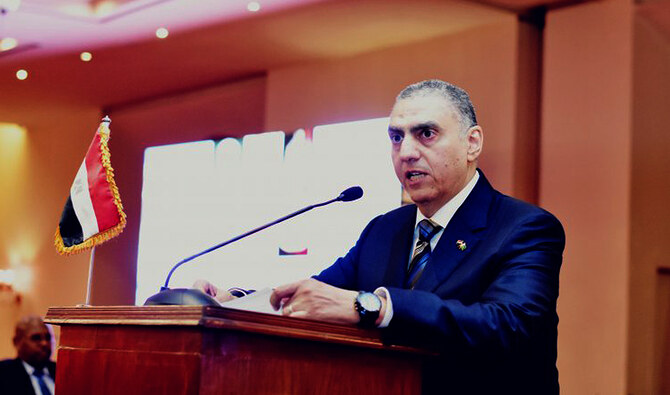
In this file photograph, taken and released by the Associated Press of Pakistan on July 24, 2024, Egypt’s Ambassador to Pakistan Dr. Ihab Abdel Hamid speaks during Egyptian National Day Event in Islamabad. (APP/File)
Short Url
Updated 19 August 2024
Follow

Egyptian envoy says ease of bilateral visas with Pakistan to strengthen trade, economic ties

  • Role of private sector important to increase cooperation in tourism between Egypt and Pakistan, says envoy
  • Cordial relations between Pakistan and Egypt, both Muslim-majority nations, can be traced back to 1947

ISLAMABAD: Egypt’s Ambassador to Pakistan Dr. Ihab Abdel Hamid recently stressed the importance of ease of bilateral visas between his country and Pakistan, saying that it would strengthen cooperation in trade and economic sectors, and facilitate tourism in both countries. 
Pakistan and Egypt, both Muslim-majority nations, enjoy cordial ties with one another. The two have resolved to enhance bilateral trade in recent years by facilitating businessmen from their countries through visas, exchanging trade-related information and promoting private sector contacts. 
Friendly ties between the two countries can be traced back to 1947 when Pakistan gained independence and its founder, Muhammad Ali Jinnah, visited Egypt at the special invitation of King Fuad II.
“Ambassador of Egypt to Pakistan, Dr. Ihab Abdel Hamid has said that the ease of bilateral visas between Pakistan and Egypt will strengthen the economic and trade ties between the two countries and tourism sectors also flourish,” the state-run Associated Press of Pakistan (APP) reported on Sunday. 
The envoy pointed out similarities between the two countries, especially in tourism, saying that both Egypt and Pakistan were popular countries for tourists. He described Pakistan’s northern region as ” rich in natural beauty.”
“The ambassador said that the role of the private sector is very important to increase cooperation in the field of tourism between Pakistan and Egypt, for which the business community of both countries must play their due role in this regard,” APP said. 
He called on the business communities of the two countries to exchange delegations to strengthen bilateral economic trade and investment ties. 
“The ambassador also stressed the need to promote people-to-people contact between the two nations to strengthen tourism and cultural relations,” APP said.


Pakistan launches privatization process for five power distributors under IMF reforms

Updated 10 sec ago
Follow

Pakistan launches privatization process for five power distributors under IMF reforms

  • Power-sector losses have pushed circular debt above $9 billion, official documents show
  • Move is tied to IMF and World Bank conditions aimed at cutting subsidies and fiscal risk

KARACHI: Pakistan has appointed financial advisers and launched sell-side due diligence for the privatization of five electricity distribution companies, marking a long-awaited step in power-sector reforms tied to International Monetary Fund (IMF) and World Bank programs, according to official documents shared with media on Monday.

The five companies, namely Islamabad Electric Supply Company (IESCO), Faisalabad Electric Supply Company (FESCO), Gujranwala Electric Power Company (GEPCO), Hyderabad Electric Supply Company (HESCO) and Sukkur Electric Power Company (SEPCO), supply electricity to tens of millions of customers and have long been a major source of financial losses for the state.

Pakistan’s power sector has accumulated more than Rs2.6 trillion (about $9.3 billion) in circular debt as of mid-2025, driven largely by distribution losses, electricity theft and weak bill recovery, according to official government data cited in the documents. The shortfall has repeatedly forced the government to provide subsidies, adding pressure to public finances in an economy under IMF supervision.

“The objective is to reduce losses, improve efficiency and limit the government’s fiscal exposure by transferring electricity distribution operations to the private sector,” the documents said, adding that sell-side due diligence for five distribution companies is under way as a prerequisite for investor engagement.

Two utilities, the Quetta Electric Supply Company and Tribal Areas Electric Supply Company, are excluded from the current privatization phase due to security and structural constraints, the documents said.

Power-sector reform is a central pillar of Pakistan’s IMF bailout program, under which Islamabad has committed to restructuring state-owned enterprises, improving governance and reducing budgetary support. The World Bank has also linked future energy-sector financing to progress on structural reforms.

Electricity distribution companies in Pakistan routinely report losses exceeding 20 percent of supplied power, far above international benchmarks, according to official figures. These inefficiencies have been a persistent obstacle to economic growth, investment and reliable power supply.

Previous attempts to privatize power distributors have stalled amid political resistance, labor union opposition and concerns over tariff increases. While officials have not announced a timeline for completing transactions, the launch of due diligence marks the most concrete step taken in years. International lenders and investors will now be closely watching whether Pakistan can translate this phase into completed sales, a key test of its ability to deliver on IMF-backed reforms.

In a related development in Pakistan’s privatization agenda, the government last month concluded the long-delayed sale of a 75 percent stake in national flag carrier Pakistan International Airlines (PIA) in a publicly televised auction. A consortium led by the Arif Habib Group emerged as the highest bidder with a Rs135 billion ($482 million) offer for the controlling stake, in a transaction officials have said will end decades of state-funded bailouts and inject fresh capital into the loss-making airline.