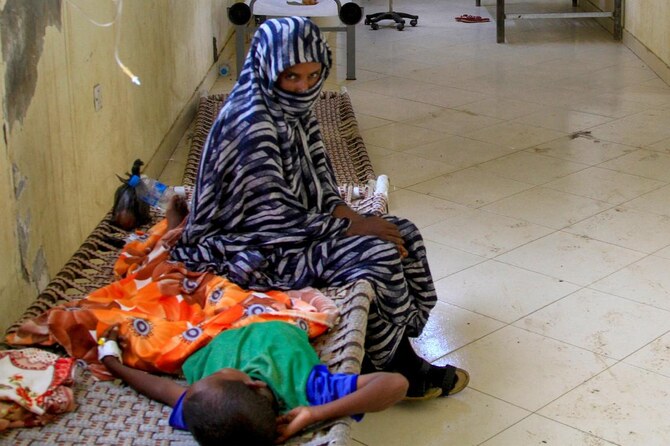
CAIRO: Sudan has been stricken by a cholera outbreak that has killed nearly two dozen people and sickened hundreds more in recent weeks, health authorities said Sunday. The African nation has been roiled by a 16-month conflict and devastating floods.
Health Minister Haitham Mohamed Ibrahim said in a statement that at least 22 people have died from the disease, and that at least 354 confirmed cases of cholera have been detected across the county.
Ibrahim didn’t give a time frame for the deaths or the tally since the start of the year. The World Health Organization, however, said that 78 deaths were recorded from cholera this year in Sudan as of July 28. The disease also sickened more than 2,400 others between Jan. 1 and July 28, it said.
Cholera is a fast-developing, highly contagious infection that causes diarrhea, leading to severe dehydration and possible death within hours when not treated, according to WHO. It is transmitted through the ingestion of contaminated food or water.
The cholera outbreak is the latest calamity for Sudan, which was plunged into chaos in April last year when simmering tensions between the military and a powerful paramilitary group exploded into open warfare across the country.
The conflict has turned the capital, Khartoum and other urban areas into battlefields, wrecking civilian infrastructure and an already battered health care system. Without the basics, many hospitals and medical facilities have closed their doors.
It has killed thousands of people and pushed many into starvation, with famine already confirmed in a sprawling camp for displaced people in the wrecked northern region of Darfur.
Sudan’s conflict has created the world’s largest displacement crisis. More than 10.7 million people have been forced to flee their homes since fighting began, according to the International Organization for Migration. Over 2 million of those fled to neighboring countries.
The fighting has been marked by atrocities including mass rape and ethnically motivated killings that amount to war crimes and crimes against humanity, according to the UN and international rights groups.
Devastating seasonal floods in recent weeks have compounded the misery. Dozens of people have been killed and critical infrastructure has been washed away in 12 of Sudan’s 18 provinces, according to local authorities. About 118,000 people have been displaced due to the floods, according to the UN migration agency.
Cholera is not uncommon in Sudan. A previous major outbreak left at least 700 dead and sickened about 22,000 in less than two months in 2017.
Tarik Jašarević, a spokesman for WHO, said the outbreak began in the eastern province of Kassala before spreading to nine localities in five provinces.
He said in comments to The Associated Press that data showed that most of the detected cases were not vaccinated. He said the WHO is now working with the Sudanese health authorities and partners to implement a vaccination campaign.
Sudan’s military-controlled sovereign council, meanwhile, said Sunday it will send a government delegation to meet with American officials in Cairo amid mounting US pressure on the military to join ongoing peace talks in Switzerland that aim at finding a way out of the conflict.
The council said in a statement the Cairo meeting will focus on the implementation of a deal between the military and the Rapid Support Forces, which required the paramilitary group to pull out from people’s homes in Khartoum and elsewhere in the country.
The talks began Aug. 14 in Switzerland with diplomats from the US, Saudi Arabia, Egypt, the United Arab Emirates, the African Union and the United Nations attending. A delegation from the RSF was in Geneva but didn’t join the meetings.


Cholera outbreak in Sudan has killed at least 22 people, health minister says
https://arab.news/zgpk3
Cholera outbreak in Sudan has killed at least 22 people, health minister says

- Cholera is a fast-developing, highly contagious infection that causes diarrhea, leading to severe dehydration and possible death


Mass grave found in Libya containing bodies of 21 migrants
- A Libyan national has been arrested on suspicion of killing the migrants and holding others captive
- Photos and video circulated by local media outlets showed bodies piled together
TRIPOLI: Libyan authorities have uncovered a mass grave containing the bodies of 21 migrants from sub-Saharan Africa, local media reported Thursday.
News outlets cited government sources as saying a Libyan national has been arrested on suspicion of killing the migrants and holding others captive on a farm in the northeastern town of Ajdabiya.
Libya is a key transit country for thousands of migrants attempting to reach Europe each year, with deaths among migrants frequently reported.
The Internal Security Agency for Libya’s east said it had “discovered a mass grave containing the bodies of 21 individuals of various African nationalities,” according to television channel Al-Masar.
The channel, which is aligned with eastern Libya’s army strongman Khalifa Haftar, said the suspect was detained during a raid on the farm.
Libya remains split between an administration in the east backed by Haftar and a government in the west recognized by the United Nations.
Independent news channel Al Wasat reported that the man had held migrants captive on the farm, some of whom were rescued and hospitalized after the raid.
Photos and video circulated by local media outlets showed bodies piled together and more than a dozen body bags laid out on the ground.
Libya has struggled to recover from chaos that erupted after a NATO-backed uprising in 2011 overthrew longtime dictator Muammar Qaddafi.
Smugglers and human traffickers have taken advantage of the instability, with the country facing criticism over conditions for migrants and rights groups levelling accusations of extortion and slavery.


