UNITED NATIONS: Yemen’s rival parties are making military preparations and threatening to return to war as hunger and cholera are increasing in the Arab world’s poorest nation, UN officials said Thursday.
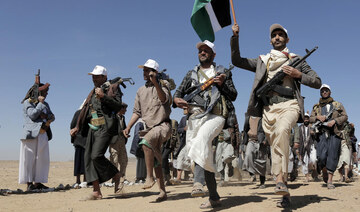
UN special representative Hans Grundberg told the Security Council that despite serious efforts to shield Yemen, it has been drawn into the Israel-Hamas war in Gaza, with Houthi rebels continuing to attack ships in the Red Sea and the United States and United Kingdom responding with strikes on military targets in Houthi-controlled areas.
“This situation, which has lasted for over eight months now, is not sustainable,” Grundberg said. “Unfortunately, this regressive trend illustrated by continuing military activities and escalatory rhetoric has continued.”
Yemen has been engulfed in civil war since 2014, when the Iranian-backed Houthis seized much of northern Yemen and forced the internationally recognized government to flee from the capital, Sanaa.
While fighting has decreased considerably since a six-month truce in 2022, Grundberg expressed deep concern at the trajectory of events in Yemen over the past months.
“We are continuing to witness military preparations and reinforcements accompanied by continuous threats of a return to war,” he said, citing reports of clashes in a half dozen towns and cities.
“Once again,” Grundberg said, “this serves as a stark reminder of how volatile the situation is along the Yemeni frontlines.”
He also pointed to the rebels’ detention of dozens of Yemenis working for the UN, civil society, national and international organizations, diplomatic missions and the private sector – and the closure of the UN human rights office in Sanaa followed by Houthi security forces storming the office Aug. 3.
Grundberg called it “an ominous signal” of the broader direction the Houthis are taking and said it represents “a serious attack” on the UN’s ability to work in Yemen.
Grundberg and Lisa Doughten, the UN humanitarian office’s finance director, demanded that the Houthis immediately release all those detained.
Doughten told the council a lack of funding is undermining efforts to meet critical needs across Yemen, where food security is deteriorating and an initial estimate of 60,000 suspected cholera cases between April and September swelled to more than 147,000 at the beginning of August.
Current funding is only able to tackle a quarter of the cholera cases, and UN health experts warn that without immediate new money “the number of suspected cases could further increase, potentially reaching more than 250,000 in just a few weeks,” she said.
As for hunger, Doughten said 60 percent of Yemenis surveyed lacked adequate food, and the rate of severe food deprivation in Houthi-controlled areas more than doubled – from 17 percent to 36 percent – compared with last year.
She said increasing food insecurity isn’t just a problem of hunger.
“Today, an alarming 30 percent of girls in Yemen are forced into marriage before the age of 18 as families struggle to provide for them,” Doughten said. “And the number of children out of school – currently at a staggering 4.5 million – is likely to rise as more children are forced to leave school to help provide for their families.”


![]()

Yemen rivals threaten to resume war as hunger and cholera worsen in the poor nation, UN envoy warns

Short Url
https://arab.news/5bzyc
Yemen rivals threaten to resume war as hunger and cholera worsen in the poor nation, UN envoy warns
- Despite serious efforts to shield Yemen, it has been drawn into the Israel-Hamas war in Gaza
- UN official: ‘We are continuing to witness military preparations and reinforcements accompanied by continuous threats of a return to war’

Latest updates


© 2026 SAUDI RESEARCH & PUBLISHING COMPANY, All Rights Reserved And subject to Terms of Use Agreement.