

CM orders probe into child marriages in Pakistan’s Sindh in wake of deadly 2022 floods

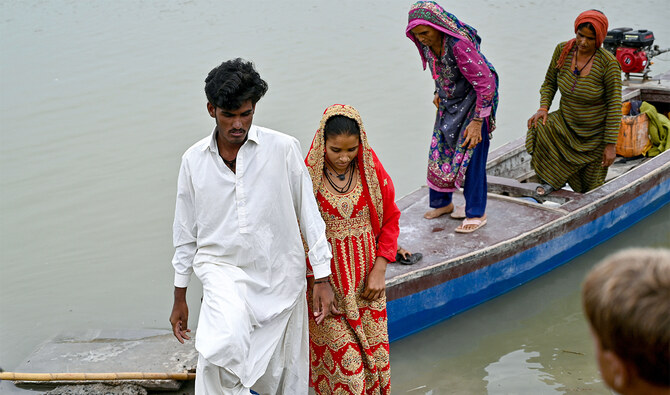
In this photograph taken on August 3, 2024 newly married underage monsoon bride Amina (2L), with their husband Mohammad Usman (L) arrives at the Khan Muhammad Mallah village in Main Nara Valley, Dadu district, Sindh province. (AFP)
Short Url
Updated 18 August 2024
Follow

CM orders probe into child marriages in Pakistan’s Sindh in wake of deadly 2022 floods

  • The high rate of marriages for underage girls had been inching lower in Pakistan in recent years
  • But after unprecedented floods in 2022, rights workers warn such weddings are now on the rise

KARACHI: The chief minister of Pakistan’s southern Sindh province has ordered an inquiry into dozens of child marriages in the Dadu district in the wake of deadly floods that hit the region two years ago, the Sindh CM’s office said on Sunday.

Pakistan’s high rate of marriages for underage girls had been inching lower in recent years, but after the unprecedented floods in 2022, rights workers warn such weddings are now on the rise due to climate-driven economic insecurity.

Many villages in the agricultural belt of Sindh have not recovered from the 2022 floods, which plunged a third of the country underwater, displaced millions and ruined harvests. Child marriages have particularly spiked in the Dadu district that for months resembled a lake, according to social activists. In Khan Mohammad Mallah village alone, 45 underage girls have become wives since the last monsoon — 15 of them in May and June this year.

Sindh CM Murad Ali Shah sought a report from the Hyderabad commissioner into these marriages in return for money given to families of the brides, inquiring about the social, financial and legal factors behind them.

“Form a committee for a detailed inquiry and furnish a report whether these girls hailed from flood-affected families,” Shah told the Hyderabad commission, according to the CM’s office.

“What is the condition of these married girls at present? Give a report from every aspect so that it can be resolved.”

Child marriages are common in parts of Pakistan, which has the sixth-highest number of girls married before the age of 18 in the world, according to government data published in December. The legal age for marriage varies from 16 to 18 in different regions, but the law is rarely enforced.

Parents of these young girls said they hurried the marriage of their daughters to save them from poverty, usually in exchange for money.

“Before the 2022 rains, there was no such need to get girls married so young in our area,” village elder Mai Hajjani, 65, told AFP this week. “They would work on the land, make rope for wooden beds, the men would be busy with fishing and agriculture. There was always work to be done.”

Pakistan is recognized as one of the most vulnerable countries to climate change effects in the world. The summer monsoon between July and September is vital for the livelihoods of millions of farmers and food security, but scientists say climate change is making them heavier and longer, raising the risk of landslides, floods and long-term crop damage.

In June, a senior UN official warned that an estimated 200,000 people in Pakistan could be affected by the upcoming monsoon season, which is expected to bring heavier rains than usual.

— With input from AFP


Pakistan defense minister discusses regional, global developments with counterparts in Munich

Updated 14 February 2026
Follow

Pakistan defense minister discusses regional, global developments with counterparts in Munich

  • The high-powered meeting of government leaders, diplomats comes shortly before Russia’s war on Ukraine enters its fifth gruelling year
  • Bruised by President Donald Trump’s comments, European leaders at summit have pledged to shoulder more of the burden of shared defenses

ISLAMABAD: Pakistan’s Defense Minister Khawaja Asif on Friday met his Italian and Albanian counterparts to discuss bilateral cooperation and regional and global developments on the sidelines of the Munich Security Conference, the Pakistani embassy in Germany said.

The high-powered Munich meeting of government leaders, diplomats, defense and intelligence chiefs comes shortly before Russia’s full-scale war on Ukraine is set to enter its fifth gruelling year.

Bruised by President Donald Trump’s designs on Greenland and his often hostile comments about America’s traditional bedrock allies, European leaders at the conference have pledged to shoulder more of the burden of shared defenses.

Asif met his Italian counterpart Guido Crosetto during the conference, running from Feb. 13 till Feb. 15, with both sides agreeing to enhance bilateral ties, according to the Pakistani embassy.

“Asif met the Defense Minister of Republic of Albania, Mr. Pirro Vengu, on the sidelines of the 62nd Munich Security Conference,” the Pakistani embassy said on X.

“Discussed matters related to enhancing bilateral cooperation in the wake of recent regional and international developments.”

The development came as US Secretary of State Marco Rubio was set to address European leaders on Saturday as they try to step up their autonomy in defense while salvaging transatlantic ties badly strained under President Trump.

German Chancellor Friedrich Merz acknowledged a “rift” had opened up between Europe and the United States, fueled by culture wars, but issued an appeal to Washington: “Let’s repair and revive transatlantic trust together.”

“In the era of great power rivalry, even the United States will not be powerful enough to go it alone,” said the conservative leader, who has ramped up defense spending in the top EU economy.

Macron said a new framework was needed to deal with “an aggressive Russia” once the fighting in Ukraine ends.

Ukrainian President Volodymyr Zelensky, who has been in Munich since Friday and meeting multiple allies, was expected to address the meeting on Saturday. No Russian officials have been invited.

Kremlin critic Mikhail Khodorkovsky said he feared “a new cold war” between Europe and Russia in the coming decade, making reopening dialogue with Moscow essential.

“If it makes sense to talk, we are willing to talk,” said Merz, but he also charged that “Russia is not yet willing to talk seriously.”