

92% of Muslims in UK feel ‘much less safe’ after nationwide rioting: Poll

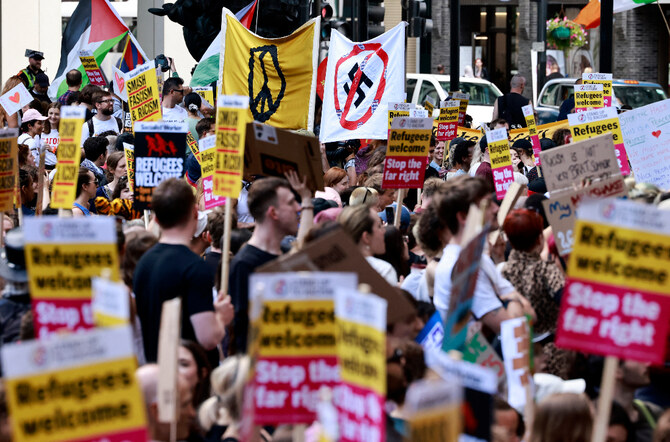
People hold anti-racist placards as they take part in a "Stop the Far-right" demonstration on a National Day of Protest, outside of the headquarters of the Reform UK political party, in London. (File/AFP)
Short Url
Updated 17 August 2024
Follow

92% of Muslims in UK feel ‘much less safe’ after nationwide rioting: Poll

  • British charity releases data highlighting spike in Islamophobia during, after violence
  • Rise in hate incidents pushing ‘really talented’ people to emigrate: King’s adviser

LONDON: Rioting in the UK has left 92 percent of Muslims feeling “much less safe,” a new poll has found.

Commissioned by Muslim Census and conducted on Aug. 5-6, the poll found that one in six people suffered racist attacks since the beginning of the riots, The Independent reported.

The week-long rioting by far-right groups, mainly in England, began on July 30 and ended with a massive campaign of arrests.

The poll came as an adviser to King Charles on race relations warned that Britain is facing a brain drain of middle-class Muslims amid rising Islamophobia.

Harris Bokhari said growing numbers of Muslims nationwide feel that Britain is no longer a welcoming place for people from different cultures.

Despite “loving this country beyond anything,” he told The Times that he has discussed emigrating with his family.

“The way I view it now is that we have a brain drain,” he said. “So, from the Muslim community we have got really talented people who have left the country and more people (are thinking about) leaving the country.”

The poll, which surveyed 1,519 people from different backgrounds, found that Muslims, in reporting racist incidents since the rioting, most frequently faced verbal attacks (28 percent).

It was followed by 16 percent reporting online abuse. A further 4 percent said they had suffered physical attacks.

The co-founder of Muslim Census, Sadiq Dorasat, said: “We have heard stories about hijabis that don’t feel safe to leave their homes or go to work. We’ve seen a witch hunt directed to people of the Muslim faith mentioning Allah and His Messenger and people are concerned for their safety.”

The violence that broke out in late July saw mosques, Muslim-owned business and asylum hotels targeted in cities across the UK.

Dorasat said: “This has been a growing and rising problem. We see it day to day and some people might not even be surprised at the riots that are taking place.

“Since the start of the year, Muslims have been experiencing these Islamophobic incidents and it has only been accelerated in the last week. Nobody should be surprised.”

Following the campaign of mass arrests to bring an end to the rioting, Prime Minister Keir Starmer pledged to combat hate and launch new protective measures for mosques nationwide. But Dorasat called on him to “properly call out and punish the perpetrators.”

Tell Mama, a British charity that monitors anti-Muslim hate incidents, released new data that also highlight the spike in Islamophobia during and after the rioting.

The charity said it had received 500 reports of online and offline hate during the period, including death threats toward Muslim women.

Iman Atta, Tell Mama’s director, told The Times that the growth of Islamophobia means that emigration is no longer a “fringe thought” for many British Muslims.

“This means that some of our best doctors, nurses, accountants and healthcare workers have left and will continue to leave as they feel increasingly unsafe,” she said.

One of the charity’s co-founders, Fiyaz Mughal, told The Times that he is leaving Britain for Europe.

He said: “I’ve always stood by Britain and stood by the values; in fact I’ve challenged Islamist extremism and stood for British Muslim communities, but after this recent round I just thought when the hell are we going to get over this racism? And my mindset is I’ve had enough — I want to go to Europe.”

Bokhari, who has worked with every prime minister since Tony Blair on race relations, described his alarm at the number of young people involved in the nationwide riots. At least 50 people aged under 18 have been charged in connection with the violence.

He said: “There are some viral videos now … of parents taking along young kids shouting, ‘P***, go home.’

“But I’m not going to blame a young person for that. Young people are not born to be racist or homophobic or prejudiced.”

Bokhari called for the creation of a national service program to allow young people from different backgrounds to interact, in a bid to “break down barriers.”

He said: “If we can create a generation of young people that can fundamentally disagree with each other, but get them to work together and not hate each other, not victimise each other, not despise each other, do something positive together, then that’s what I think interfaith has to move towards.”



2025 among world’s three hottest years on record, WMO says

Updated 14 January 2026
Follow

2025 among world’s three hottest years on record, WMO says

  • All eight datasets confirmed that the last three years were the planet’s three hottest since records began, the WMO said
  • The slight differences in the datasets’ rankings reflect their different methodologies and types of measurements

BRUSSELS: Last year was among the planet’s three warmest on record, the World Meteorological Organization said on Wednesday, as EU scientists also confirmed average temperatures have now exceeded 1.5 degrees Celsius of global warming for the longest since records began.
The WMO, which consolidates eight climate datasets from around the world, said six of them — including the European Union’s European Center for Medium-Range Weather Forecasts (ECMWF) and the British national weather service — had ranked 2025 as the third warmest, while two placed it as the second warmest in the 176-year record.
All eight datasets confirmed that the last three years were the planet’s three hottest since records began, the WMO said. The warmest year on record was 2024.

THREE-YEAR PERIOD ABOVE 1.5 C AVERAGE ⁠WARMING LEVEL
The slight differences in the datasets’ rankings reflect their different methodologies and types of measurements — which include satellite data and readings from weather stations.
ECMWF said 2025 also rounded out the first three-year period in which the average global temperature was 1.5 C above the pre-industrial era — the limit beyond which scientists expect global warming will unleash severe impacts, some of them irreversible.
“1.5 C is not a cliff edge. However, we know that every fraction of a degree matters, particularly for worsening extreme weather events,” said Samantha Burgess, strategic ⁠lead for climate at ECMWF.
Burgess said she expected 2026 to be among the planet’s five warmest years.

CHOICE OF HOW TO MANAGE TEMPERATURE OVERSHOOT
Governments pledged under the 2015 Paris Agreement to try to avoid exceeding 1.5 C of global warming, measured as a decades-long average temperature compared with pre-industrial temperatures.
But their failure to reduce greenhouse gas emissions means that target could now be breached before 2030 — a decade earlier than had been predicted when the Paris accord was signed in 2015, ECMWF said. “We are bound to pass it,” said Carlo Buontempo, director of the EU’s Copernicus Climate Change Service. “The choice we now have is how to best manage the inevitable overshoot and its consequences on societies and natural systems.”
Currently, the world’s long-term warming level is about 1.4 C above the pre-industrial era, ECMWF said. Measured on a short-term ⁠basis, average annual temperatures breached 1.5 C for the first time in 2024.

EXTREME WEATHER
Exceeding the long-term 1.5 C limit would lead to more extreme and widespread impacts, including hotter and longer heatwaves, and more powerful storms and floods. Already in 2025, wildfires in Europe produced the highest total emissions on record, while scientific studies confirmed specific weather events were made worse by climate change, including Hurricane Melissa in the Caribbean and monsoon rains in Pakistan which killed more than 1,000 people in floods.
Despite these worsening impacts, climate science is facing political pushback. US President Donald Trump, who has called climate change “the greatest con job,” last week withdrew from dozens of UN entities including the scientific Intergovernmental Panel on Climate Change.
The long-established consensus among the world’s scientists is that climate change is real, mostly caused by humans, and getting worse. Its main cause is greenhouse gas emissions from burning fossil fuels like coal, oil and gas, which trap heat in the atmosphere.