

Philippines urges citizens to leave Lebanon ‘immediately’

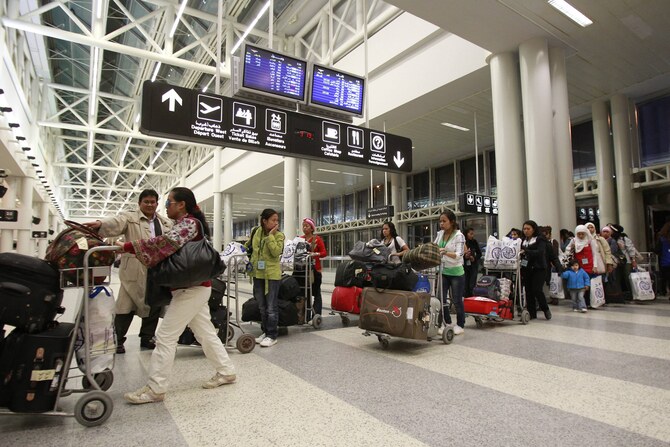
Filipino nationals leave Beirut international airport on their way back home on December 12, 2012. (File/AFP)
Short Url
Updated 17 August 2024
Follow

Philippines urges citizens to leave Lebanon ‘immediately’

  • Authorities have so far repatriated more than 350 Filipinos from Lebanon
  • Around 11,000 Philippine nationals live and work in the Middle East country

MANILA: The Philippines has urged its citizens in Lebanon to leave the country “immediately” amid growing fears of an escalation in the conflict between Israel and Hezbollah.

Around 11,000 Filipinos live and work in Lebanon, according to the latest official data. Manila has placed the Middle Eastern country under their “alert level 3,” meaning that Philippine nationals are urged to leave.

In an advisory issued late on Friday, the Philippine Embassy in Beirut “urges all Filipino citizens to leave Lebanon immediately while the airport remains operational,” adding that Philippine nationals should prioritize their safety and depart the country “as soon as possible.”

Manila has had a voluntary repatriation program since late October, following the escalation of fighting along the Israel-Lebanon border, where Hezbollah fighters and Israeli forces have been engaged in frequent exchanges of rocket fire since the beginning of Israel’s deadly onslaught on the Gaza Strip.

Foreign Affairs Undersecretary Eduardo De Vega said the latest advisory was “not intended to alarm anyone.”

He said: “We are highlighting the fact that safety of those who stay is not guaranteed.”

Several countries, including the US, UK and France have urged their citizens to leave Lebanon since earlier this month, as heightened tensions in the region spark fears of a widening conflict in the Middle East.

Philippine Ambassador to Lebanon Raymond Balatbat said more than 350 Philippine nationals have so far been repatriated, with another 40 overseas Filipino workers waiting for Lebanese immigration authorities to clear their request for repatriation.

“Situation is tense,” he said. “There is uncertainty as locals and foreigners alike await the unfolding of future events.”


Homeless Muslims in southern Philippines observe Ramadan as month of trial

Updated 23 February 2026
Follow

Homeless Muslims in southern Philippines observe Ramadan as month of trial

  • Thousands lost their homes when parts of Bongao in Tawi-Tawi were burnt to ashes
  • Many trying to fully observe the fasting month say they are grateful to be alive

Manila: As Annalexis Abdulla Dabbang was looking forward to observing the month of Ramadan with her family, just days before it began they lost everything when an enormous fire tore through whole neighborhoods of their city in the southernmost province of the Philippines.

Bongao is the capital of Tawi-Tawi, an island province, forming part of the country’s Muslim minority heartland in the Bangsamoro region. The city experienced its worst fire in years in early February, when flames swept through the coastal community, leaving more than 5,000 people homeless.

“We were swimming for our lives. We had to swim to escape from the fire ... We swam in darkness, and (even) the sea was already hot because of the fire,” Dabbang, a 27-year-old teacher, told Arab News.

“Everything we owned was gone in just a few hours — our home, our memories, the things we worked hard for, everything turned to ashes.”

Trying to save their 2-year-old daughter and themselves, she and her husband left everything behind — as did hundreds of other families that together with them have since taken shelter at the Mindanao State University gymnasium — one of the evacuation centers.

Unable to secure a tent, Dabbang’s family has been sleeping on the bleachers, sharing a single mat as their bed. When Ramadan arrived a few days after they moved to the makeshift shelter, they welcomed it in a different, more solemn way. There is no family privacy for suhoor, no room or means to welcome guests for iftar.

“Ramadan feels different now. It’s painful but at the same time more real. When we lost our home, we began to understand what sacrifice really means. When you sleep in an evacuation center, you understand hunger, discomfort in a deeper way,” Dabbang said.

“We don’t prepare special dishes. We prepare our hearts.”

While she and thousands of others have lost everything they have ever owned, she has not lost her faith.

“Our dreams may have turned to ashes, but our prayers are still alive,” she said.

“This Ramadan my prayers are more emotional than ever. I pray for strength, not just for myself, but for my family and for every neighbor who also lost their family home. I pray for healing from the trauma of fire. I pray that Allah will replace what we lost with something better. I pray for the chance to rebuild not just our house, but our sense of security.”

Juraij Dayan Hussin, a volunteer helping the Bongao fire victims, observed that many of them were traumatized and the need to cleanse the heart and mind during Ramadan was what kept many of them going, because they are “thankful that even though they lost their property, they are still alive.”

But the religious observance related to the fasting month is not easy in a cramped shelter.

“It’s hard for Muslims to perform their prayers when they do not have their proper attire because they usually have specific clothes for prayer,” he said. “Sanitation in the area is also an issue ... when you fast and when you pray, cleanliness is essential.”

For Abdulkail Jani, who is staying at a basketball court with his brother and more than 70 other families, this Ramadan will be spent apart from their parents, whom they managed to move to relatives.

“The month of Ramadan this year is a month of trial ... there will be a huge change from how we observed Ramadan in the past, but we will adjust to it and try to comfort ourselves and our family. The most important thing is that we can perform the fasting,” he told Arab News.

“Despite our situation now, despite everything, as long as we’re alive, we will observe Ramadan. We’ll try to observe it well, without missing anything.”