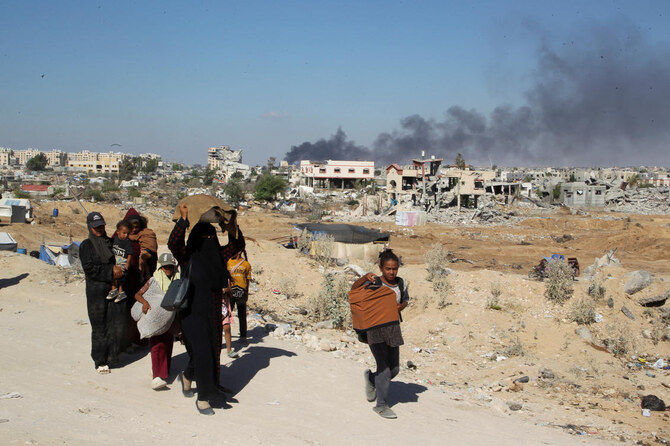

DEIR AL-BALAH, Gaza Strip: An Israel airstrike in Gaza killed at least 18 people, all from the same family, on Saturday, hours after mediators expressed optimism for an imminent ceasefire deal between Israel and Hamas.
Officials from the United States, Egypt and Qatar ended two days of ceasefire talks and expressed hope that a deal could be reached in the 10-month-old war. A joint statement said a proposal to bridge gaps between Israel and Hamas was presented and they expect to work out implementation details next week in Cairo.
The mediation efforts are aimed at securing the release of scores of Israeli hostages and stopping the fighting that has devastated Gaza, where the death toll has surpassed 40,000 and health workers fear a possible polio outbreak. Talks are also aimed at calming regional tensions that have threatened to explode into a broader war if Iran and Hezbollah militants in Lebanon attack Israel in retaliation for the recent killings of militant leaders.
Saturday’s airstrike hit a house and adjacent warehouse sheltering displaced people at the entrance to Zawaida town, according to the Al-Aqsa Martyrs Hospital in Deir Al-Balah, where casualties were taken. An Associated Press reporter there counted the dead.
Among those killed was Sami Jawad Al-Ejlah, a wholesaler who coordinated with the Israeli military to bring meat and fish to Gaza. The dead also included his two wives, 11 of their children ages 2 to 22, the children’s grandmother and three other relatives, according to a list provided by the hospital.
“He was a peaceful man,” said Abu Ahmed, a neighbor. More than 40 civilians were sheltering in the house and warehouse at the time, he said.
The Israeli military, which rarely comments on individual strikes, said it struck “terrorist infrastructure” in central Gaza where rockets had been fired toward Israel in recent weeks. It said it was continuing attacks on militants in central Gaza.
Another mass evacuation is ordered in Gaza
Another mass evacuation was ordered for parts of central Gaza. In a post on X, Israeli military spokesperson Avichay Adraee said Palestinians in areas in and around the urban Maghazi refugee camp should leave. He said Israeli forces will operate in them in response to Palestinian rocket fire.
The vast majority of Gaza’s population has been displaced by the fighting, often multiple times, and around 84 percent of the territory has been placed under evacuation orders by the Israeli military, according to the United Nations.
The war began when Hamas-led militants stormed across the border on Oct. 7, killing about 1,200 people, mostly civilians, and abducting 250 to Gaza. More than 100 were released in a November ceasefire. Around 110 are believed to be in Gaza, though Israeli authorities believe around a third are dead.
Israel says it has killed more than 17,000 Hamas militants, without providing evidence.
Gaza’s Health Ministry said Saturday that at least 40,074 Palestinians have been killed in the war. The ministry does not distinguish between fighters and civilians.
Ceasefire and implementation plans
Mediators have spent months pursuing a three-phase plan in which Hamas would release the hostages in exchange for a lasting ceasefire, the withdrawal of Israeli forces from Gaza and the release of Palestinians imprisoned by Israel.
Efforts took on new urgency in recent weeks after the killing of a top Hezbollah commander in an Israeli airstrike in Beirut and of Hamas’ top political leader in an explosion in Tehran that was widely blamed on Israel.
Israel and Hezbollah have traded fire since the war started, and an Israeli strike Saturday killed at least 10 Syrians, including a woman and her two children, Lebanon’s Health Ministry said. Israel said it targeted a Hezbollah weapons depot.
In an apparent sign of confidence, mediators were beginning preparations for implementing the ceasefire proposal even before its approval, said an American official, who spoke on condition of anonymity in keeping with rules set by the White House.
But Hamas cast doubt on whether an agreement was near, saying the latest proposal diverged significantly from a previous iteration they had accepted in principle.
Hamas has rejected Israel’s demands that include a lasting military presence along the border with Egypt and a line bisecting Gaza where it would search Palestinians returning to their homes to root out militants.
But Israel showed flexibility on retreating from the border corridor, and a meeting between Egyptian and Israeli military officials was scheduled for next week to agree on a withdrawal mechanism, according to two Egyptian officials, who spoke on condition of anonymity because they were not authorized to discuss the private negotiations.
Israel insisted on keeping control of the road bisecting Gaza, but US mediators vowed to return to the talks with a compromise on that demand, the officials said.
US Secretary of State Antony Blinken planned to travel to Israel over the weekend and was expected to meet with Israeli Prime Minister Benjamin Netanyahu on Monday.