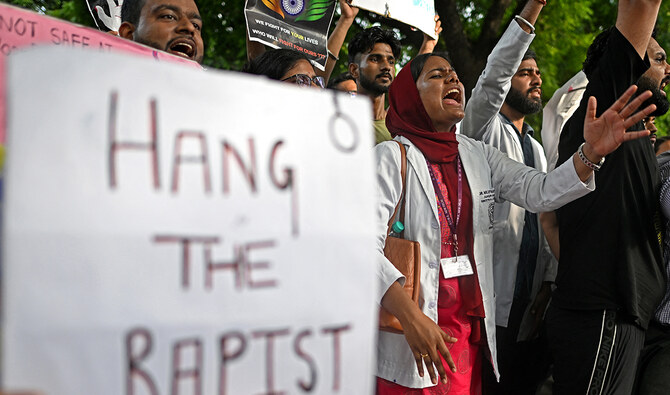
KOLKATA/BHUBANESWAR: Hospitals and clinics across India turned away patients except for emergency cases on Saturday as medical professionals started a 24-hour shutdown in protest against the brutal rape and murder of a doctor in the eastern city of Kolkata.
More than one million doctors were expected to join the strike, paralysing medical services across the world’s most populous nation. Hospitals said faculty staff from medical colleges had been pressed into service for emergency cases.
The strike, which began at 6 a.m. (0030 GMT), cut off access to elective medical procedures and out-patient consultations, according to a statement by the Indian Medical Association.
A 31-year old trainee doctor was raped and murdered last week inside a medical college in Kolkata where she worked, triggering nationwide protests among doctors and drawing parallels to the notorious gang rape and murder of a 23-year-old student on a moving bus in New Delhi in 2012.
Outside the RG Kar Medical College, where the crime took place, a heavy police presence was seen on Saturday while the hospital premises were deserted, according to the ANI news agency.
Mamata Banerjee, the chief minister of West Bengal, which includes Kolkata, has backed the protests across the state, demanding the investigation be fast tracked and the guilty be punished in the strongest way possible.
A large number of private clinics and diagnostic centers remained closed in Kolkata on Saturday.
Dr. Sandip Saha, a private paediatrician in the city, told Reuters that he will not attend to patients except in the case of emergencies.
In Odisha state, patients were queuing up and senior doctors were trying to manage the rush, Dr. Prabhas Ranjan Tripathy, additional medical superintendent of All India Institute of Medical Sciences in the city of Bhubaneswar, told Reuters,
“Resident doctors are on full strike, and because of that, the pressure is mounting on all faculty members, which means senior doctors,” he said.
Patients queued up at hospitals, some unaware that the agitation would not allow them to get medical attention.
“I have spent five hundred rupees on travel to come here. I have paralysis and a burning sensation in my feet, head, and other parts of my body,” a patient at SCB Medical College Hospital at Cuttack in Odisha told a local television channel.
“We were not aware of the strike. What can we do? We have to return home.”
Anger at the failure of tough laws to deter a rising tide of violence against women has fueled protests by doctors and women’s groups.
“Women form the majority of our profession in this country. Time and again, we have asked for safety for them,” IMA President R. V. Asokan told Reuters on Friday.
India’s Central Bureau of Investigation, the agency investigating the rape and murder, has summoned a number of medical students from the RG Kar college to ascertain the circumstances of the crime, according to a police source in Kolkata.
The CBI also questioned the principal of the hospital on Friday, the police source said.


Indian hospitals hit as doctors strike to protest brutal rape of medic
https://arab.news/wcwg4
Indian hospitals hit as doctors strike to protest brutal rape of medic

- Over 1 million doctors expected to join strike, paralysing services in world’s most populous nation
- Hospitals said faculty staff from medical colleges had been pressed into service for emergency cases

Indonesia to send record number of women officers to assist Hajj pilgrims
- Women comprise 33% of Indonesian Hajj officers in 2026
- They will assist the world’s largest contingent of Hajj pilgrims
JAKARTA: Indonesia’s Ministry of Hajj and Umrah on Friday concluded a training program for Hajj officers, a group that this year includes a record number of female guides to help Indonesian pilgrims perform the spiritual journey.
The world’s biggest Muslim-majority nation, Indonesia sends the largest contingent of Hajj pilgrims every year, comprising 221,000 people in 2026.
They will be assisted by more than 1,600 Indonesian officers who came from different parts of the country to participate in a 20-day training program in East Jakarta to prepare them for the roles, ahead of the pilgrimage season in May.
“Education and training for Indonesian Hajj officers … are carried out as part of the operational preparations for the 2026 Hajj pilgrimage,” said Puji Raharjo, director general of Hajj management at the ministry, during the closing ceremony on Friday.
“This program is aimed at ensuring the physical, mental, technical and organizational readiness of the officers in order to guide, serve and protect Indonesian Hajj pilgrims.”
Indonesia is sending more than 500 female Hajj officers in 2026 — its largest group of women guides yet.
“This year, women officers comprise about 33 percent, the highest in the history of Hajj management in Indonesia,” Arifatul Choiri Fauzi, the minister of women’s empowerment and child protection, told reporters.
As over 55 percent of Indonesian Hajj pilgrims are women and most of them are elderly, female officers can help ensure that they are treated with more care and empathy, she added.
Fauzi said: “There are many issues that are more suitable to be handled by female officers, things related to women’s issues, assistance inside the room, or emergencies that concern the privacy of the (women) pilgrims.”
The training program, which ran from Jan. 10-30, was aimed at preparing the officers physically and educating them on existing Hajj policies and mechanisms, while also covering operational case studies and lessons on effective communication and Arabic, as well as simulations of real-life situations related to the pilgrimage.
Indonesian Hajj officers will undergo a round of training online in February, before another session is held with reference to their departure locations in Indonesia.
“Every year, Indonesia sends the largest number of pilgrims in the world. This fact demands us to be truly ready and organized with officers who are dependable. Hajj officers fill a strategic role, you represent the state for the pilgrims, (and) you represent the state in front of the world,” Minister of Hajj and Umrah Mochamad Irfan Yusuf said while addressing this year’s batch of Hajj officers.
“This training and guidance program is therefore very important, as this is where you all prepare in order to understand the extent of your duties, strengthen coordination and come together in unity and discipline for the mission ahead.”


