

Abbas visit to Turkish parliament linked to several geopolitical dynamics

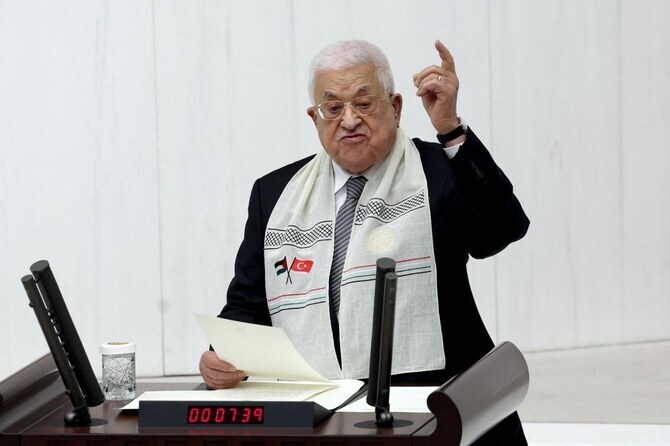
Palestinian Authority president Mahmud Abbas adresses a speech at Grand National Assembly of Turkiye in Ankara on Aug.15, 2024. (AFP)
Short Url
Updated 16 August 2024
Follow

Abbas visit to Turkish parliament linked to several geopolitical dynamics

  • Erdogan’s invitation to Palestinian president is significant for Middle East diplomacy in the wake of Haniyeh’s assassination, analysts say

ANKARA: After meeting Russian President Vladimir Putin in Moscow, Mahmoud Abbas visited Ankara and gave key messages about efforts for Palestinian unity and a ceasefire at a tense time during the Israel-Hamas war.

Abbas heads the Fatah Palestinian movement, a rival to Hamas, and has a more distant relationship with the Turkish government.

However, Turkiye’s invitation to Abbas was strategic as it came shortly after Israeli Prime Minister Benjamin Netanyahu’s speech to the US Congress on July 25, which Ankara condemned.

“We will show that Mr. Abbas has the right to speak in our parliament, just as Netanyahu has the right to speak in the US Congress,” Erdogan told members of his ruling Justice and Development Party on Wednesday, before meeting Abbas in Ankara on Wednesday.

A staunch supporter of Hamas, President Erdogan said that Turkiye had also planned to invite Hamas political leader Ismail Haniyeh before he was assassinated in Tehran. 

Abbas was addressing an extraordinary session of the Turkish parliament on Thursday, decorated with photographs of Haniyeh, who frequently visited Turkiye and had close ties with Erdogan.

The parliament’s presidency said that the special session for Abbas aimed to “demonstrate strong support for the Palestinian people and their cause and ensure that the voice of the oppressed Palestinian people is heard worldwide.” 

During his speech, which was interrupted several times by applause, Abbas — based in Ramallah in the West Bank — said that he would visit the besieged Gaza Strip to protest Israel’s war on the enclave, adding that the conflict could not end until Israel withdrew from occupied Palestinian land.

Abbas has not gone to Gaza since Hamas took power in 2007.

He also said that he would stand by the Palestinian people “even at the cost of his life” and added: “There cannot be a Palestinian state without Gaza.”

The last time Abbas visited Turkiye was on March 5.

But this time the visit coincides with a tense geopolitical situation and speculation about retaliation against Israel by Iran and Hezbollah.

Ankara, meanwhile, is also grappling with its position on Hamas following the appointment of Yahya Sinwar, who is seen as closer to Iran, after Haniyeh’s assassination.

Turkiye recently imposed a temporary one-week block on Instagram after the social media platform blocked condolence posts on the killing of Haniyeh.

Betul Dogan-Akkas, assistant professor of international relations at Ankara University’s department of international relations, believes that Abbas’s visit to the Turkish parliament is linked to several dynamics in regional and global politics.

“Turkiye is known for its social and political support for the Palestinian cause, but in the last decade it has become more and more involved with Hamas,” she told Arab News.

“However, Ankara’s support for Palestine goes beyond its ties with Hamas or Fatah,” Dogan-Akkas said.

“Inviting Abbas to deliver a speech in parliament shows Turkiye’s current efforts to adopt a comprehensive approach to the resistance without differentiating between the West Bank and Gaza.”

Dogan-Akkas believes that the visit was also significant for Middle East politics in the wake of Haniyeh’s assassination.

“Abbas can speak safely in Turkiye, and Turkiye is happy to host him to pave the way for the unification of the Palestinian resistance,” she said.

He had also dedicated an important part of his speech to the resistance in Gaza. “Having the opportunity to speak on behalf of Palestine, his discourse was inclusive and representative of both the West Bank and Gaza, despite the ongoing fragility of Palestinian domestic politics.”

Abbas “is an important figure in the Middle East, and hosting him in the Turkish parliament means that Turkiye is keeping channels of communication open with various powers in the Middle East, especially in Palestine,” Dogan-Akkas said.

“However, his visit is more oriented to the international community as Turkiye has recently submitted a request to join South Africa’s case at the International Court of Justice accusing Israel of genocide,” she said.

Galip Dalay, a senior consulting fellow at Chatham House, thinks that the significance of the visit is largely symbolic.

“Politically, the Palestinian Authority, despite its international legitimacy, has no influence in Gaza and limited one in West Bank, where its popularity is quite low,” he told Arab News.

“Turkiye’s most important role in the Palestinian cause at present lies in its ability to promote a common framework of governance and leadership within Palestine, contributing to the creation of a reformed and unified Palestinian leadership,” Dalay said.

“This includes restructuring the Palestine Liberation Organization to ensure broader representation of all Palestinian factions, including Hamas and Fatah elements. In addition, Turkiye envisages the emergence of a new government that is not linked to any existing organization.”

According to Dalay, this approach also applies to Turkiye’s relationship with Fatah and aims to contribute to the internal Palestinian dialogue.

“Turkiye is trying to internationalize the Palestinian issue by involving Arab and non-Arab, Western and non-Western actors as well as international institutions,” he said. 

Many experts believe that Turkiye’s increased engagement with the Palestinian issue is for domestic consumption, as one of the ruling government’s rivals, the New Welfare Party, with a strong Islamist tendency, has criticized Ankara for not being active enough on the Palestinian issue, creating significant domestic pressure on the issue.

Mehmet Akif Koc, a researcher on Middle East politics, considers Abbas’s visit to Turkiye significant for three main reasons.

“His stop in Ankara after Beijing and Moscow underscores Turkiye’s role in global diplomacy,” he told Arab News.

The visit comes as Turkiye “seeks to normalize relations with Syria and increase its influence in Iraq, positioning itself to take more initiative in the Middle East,” Koc said.

According to Koc, in the aftermath of the Gaza massacre on Oct. 7 and Haniyeh’s assassination, Turkish public opinion has leaned strongly toward Hamas.

“For the flexibility and maneuverability capacity of Turkish foreign policy, balancing the Fatah aspect is important, particularly from a state perspective,” he said.

Koc said that the visit helped to balance the pressure on Mahmoud Abbas from Israel and encouraged a more supportive approach to Gaza and Hamas under difficult conditions.

Abbas “had not indicated plans to visit Gaza for the last 11 months since the beginning of the massacre, and it is evident that he chose Ankara as the place to announce this.

“It is not difficult to speculate that Ankara may have pressured Abbas for this significant move, making this visit a crucial step toward fostering Palestinian unity,” he said.


Palestinians wait at border between Gaza and Egypt as uncertainty clouds reopening of Rafah crossing

Updated 04 February 2026
Follow

Palestinians wait at border between Gaza and Egypt as uncertainty clouds reopening of Rafah crossing

  • At that pace, long waits are facing most of the roughly 20,000 sick and wounded people who Gaza’s Health Ministry has said need treatment abroad
  • Reopening the crossing is considered key as the ceasefire agreement moves into a complicated second phase
  • The bus with about 40 Palestinians that entered Gaza via Rafah on Tuesday arrived at Nasser hospital in Khan Younis early Wednesday morning, where their families welcomed them after spending the entire day waiting

KHAN YOUNIS, Gaza Strip: Palestinians gathered on both sides of Gaza’s border with Egypt on Tuesday hoping to pass through the Rafah crossing, after its reopening the previous day was marred by delays, interrogations and uncertainty over who would be allowed to cross.
On the Egyptian side were Palestinians who fled Gaza earlier in the Israel-Hamas war to seek medical treatment, according to Egypt’s state-run Al-Qahera News television. On the Gaza side, Palestinians in need of medical care that is unavailable in Gaza gathered at a hospital before ambulances moved toward Rafah, hoping for word that they would be allowed to cross the other way.
The office of the North Sinai governor confirmed Tuesday that an unknown number of patients and their companions had crossed from Gaza into Egypt.
The bus with about 40 Palestinians that entered Gaza via Rafah on Tuesday arrived at Nasser hospital in Khan Younis early Wednesday morning, where their families welcomed them after spending the entire day waiting.
Though hailed as a step forward for the fragile ceasefire struck in October, it took more than 10 hours for only about a dozen returnees and a small group of medical evacuees to cross in each direction on the first day Rafah reopened.
Three women who crossed into Gaza on Monday told The Associated Press on Tuesday that Israeli troops blindfolded and handcuffed them, then interrogated and threatened them, holding them for several hours before they were released.
The numbers permitted to cross on Monday fell well short of the 50 people that officials had said would be allowed each way and barely began to address the needs of tens of thousands of Palestinians who are hoping to be evacuated for treatment or to return home.
The import of humanitarian aid or goods through Rafah remains prohibited.
’Not a solution to the crisis’
Evacuation efforts on Tuesday morning converged around a Red Crescent hospital in Khan Younis, where a World Health Organization team arrived and a vehicle carrying patients and their relatives rolled in from another hospital. Then the group of WHO vehicles and Palestinian ambulances headed toward Rafah to await crossing.
As the sick, wounded and displaced waited to cross in both directions, health officials said the small number allowed to exit so far paled beside Gaza’s tremendous needs. Two years of fighting destroyed much of its medical infrastructure and left hospitals struggling to treat trauma injuries, amputations and chronic conditions like cancer.
In Gaza City, Shifa Hospital director Mohamed Abu Selmiya called the pace “crisis management, not a solution to the crisis,” imploring Israel to permit the importing of medical supplies and equipment. He wrote on Facebook: “Denying the evacuation of patients and preventing the entry of medicines is a death sentence for them.”
UN and WHO officials said the trickle of patients allowed out and restrictions on bringing in desperately needed supplies are prolonging a disastrous situation in Gaza.
“Rafah must function as a real humanitarian corridor so we can have a surge in aid deliveries,” said Tom Fletcher, the UN’s top relief official.
Palestinian Red Crescent spokesperson Raed Al-Nims told AP that only 16 patients with chronic conditions or war wounds, accompanied by 40 relatives, were brought from Khan Younis to the Gaza side of Rafah on Tuesday — less than the 45 patients and wounded the Red Crescent was told would be allowed.
After days of anticipation over the reopening, hope lingered that it might mark a meaningful first step. In Khan Younis, Iman Rashwan waited for hours until her mother and sister returned from Egypt, hoping others would soon see their loved ones again.
Waiting on both sides
Officials say the number of crossings could gradually increase if the system works, with Israel and Egypt vetting those allowed in and out. But security concerns and bureaucratic snags quickly tempered expectations raised by officials who for weeks had cast reopening as a major step in the ceasefire deal.
There were delays on Monday over disagreements about luggage allowances. Returnees were carrying more than anticipated with them, requiring additional negotiations, a person familiar with the situation told the AP, speaking on condition of anonymity to discuss the diplomatic matter.
“They didn’t let us cross with anything,” Rotana Al-Regeb said as she returned around midnight Monday to Khan Younis. “They emptied everything before letting us through. We were only allowed to take the clothes on our backs and one bag per person.”
The initial number of Palestinians allowed to cross is mostly symbolic. Israeli and Egyptian officials have said that 50 medical evacuees would depart — along with two caregiver escorts — and 50 Palestinians who left during the war would return.
At that pace, long waits are facing most of the roughly 20,000 sick and wounded people who Gaza’s Health Ministry has said need treatment abroad. About 150 hospitals across Egypt are ready to receive patients, authorities said.
Who and what would be allowed through Rafah was a central concern for both Israel and Egypt.
Israeli Prime Minister Benjamin Netanyahu has said that anyone who wants to leave will eventually be permitted to do so, but Egypt has repeatedly said the Rafah crossing must open in both directions, fearing Israel could use it to push Palestinians out of Gaza.
Reopening the crossing is considered key as the ceasefire agreement moves into a complicated second phase. That calls for installing a new Palestinian committee to govern Gaza, deploying an international security force, disarming Hamas and taking steps to begin rebuilding.
In a meeting Tuesday with US special envoy Steve Witkoff in Jerusalem, Netayanhu repeated Israel’s “uncompromising demand” that Hamas be disarmed before any reconstruction begins, the prime minister’s office said.
A 19-year-old killed in southern Gaza
Nasser Hospital in Khan Younis said Ahmed Abdel-Al, 19, was shot and killed by Israeli troops on Tuesday morning in a part of the southern Gaza City, some distance away from the area under the Israeli military’s control.
Israel’s military said it was not immediately aware of any shootings in the area.
Abdel-Al was the latest of the 529 Palestinians killed by Israeli fire since the Oct. 10 start of the ceasefire, according to Gaza’s Health Ministry. They are among more than 71,800 Palestinians killed since the start of the war, according to the ministry, which does not distinguish between fighters and civilians.
The ministry, part of Gaza’s Hamas-led government, keeps detailed casualty records that are seen as generally reliable by UN agencies and independent experts.