KYIV: Military authorities in the eastern Ukrainian town of Pokrovsk on Friday urged civilians to speed up their evacuation because the Russian army is quickly closing in on what has for months been one of Moscow’s key targets in the war.
The call for people to get out as soon as possible came as Kyiv’s forces are trying to divert the Kremlin’s military effort from the front line in Ukraine to Russian soil by launching a bold incursion across the border into Russia’s Kursk region.
The urgency also underscored the high-stakes gamble Ukraine is making by taking the war into Russia with its ongoing Kursk assault that started Aug. 6.
The attack is a daring attempt to change the dynamics of the 2½-year conflict, but it could backfire and leave Ukraine’s shorthanded defense on the front line at the mercy of Russia’s push. The Kremlin’s forces have had battlefield momentum and superior forces in eastern Ukraine’s Donetsk region since the spring.
Ukraine is wagering it can cope with the strain on its resources in Kursk without sacrificing Donetsk. Russia apparently reckons it can contain the incursion without needing to ease up in Donetsk.
“Both cannot be right,” Nigel Gould-Davies, a senior fellow at the International Institute for Strategic Studies, said Thursday. “The outcome hangs in the balance.”
Russia’s slow slog across Donetsk this year has been costly in terms of troops and armor, but its gains have mounted up.
Pokrovsk, which had a prewar population of about 60,000, is one of Ukraine’s main defensive strongholds and a key logistics hub in the Donetsk region. Its capture would compromise Ukraine’s defensive abilities and supply routes. It would bring Russia closer to its stated aim of capturing the Donetsk region than ever before.
Evacuations in the Donetsk region around Pokrovsk have become increasingly urgent in recent weeks.
Pokrovsk officials said in a Telegram post Friday that Russian troops are “advancing at a fast pace. With every passing day there is less and less time to collect personal belongings and leave for safer regions.”
Ukrainian President Volodymyr Zelensky had warned on Thursday that Pokrovsk and other nearby towns in the Donetsk region were “facing the most intense Russian assaults.”
“Priority supplies — everything that is needed — are being sent there,” Zelensky said on X.
That same day, authorities told people to start evacuating the town.
Pokrovsk officials were meeting with the residents to provide them with logistical details on the evacuation. People were offered shelter in western Ukraine, where they will be hosted in dormitories and separate houses prepared for them.
“As the front line approaches Pokrovsk, the need to move to a safer place is becoming increasingly urgent,” the local administration said.
In Kursk, meanwhile, Ukrainian troops have taken full control of Sudzha, Zelensky said Thursday. It’s the largest Russian town to fall to Ukraine’s forces since the start of their incursion 10 days ago, and the success raised Ukrainian spirits while embarrassing the Kremlin.
A family who fled from Sudzha showed on Russian state TV the shattered windows of their car, the result of an attack while on the road.
“At the turn they were shooting, there were mines, we drove around the mines. Then we were driving further, the drone hit us in Bondarevka,” said Nikolai Netbayev.

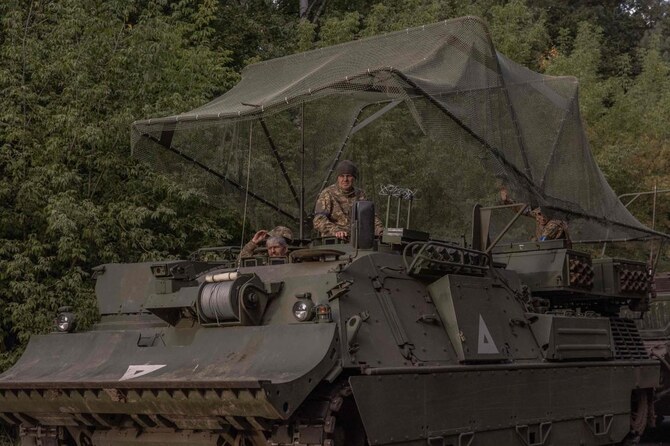
Ukrainian officials urge civilians to evacuate eastern town of Pokrovsk as Russian troops close in
https://arab.news/y5u3a
Ukrainian officials urge civilians to evacuate eastern town of Pokrovsk as Russian troops close in
- The urgency also underscored the high-stakes gamble Ukraine is making by taking the war into Russia with its ongoing Kursk assault
- The attack is a daring attempt to change the dynamics of the 2½-year conflict
Somalia denounces Israeli recognition of Somaliland
- Israel repeatedly hit targets in Yemen after the Gaza war broke out in October 2023, in response to Houthi attacks on Israel that the rebels said were in solidarity with Palestinians in the Gaza Strip
- Egypt’s foreign ministry said its top diplomat had spoken with his counterparts from Turkiye, Somalia and Djibouti, who together condemned the move and emphasized “their full support for the unity, sovereignty and territorial integrity of Somalia”
MOGADISHU: Somalia reacted angrily Friday after Israel formally recognized its northern region of Somaliland as an “independent and sovereign state” — the first country country to do so.
Somaliland, which declared independence from Somalia in 1991, has for decades pushed for international recognition, which has been the key priority for president Abdirahman Mohamed Abdullahi since he took office last year.
But a Somali foreign ministry statement warned that the decision was “deliberate attack” on its sovereignty that would undermine peace in the region. Several other countries also condemned Israel’s decision.
Israeli Prime Minister Benjamin Netanyahu’s office said he announced “the official recognition of the Republic of Somaliland as an independent and sovereign state,” making Israel the first country to do so.
“The declaration is in the spirit of the Abraham Accords,” Netanyahu’s office said, referring to several agreements between Israel and Arab countries brokered by US President Donald Trump during his first presidency to normalize ties with Israel.
It said Netanyahu had invited Abdullahi to visit.
Hailing Israel’s decision, Abdullahi said in a post on X that it marked the beginning of a “strategic partnership.”
“This is a historic moment as we warmly welcome” he said, affirming “Somaliland’s readiness to join the Abraham Accords,” he added.
In Hargeisa, the capital of Somaliland, crowds of people took to the streets to celebrate, many carrying the flag of the breakaway state, said sources.
- ‘Illegitimate actions’ -
Somalia’s foreign ministry said: “Illegitimate actions of this nature seriously undermine regional peace and stability, exacerbate political and security tensions, in the Horn of Africa, the Red Sea and Gulf of Aden, the Middle East and the wider region.”
Turkiye, a close ally of Somalia, also condemned the move.
“This initiative by Israel, which aligns with its expansionist policy... constitutes overt interference in Somalia’s domestic affairs,” it said in a foreign ministry statement.
Egypt’s foreign ministry said its top diplomat had spoken with his counterparts from Turkiye, Somalia and Djibouti, who together condemned the move and emphasized “their full support for the unity, sovereignty and territorial integrity of Somalia.”
In video showing Netanyahu speaking to Abdullahi by telephone, the Israeli leader said: “I want you to know that I am signing now as we speak Israel’s official recognition of the Somaliland,” adding that the new relationship would offer economic opportunities.
“I am very, very happy and I am very proud of this day and I want to wish you and the people of Somaliland the very, very best,” he said.
Netanyahu also said that he would communicate to Trump Abdullahi’s “willingness and desire to join the Abraham accords.”
A self-proclaimed republic, Somaliland enjoys a strategic position on the Gulf of Aden, has its own money, passports and army. But since its unilateral declaration of independence in 1991, it has grappled with decades of isolation.
- Strategic -
Analysts say matters of strategy were behind Israel’s drive to recognize Somaliland.
“Israel requires allies in the Red Sea region for many strategic reasons, among them the possibility of a future campaign against the Houthis,” said the Institute for National Security Studies in a paper last month, referring to Yemen’s Iran-backed rebels.
“Somaliland is an ideal candidate for such cooperation as it could offer Israel potential access to an operational area close to the conflict zone,” it said, adding there were also economic motives.
Israel repeatedly hit targets in Yemen after the Gaza war broke out in October 2023, in response to Houthi attacks on Israel that the rebels said were in solidarity with Palestinians in the Gaza Strip.
The Houthis have halted their attacks since a fragile truce began in Gaza in October.
Somaliland’s lack of international recognition has hampered access to foreign loans, aid and investment, and the territory remains deeply impoverished.
A deal between landlocked Ethiopia and Somaliland last year to lease a stretch of coastline for a port and military base enraged Somalia.
Israel has been trying to bolster relations with countries in the Middle East and Africa.
Historic agreements struck late in Trump’s first term in 2020 saw several countries including Muslim-majority United Arab Emirates and Morocco normalize relations with Israel, but wars that have stoked Arab anger, particularly in Gaza, have hampered recent efforts.


