

Why is mpox an emergency again, and how worried should I be?

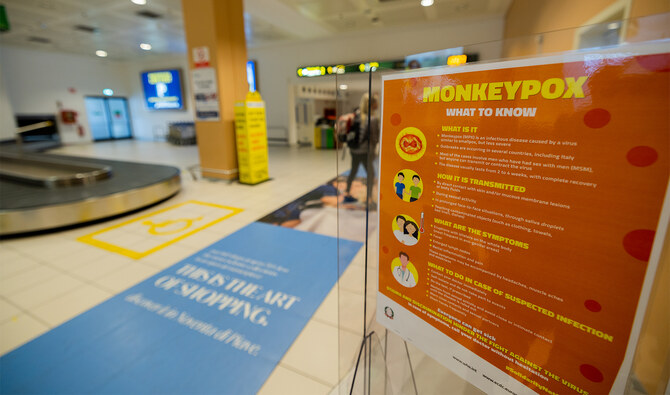
A sign announcing monkeypox informations is setup in International Airport Treviso A. Canova, in Treviso, Italy, on November 30, 2022. (NurPhoto via REUTERS)
Short Url
Updated 16 August 2024
Follow

Why is mpox an emergency again, and how worried should I be?

  • Mpox is a viral infection that causes flu-like symptoms and pus-filled lesions
  • Unlike COVID-19, there are tools that are proven to work to stop its spread

LONDON: The World Health Organization has declared that an outbreak of mpox, a viral infection that spreads through close contact, represents a global health emergency for the second time in two years.

Here’s what that means.

WHAT IS MPOX?

Mpox is a viral infection that causes flu-like symptoms and pus-filled lesions, and while usually mild, it can kill. Children, pregnant women and people with weakened immune systems, such as those with HIV, are all at higher risk of complications.

The WHO declared the recent outbreak of the disease a public health emergency after a new offshoot of the mpox virus, first identified in Democratic Republic of Congo, began spreading to other neighboring countries.

Mpox transmits through close physical contact, including sexual contact, but there is no evidence that it spreads easily through the air.

The new offshoot has caused global alarm because it appears to spread more easily between people.

WHAT IS A GLOBAL HEALTH EMERGENCY?

A “public health emergency of international concern,” or PHEIC, is the WHO’s highest form of alert. It is announced when diseases are spreading in new or unusual ways, and is aimed at galvanizing international co-operation and funding to tackle an outbreak.

The WHO’s declaration follows a similar label from the Africa Centers for Disease Control and Prevention earlier this week.

WHY IS MPOX AN EMERGENCY AGAIN?

Two years ago, the WHO declared mpox was an emergency when a form of the disease, clade IIb, began to spread globally, largely among men who have sex with men.

That outbreak was brought under control after behavior change and safe sex practices, plus vaccines, helped people at risk protect themselves in many countries.

But mpox has been a public health problem in parts of Africa for decades. The first ever human case was in Congo in 1970, and it has had outbreaks ever since.

The current outbreak, Congo’s worst ever, has seen 27,000 cases and more than 1,100 deaths since January 2023, largely among children.

Two strains of mpox are now spreading in Congo — the endemic form of the virus, clade I, and a new offshoot called clade Ib, with the term ‘clade’ referring to a form of the virus.

The new offshoot has now moved from eastern Congo to Rwanda, Uganda, Burundi and Kenya.

Sweden reported the first case of the new form, clade Ib, outside Africa on Thursday.

A WHO spokesperson said the case reiterated the need for partnership, and the agency continues to advise against travel restrictions to stop the spread of mpox.

Pakistan on Friday also confirmed a case of the mpox virus in a patient who had returned from a Gulf country, though it was unclear whether it was of the new variant or of the clade that has been spreading globally since 2022.

WHAT HAPPENS NOW?

Scientists hope that the emergency declarations will speed up efforts to get more medical tools and funding to Congo to help the authorities there tackle the outbreak. Better surveillance is needed to study the virus and help stop the spread.

But in 2022, a WHO appeal for $34 million to fight mpox got no take-up from donors, and there was huge inequity in who had access to vaccine doses. African countries had no access to the two shots used in the global outbreak, made by Bavarian Nordic and KM Biologics.

Two years later that remains the case, although there are efforts to change that, the WHO said on Wednesday as it appealed for dose donations from countries with stockpiles.

Africa CDC said it has a plan to secure doses, without elaborating further, but stocks are currently limited.

HOW WORRIED SHOULD I BE?

Fatality rates vary, and depend heavily on the health care available to the sickest patients. In Congo in this outbreak, the rate across both clade I and clade Ib has been around 4 percent. Clade II, which spread globally, was much less deadly.

However, mpox is not COVID-19. There are tools that are proven to work to stop the spread and help those at risk, and it does not spread as easily.

The challenge now, which the emergency declarations aim to highlight, is making sure those tools reach those who need them most, in Congo and neighboring countries.


Trump sues the BBC for defamation over editing of January 6 speech, seeks up to $10 billion in damages

Updated 59 min 28 sec ago
Follow

Trump sues the BBC for defamation over editing of January 6 speech, seeks up to $10 billion in damages

  • A BBC spokesperson told Reuters earlier on Monday that it had “no further contact from President Trump’s lawyers at this point
  • The BBC is funded through a mandatory license fee on all TV viewers, which UK lawyers say could make any payout to Trump politically fraught

WASHING: President Donald Trump sued the BBC on Monday for defamation over edited clips of a speech that made it appear he directed supporters to storm the US Capitol, opening an international front in his fight against media coverage he deems untrue or unfair. Trump accused Britain’s publicly owned broadcaster of defaming him by splicing together parts of a January 6, 2021 speech, including one section where he told supporters to march on the Capitol and another where he said “fight like hell.” It omitted a section in which he called for peaceful protest.
Trump’s lawsuit alleges the BBC defamed him and violated a Florida law that bars deceptive and unfair trade practices. He is seeking $5 billion in damages for each of the lawsuit’s two counts. The BBC has apologized to Trump, admitted an error of judgment and acknowledged that the edit gave the mistaken impression that he had made a direct call for violent action. But it has said there is no legal basis to sue.
Trump, in his lawsuit filed Monday in Miami federal court, said the BBC despite its apology “has made no showing of actual remorse for its wrongdoing nor meaningful institutional changes to prevent future journalistic abuses.”
The BBC is funded through a mandatory license fee on all TV viewers, which UK lawyers say could make any payout to Trump politically fraught.
A spokesman for Trump’s legal team said in a statement the BBC “has a long pattern of deceiving its audience in coverage of President Trump, all in service of its own leftist political agenda.”
A BBC spokesperson told Reuters earlier on Monday that it had “no further contact from President Trump’s lawyers at this point. Our position remains the same.” The broadcaster did not immediately respond to a request for comment after the lawsuit was filed.

CRISIS LED TO RESIGNATIONS
Facing one of the biggest crises in its 103-year history, the BBC has said it has no plans to rebroadcast the documentary on any of its platforms.
The dispute over the clip, featured on the BBC’s “Panorama” documentary show shortly before the 2024 presidential election, sparked a public relations crisis for the broadcaster, leading to the resignations of its two most senior officials.
Trump’s lawyers say the BBC caused him overwhelming reputational and financial harm.
The documentary drew scrutiny after the leak of a BBC memo by an external standards adviser that raised concerns about how it was edited, part of a wider investigation of political bias at the publicly funded broadcaster.
The documentary was not broadcast in the United States.
Trump may have sued in the US because defamation claims in Britain must be brought within a year of publication, a window that has closed for the “Panorama” episode.
To overcome the US Constitution’s legal protections for free speech and the press, Trump will need to prove not only that the edit was false and defamatory but also that the BBC knowingly misled viewers or acted recklessly.
The broadcaster could argue that the documentary was substantially true and its editing decisions did not create a false impression, legal experts said. It could also claim the program did not damage Trump’s reputation.
Other media have settled with Trump, including CBS and ABC when Trump sued them following his comeback win in the November 2024 election.
Trump has filed lawsuits against the New York Times, the Wall Street Journal and a newspaper in Iowa, all three of which have denied wrongdoing. The attack on the US Capitol in January 2021 was aimed at blocking Congress from certifying Joe Biden’s presidential win over Trump in the 2020 US election.