Britain’s King Charles honors UK train attack ‘hero’ Samir Zitouni

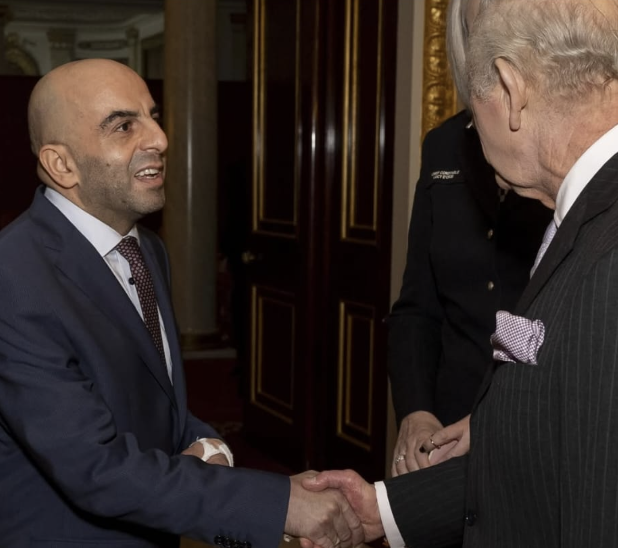
King Charles met “heroic ” British-Arab train guard Samir Zitouni at a reception at Buckingham Palace on Wednesday. (Instagram/@theroyalfamily)
Short Url
Updated 18 December 2025
Follow

Britain’s King Charles honors UK train attack ‘hero’ Samir Zitouni

  • Zitouni was hailed a hero for protecting passengers during a knife attack on a train in England last month

LONDON: King Charles met “heroic ” British-Arab train guard Samir Zitouni at a reception at Buckingham Palace on Wednesday.

Zitouni was hailed a hero for protecting passengers during a knife attack on a train in England last month.

The king was pictured shaking hands with Zitouni, who was seriously injured when he intervened as an attacker stabbed passengers on a Doncaster to London service on Nov. 1.

The train was diverted to Huntingdon station in Cambridgeshire following the incident.

Known as Sam to friends, Zitouni attended the reception with his wife, Eleni Sakkoulei, alongside members of the public and railway staff who displayed exceptional bravery during the attack.

The suspect arrested in connection with the incident has been charged with multiple offenses, including possession of a bladed article on Nov. 1, as well as other offenses in the hours leading up to the attack.

He remains in custody pending court hearings scheduled for next year.

A GoFundMe page set up to support Zitouni, who has worked for LNER for more than 20 years, has raised almost £80,000 ($107,000).

In a statement shared on the crowdfunding page, Zitouni’s wife said he “acted as a shield to protect the lives of others,” adding that he would do the same “for anyone, regardless of color, age, gender, religion or origin.”

Fund organizer Gemma Royce said the appeal was launched while Zitouni was in critical condition in hospital, to allow the family to focus on his recovery.

LNER managing director David Horne said Zitouni’s actions were “incredibly brave,” adding that the company was proud of all staff who showed courage during the incident.

UK Transport Secretary Heidi Alexander said Mr. Zitouni had gone to work to do his job and “left a hero,” while shadow transport secretary Richard Holden said he would be nominating him for a gallantry award.


8 in 10 British Muslims face ‘financial faith penalty’ when seeking home finance, survey finds

Updated 04 February 2026
Follow

8 in 10 British Muslims face ‘financial faith penalty’ when seeking home finance, survey finds

  • Restricted choices plague potential buyers

LONDON: Eight in 10 British Muslims say their home finance choices are restricted because of their faith, according to a new national survey that highlighted what researchers describe as a growing “financial faith penalty” in the UK housing market.

The report, published by Islamic home finance fintech firm Offa, found that 80 percent of Muslim respondents believe their religious beliefs limit their access to suitable home finance, while those who do use Islamic products often face slower decisions, heavier paperwork and poorer customer experiences than in the conventional mortgage market.

Based on surveys of 1,000 British Muslims conducted by Muslim Census, and 2,000 non-Muslims carried out by OnePoll, the research calls on providers, brokers and policymakers to modernize Islamic home finance and improve access to Sharia-compliant products.

Among the 24.3 percent of British Muslims who have used Islamic home finance, just 5 percent said they had received a same-day decision.

Some 62 percent waited up to two weeks, while 33 percent waited more than 15 days, including 16 percent who waited over a month.

Long decision times were cited as the biggest challenge by 28 percent of respondents, followed by excessive paperwork (22.6 percent) and poor customer service (18.9 percent).

Islamic home finance differs from conventional mortgages by avoiding interest and steering investment away from sectors considered harmful to society, including gambling, alcohol, tobacco, arms trading and animal testing.

Sagheer Malik, chief commercial officer and managing director of home finance at Offa, said the findings showed British Muslims were being underserved by outdated systems.

Malik said: “Property is the asset class of choice for many of the UK’s 3.87 million Muslims, both as a route to generational wealth and as a long-term financial foundation, yet our insightful research report reveals that British Muslims are being underserved and deterred by slow, outdated and opaque Islamic home finance provision.

“This is not a niche concern. It goes to the heart of financial fairness and inclusion in modern Britain.”

He added that Muslims deserved Sharia-compliant products that matched mainstream standards on “price, speed and simplicity.”

Despite strong demand, uptake remains low.

Only 12.8 percent of British Muslims surveyed said they currently use Islamic home finance, with a further 11.5 percent having done so in the past. More than three quarters (75.7 percent) have never used it.

Faith plays a central role in financial decisions, with 94.2 percent saying it is important that their financial products align with their ethical or religious beliefs. Yet more than half of those using conventional mortgages said they felt unhappy or uneasy about doing so because of their faith.

The study also found that British Muslims share similar home ownership aspirations to the wider population, with 79.1 percent citing the desire to provide a stable home for their family, while 18.6 percent said building generational wealth was their main motivation. Only 2.2 percent said they did not want to own a home.

The report suggests Islamic finance could appeal beyond Muslim communities. While 64 percent of non-Muslim respondents had never heard of Islamic home finance, 63 percent said they favored its ethical principles once explained.

Younger generations were the most receptive, with 43 percent of Generation Z and 37 percent of millennials saying they would consider using Islamic home finance, compared with just 7 percent of baby boomers. More than three quarters of Gen Z and 72 percent of millennials also said it was important that their finance provider avoided investing in ethically harmful sectors.

Offa said the findings pointed to an opportunity to expand ethical finance in the UK, provided the industry can deliver faster, simpler and more transparent services.