

Authorities warn of floods, landslides as rains kill 64 in Pakistan’s northwest since July 1

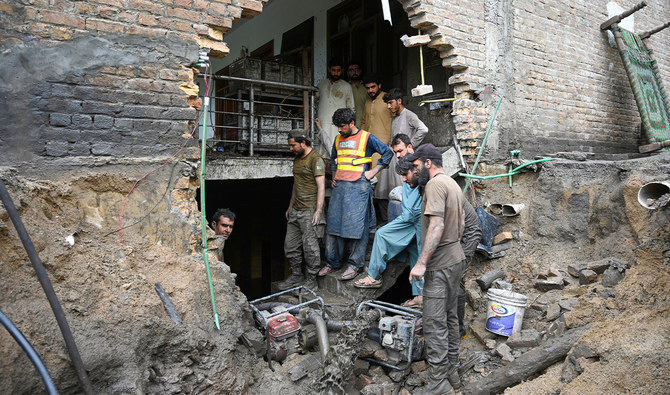
Rescue workers clean the basement of a house damaged by flash flood waters in Darra Adamkhel, Khyber Pakhtunkhwa province of Pakistan, on July 30, 2024. (AFP/File)
Short Url
Updated 16 August 2024
Follow

Authorities warn of floods, landslides as rains kill 64 in Pakistan’s northwest since July 1

  • Torrential monsoon rains have killed at least 180 people in Pakistan this year
  • An estimated 200,000 people could be affected during this monsoon season

ISLAMABAD: Authorities on Friday warned of further rains and landslides in Pakistan’s northwestern Khyber Pakhtunkhwa (KP) province over the next 24 hours, as death toll from rain-related incidents rose to 64 in the region.

Torrential monsoon rains have killed at least 180 people across Pakistan, including 64 in the Khyber Pakhtunkhwa province, since July 1, according to disaster management authorities.

A westerly wave is likely to affect upper parts of Pakistan as monsoon currents from the Arabian Sea and the Bay of Bengal continue to penetrate southern and central regions of the South Asian country.

“[There is a] risk of urban flooding in main cities of the province,” the KP provincial disaster management authority (PDMA) said in a statement on Friday.

“Landslides in Chitral, Dir, Swat, Buner, Shangla, Kohistan, Battagram, Torghar, Mansehra, Abbottabad districts may affect the vulnerable points in the area during the wet spell.”

It said thunderstorms could damage loose structures like electric poles, vehicles and solar panels, urging relevant departments to remain alert during the forecast period.

Pakistan is recognized as one of the most vulnerable countries to climate change effects in the world. This year, the South Asian country recorded its “wettest April since 1961,” with 59.3 millimeters rainfall and at least 144 deaths in thunderstorms and house collapses, mostly in Khyber Pakhtunkhwa, according to authorities.

In June, a senior UN official warned that an estimated 200,000 people in Pakistan could be affected by the upcoming monsoon season, which is expected to bring heavier rains than usual.

Unusually heavy rains in 2022 triggered flash floods in many parts of the country, killing over 1,700 people, inflicting losses of around $30 billion, and affecting at least 30 million people.


World Bank approves $700 million for Pakistan’s economic stability

Updated 20 December 2025
Follow

World Bank approves $700 million for Pakistan’s economic stability

  • Of this, $600 million will go for federal programs and $100 million will ⁠support a provincial program in Sindh
  • The results-based design ensures that resources are only disbursed once program objectives are achieved

ISLAMABAD: The World Bank has approved $700 million in ​financing for Pakistan under a multi-year initiative aimed at supporting the country’s macroeconomic stability and service delivery, the bank said on Friday.

The funds will be released under the bank’s Public ‌Resources for Inclusive ‌Development — Multiphase ‌Programmatic ⁠Approach (PRID-MPA) that ‌could provide up to $1.35 billion in total financing, according to the lender.

Of this amount, $600 million will go for federal programs and $100 million will ⁠support a provincial program in ‌the southern Sindh province. The results-based design ensures that resources are only disbursed once program objectives are achieved.

“Pakistan’s path to inclusive, sustainable growth requires mobilizing more domestic resources and ensuring they are used efficiently and transparently to deliver results for people,” World Bank country director Bolormaa Amgaabazar said in a statement.

“Through this MPA, we are working with the Federal and Sindh governments to deliver tangible impacts— more predictable funding for schools and clinics, fairer tax systems, and stronger data for decision‑making— while safeguarding priority social and climate investments and strengthening public trust.”

The approval ‍follows a $47.9 ‍million World Bank grant ‍in August to improve primary education in Pakistan’s most populous Punjab province.

In November, an IMF-World Bank ​report, uploaded by Pakistan’s finance ministry, said Pakistan’s fragmented ⁠regulation, opaque budgeting and political capture are curbing investment and weakening revenue.

Regional tensions may surface over international financing for Pakistan. In May, Reuters reported that India would oppose World Bank funding for Pakistan, citing a senior government ‌source in New Delhi.

“Strengthening Pakistan’s fiscal foundations is essential to restoring macroeconomic stability, delivering results and strengthening institutions,” said Tobias Akhtar Haque, Lead Country Economist for the World Bank in Pakistan.

“Through the PRID‑MPA, we are launching a coherent nationwide approach to support reforms that expand fiscal space, bolster investments in human capital and climate resilience, and strengthen revenue administration, budget execution, and statistical systems. These reforms will ensure that resources reach the frontline and deliver better outcomes for people across Pakistan with greater efficiency and accountability.”

In Sindh, the program is expected to increase provincial revenues, enhance the speed and transparency of payments, and broaden the use of data to guide provincial decision making. The program will directly support the increase of public resources for inclusive development, including more equitable and responsive financing for primary health care facilities and more funding for schools.