DOHA: Negotiators seeking a Gaza ceasefire were set to meet for a second day in Qatar on Friday, while top European diplomats were expected in Israel to stress the urgency of averting a wider war.
The on-and-off truce talks reconvened in Qatar’s capital on Thursday without Hamas, which has accused Israel of obstructing a deal and insists on the implementation of previously agreed terms.
Months of talks have yet to secure the return of hostages held by militants in Gaza or staunch the spiralling death toll, which authorities in Hamas-ruled Gaza on Thursday said had topped 40,000 in the Palestinian territory after more than 10 months of war.
US National Security Council spokesman John Kirby said the talks had “a promising start” but acknowledged “there remains a lot of work to do.”
Israel’s main military supplier the United States has been mediating the talks with Qatar and Egypt.
The United States and its allies see the proposed Gaza truce as key to de-escalating soaring regional tensions, particularly with Iran.
“This is a dangerous moment for the Middle East. The risk of the situation spiralling out of control is rising,” British Foreign Secretary David Lamy said ahead of his visit with French Foreign Minister Stephane Sejourne.
During meetings with Israel’s Foreign Minister Israel Katz and Minister of Strategic Affairs Ron Dermer, they would “stress there is no time for delays or excuses from all parties on a ceasefire deal” in Gaza, according to Britain’s foreign ministry.
Sejourne said “any miscalculation in the current situation could provoke a generalized conflagration.”
While talks take place in the Gulf emirate, bombs have continued to fall in Gaza.
As they struggled to recover bodies from the ruins of yet another air strike on Thursday, Palestinians in north Gaza questioned why, when Israeli Prime Minister Benjamin Netanyahu’s team was in Qatar.
“Why did Netanyahu send a delegation to the talks while we are being killed here?” in Jabalia, Mohammed Al-Balwi said as rescuers around him pulled bodies from the concrete wreckage.
They had found “limbs on the ground,” he said.
Fears of a wider Middle East war have soared since the July 31 killing of Hamas political leader and truce negotiator Ismail Haniyeh in Tehran. Iran and its allied groups in the region blamed Israel and vowed revenge.
Haniyeh’s death came hours after an Israeli strike killed Fuad Shukr, the military commander of Lebanon’s Iran-backed Hezbollah movement, which has exchanged near-daily cross border fire with Israeli forces.
The Gaza war has also drawn in Tehran-aligned groups in Iraq, Syria and Yemen.
The US military said its forces had destroyed a “ground control station” operated by Yemen’s Iran-backed Houthi rebels. The Houthis have for months fired missiles and drones at shipping in waterways vital to world trade off Yemen.
The Houthis, like Hezbollah, say they are acting in support of the Palestinians.
Violence has also surged in the Israeli-occupied West Bank.
Israeli President Isaac Herzog on Thursday condemned a Jewish settler attack on a West Bank village that the Palestinian Authority said killed one Palestinian and wounded another.
The Israeli military said dozens of Israeli civilians, some masked, entered Jit on Thursday evening and “set fire to vehicles and structures in the area, hurled rocks and Molotov cocktails.”
It added that it had opened an investigation and was looking into reports of a fatality.
Since the war in Gaza began, hundreds of Palestinians have been killed in the West Bank by the Israeli army or settlers, according to an AFP count based on official Palestinian data.
During the same period in the West Bank, at least 18 Israelis, including soldiers, have been killed in Palestinian attacks, according to official Israeli data.
The Qatari foreign ministry said Gaza truce negotiations would continue on Friday.
Mediators remain committed “in their endeavours to reach a ceasefire in the strip that would facilitate the release of hostages and enable the entry of the largest possible amount of humanitarian aid into Gaza,” a ministry spokesperson said.
They are seeking to finalize details of a three-phase proposal initially outlined by US President Joe Biden in May.
While Hamas is not directly taking part, an official of the Islamist movement, Osama Hamdan, told AFP the group would join if the meeting set a timetable for implementing the agreed terms.
He added that Hamas would not engage in negotiations that “give Netanyahu more time to kill our Palestinian people.”
Netanyahu has called Hamas leader Yahya Sinwar “the only obstacle to a hostage deal.”
Hamas’s unprecedented October 7 attack on Israel that triggered the war resulted in the deaths of 1,198 people, mostly civilians, according to an AFP tally of Israeli official figures.
Militants also seized 251 hostages, 111 of whom are still held in Gaza, including 39 the military says are dead.
Some were freed during a one-week truce in November.
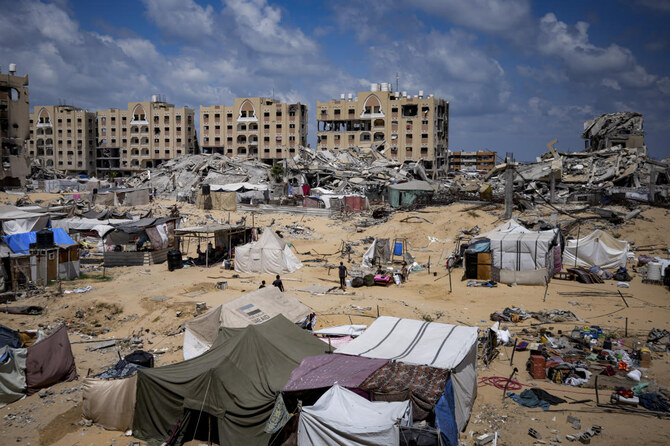
The war has displaced almost the entire population of Gaza and destroyed much of its housing and other infrastructure, leaving widespread shortages of food.
Gaza’s health ministry, which does not provide a breakdown of civilian and militant casualties, on Thursday said the war has killed at least 40,005 people.
The United Nations human rights chief, Volker Turk, called it a “grim milestone for the world.”


![]()

Gaza ceasefire talks to resume for 2nd day in Qatar
Short Url
https://arab.news/zyzb2
Gaza ceasefire talks to resume for 2nd day in Qatar
- The on-and-off truce talks reconvened in Qatar’s capital on Thursday without Hamas
- United States and its allies see the proposed Gaza truce as key to de-escalating soaring regional tensions, particularly with Iran
Latest updates


© 2026 SAUDI RESEARCH & PUBLISHING COMPANY, All Rights Reserved And subject to Terms of Use Agreement.