

UK foreign minister to visit Israel to prevent Middle East escalation, hails ‘crucial’ Gaza ceasefire talks

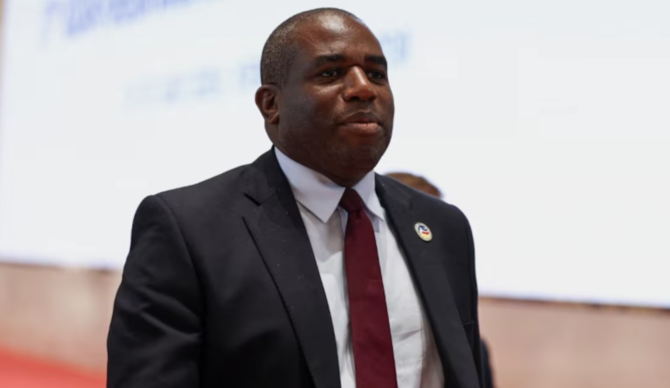
British foreign minister David Lammy is set to travel to Israel in an attempt to prevent an all-out war in the Middle East, Sky News reported on Thursday, citing a diplomatic source. (Reuters/File Photo)
Short Url
Updated 16 August 2024
Follow

UK foreign minister to visit Israel to prevent Middle East escalation, hails ‘crucial’ Gaza ceasefire talks

  • FCDO statement quoted Lammy as urging UK partners in Middle East to “choose peace”

LONDON: British foreign minister David Lammy is set to travel to Israel in an attempt to prevent an all-out war in the Middle East, Sky News reported on Thursday, citing a diplomatic source.

Also on Thursday, a Foreign, Commonwealth & Development Office statement quoted Lammy as urging UK’s partners in the Middle East to “choose peace” amid rising tensions in the region. 

Commenting on the restart of negotiations on a ceasefire and hostage deal in Gaza, Lammy said: “We are at a crucial moment for global stability. The coming hours and days could define the future of the Middle East, that is why today, and every day, we are urging for our partners across the region to choose peace.

“As the UK made clear at the UN Security Council this week, the situation in Gaza is devastating. The strike on the Al-Tabeen school demonstrated that Palestinians in Gaza have nowhere safe to turn.

“These talks are an opportunity to secure an immediate ceasefire that protects civilians in Gaza, secures the release of hostages still cruelly held by Hamas and restores stability at a dangerous moment for the region,” he added.

Lammy said Britain would continue to push for a ceasefire and would work with allies to achieve one, as he pointed to discussions between Prime Minister Keir Starmer and leaders in the US, France and Germany, as well as the presidents of Iran and Egypt.

“It’s clear from these conversations that a ceasefire would not only protect civilians in Gaza, but also pave the way for wider de-escalation and bring much-needed stability for the Middle East,” he said.

“It is in the interests of both Israelis and Palestinians for a deal to be agreed, urgently. I urge all parties to engage in the negotiations in good faith and show the flexibility needed to reach an agreement.

“I thank Qatar, Egypt, the US and all international partners for their efforts in co-ordinating this vital moment.”


Germany plays down threat of US invading Greenland after talks

Updated 13 January 2026
Follow

Germany plays down threat of US invading Greenland after talks

WASHINGTON: Germany’s top diplomat on Monday played down the risk of a US attack on Greenland, after President Donald Trump’s repeated threats to seize the island from NATO ally Denmark.
Asked after meeting Secretary of State Marco Rubio about a unilateral military move by Trump, German Foreign Minister Johann Wadephul said: “I have no indication that this is being seriously considered.”
“Rather, I believe there is a common interest in addressing the security issues that arise in the Arctic region, and that we should and will do so,” he told reporters.
“NATO is only now in the process of developing more concrete plans on this, and these will then be discussed jointly with our US partners.”
Wadephul’s visit comes ahead of talks this week in Washington between Rubio and the top diplomats of Denmark and Greenland, which is an autonomous territory of Denmark.
Trump in recent days has vowed that the United States will take Greenland “one way or the other” and said he can do it “the nice way or the more difficult way.”
Greenland’s government on Monday repeated that it would not accept a US takeover under “any circumstance.”
Greenland and NATO also said Monday that they were working on bolstering defense of the Arctic territory, a key concern cited by Trump.
Trump has repeatedly pointed to growing Arctic activity by Russia and China as a reason why the United States needs to take over Greenland.
But he has also spoken more broadly of his desire to expand the land mass controlled by the United States.