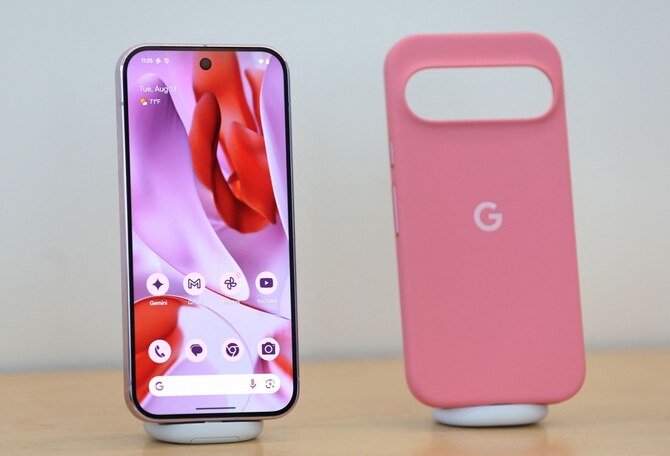
MOUNTAIN VIEW, California: Google on Tuesday unveiled its next generation of Pixel phones, providing the maker of Android software a head start on the next iPhone in the race to bring more artificial-intelligence services to devices that have become people’s constant companions.
The showcase held near Google’s Mountain View, California, headquarters took place two months earlier than when the company typically rolls out the next models in its Pixel phone line-up, which made its debut eight years ago.
Although Pixel phones still represent a sliver of worldwide smartphone sales, they are still closely watched because they serve as Google’s platform for demonstrating the latest advances in the Android operating system that powers virtually every phone not made by Apple.
And Google left little doubt that the Pixel 9 phones are meant to be a vessel for the AI technology that is expected to reshape the way people live and work, just as smartphones in general have done over the past 15 years.
“We are obsessed with the idea that AI can make life easier and more productive for people,” Rick Osterloh, a Google senior vice president who oversees the Pixel phones, said Tuesday.
That’s similar to the theme Apple is accentuating as it prepares to make AI a centerpiece of the iPhone.
That moment is expect to arrive shortly after Labor Day when Apple traditionally takes the wraps off its next iPhone. The next model, the iPhone 16, is expected to be a big attraction because it will be equipped with the special chip needed to run a suite of AI features. Those features are designed to make Apple’s virtual assistant Siri smarter and perform a wide variety of other tasks that the company is promising will bring more joy to people’s lives, while still protecting their privacy.
But Apple’s plans for AI remain hazier than Google’s vision, and Google is also rolling it out more broadly, including on Samsung phones powered by Android, said Emarketer analyst Grace Harmon. That may increase the pressure on Apple next month when it unveils the next iPhone.
Not surprisingly, the Pixel 9 lineup is also packed with AI technology, a shift that the Google began last October when it released that year’s model. This generation of phones will be the first centered around the Gemini technology that’s become the focal point of its push into AI.
Just as Apple is aiming to do with Siri, Google has designed its Gemini assistant to be more conversational, providing it with a range of 10 different human-like voices. It’s able to handle even more tasks, especially if users are willing to give it access to email and other documents.
In another move mirroring Apple, Google is equipping the Pixel 9 lineup with a special chip enabling many AI-powered services to be handled on the device instead of remote data centers, with the aim of boosting personal privacy and security.
In on-stage demonstrations Tuesday, the Gemini assistant speaking in a voice called “Ursa” was able to come up with helpful ideas for a fun way to use invisible ink when asked to come up with creative ideas.
But the Gemini assistant also stumbled when shown a picture of a poster for singer Sabrina Carpenter, and when asked to let the questioner know when she was performing a concert in the area. After coming up blank on the first two requests, the Gemini assistant provided the requested information.
The Pixel 9 phones also will feature “Magic Editor,” AI technology capable of completely transforming pictures by quickly and seamlessly adding a person who wasn’t in the original photo, or by altering the photo’s landscape or background.
The more advanced Gemini Assistant will require a $20 monthly subscription that will be free for one year for all buyers of the next Pixel 9 phones, which will begin shipping Aug. 22 before becoming more widely available next month. The $240 benefit that Google is offering with a free one-year subscription to its Gemini Advanced service makes it more likely Apple won’t be able to charge for its suite of AI services, Emarketer’s Harmon said.
The standard Pixel 9 will sell for $800, a $100 increase from last year, while the Pixel 9 Pro will sell for $1,000 or $1,100, depending on the size. The next generation of a foldable Pixel phone that Google introduced last year will sell for $1,800.
The event also signaled that Google intends to conduct business as usual even as its Internet empire is being threatened by a judge’s recent decision declaring its dominant search engine to be an illegal monopoly.
The landmark ruling will trigger another round of court hearings to determine the measures that Google must take to create a more competitive market – a process that could result in Google being banned from engaging in some deals or, in the drastic scenario, being ordered to spin off its Android software or relinquish other key pillars bolstering the nearly $2 trillion market value of its corporate parent, Alphabet Inc.
Besides its latest phones, Google also took aim at several other popular Apple products with its next Pixel Watch and wireless earbuds.


![]()

Google rolls out Pixel 9 phones earlier than usual as AI race with Apple heats up
Short Url
https://arab.news/57d3x
Google rolls out Pixel 9 phones earlier than usual as AI race with Apple heats up
Latest updates




© 2026 SAUDI RESEARCH & PUBLISHING COMPANY, All Rights Reserved And subject to Terms of Use Agreement.