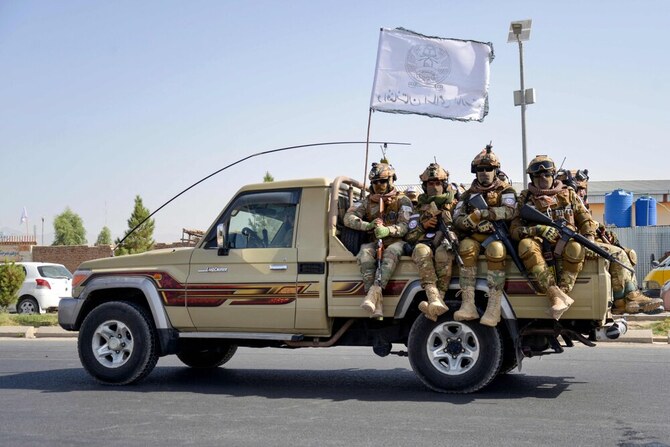
BAGRAM, Afghanistan: Afghanistan’s Taliban rulers celebrated three years in power on Wednesday with a military parade paying homage to their homemade bombs used in war, fighter aircraft and goose-stepping security forces.
The Taliban’s armed forces towed Soviet-era tanks and artillery pieces through the former US air base in Bagram, where Chinese and Iranian diplomats were among hundreds who gathered for the parade and speeches.
The former Bagram base once served as the linchpin for US-led operations against the Taliban for two decades.
A swarm of motorbikes strapped with yellow jerry cans, often used to carry homemade bombs during the fight against international forces, also rumbled past assembled officials.
There were US-made armored personnel carriers, the black-and-white flag of the Islamic Emirate of Afghanistan — the Taliban government’s formal name for the country — fluttering above them.
Helicopters and fighter aircraft flew over the base, where Taliban fighters were once imprisoned, about 40 kilometers (25 miles) north of Kabul.
Taliban forces seized the capital on August 15, 2021, after the US-backed government collapsed and its leaders fled into exile. The anniversary is marked a day earlier on the Afghan calendar.
Their government remains unrecognized by any other state, with restrictions on women, who bear the brunt of policies the United Nations has called “gender apartheid,” remaining a key sticking point.
“Three years have passed since the dreams of girls have been buried,” Madina, a 20-year-old former university student in Kabul, told AFP.
“It’s a bitter feeling that every year, the celebration of this day reminds us of the efforts, memories, and goals we had for our future.”
Prime Minister Mohammad Hassan Akhund, who had been scheduled to appear at Bagram, praised the Taliban authorities’ victory over “Western occupiers” in a statement read by his chief of staff.
The Taliban government has “the responsibility to maintain Islamic rule, protect property, people’s lives and the respect of our nation,” he said.
Security has been a priority for Taliban authorities as they consolidated their power over the past three years, implementing laws based on their strict interpretation of Islam.
However, attacks by the Daesh group remain a threat and extra security was deployed in Kabul and in the Taliban’s spiritual home of Kandahar ahead of the “day of victory.”
A convoy of military vehicles and arms also paraded near the southern city.
Helicopters flew over the Ghazi stadium in Kabul, where hundreds of men gathered to watch speeches and an exhibition of athletics and performances of Taliban anthems.
Rugby player Samiullah Akmal praised the day’s events, saying it was “better than other years.”
“As a young man, I see Afghanistan’s future is bright... we are independent and the people surrounding us are our own.”
The stadium was full of people from surrounding provinces, Noorullah Noori, Minister of Borders and Tribal Affairs, told AFP, adding that there was a feeling of “unity.”
“Whether people are members of Islamic Emirate or not... they should be grateful for this blessing from God, they should stand behind the Islamic Emirate.”
The black-and-white standard decorated streets and trucks full of smiling men that choked Kabul streets.
Happy young boys carried a large flag in the Green Zone, once a secure enclave of foreign embassies, saying “We’re ready to do a suicide attack!“
While many Afghans expressed relief at the end of 40 years of successive conflicts, the economy remains stagnant and the population mired in a worsening humanitarian crisis.
“The past three years have been some of the worst of our lives,” said 26-year-old Zalmai, who works for a non-profit and only gave his last name.
“I don’t know what security the Taliban are talking about, people are hungry, the youth don’t have jobs... both girls and boys are facing uncertain future,” he said.
A joint statement from international non-governmental groups warned of the growing aid funding gap, with 23.7 million people in need of humanitarian assistance.
Women have been squeezed from public life — banned from many jobs as well as parks and gyms — and barred from secondary and higher education.
Human Rights Watch (HRW) reiterated calls for pressure on the Taliban government to lift restrictions on women.
“The third anniversary of the Taliban’s takeover is a grim reminder of Afghanistan’s human rights crisis, but it should also be a call for action,” said Fereshta Abbasi, HRW’s Afghanistan researcher.


![]()

Taliban celebrate 3 years since Afghanistan takeover with military show
Short Url
https://arab.news/8t52h
Taliban celebrate 3 years since Afghanistan takeover with military show
- The Taliban’s armed forces towed Soviet-era tanks and artillery pieces through the former US air base in Bagram
- Helicopters and fighter aircraft flew over the base, where Taliban fighters were once imprisoned


Latest updates


© 2026 SAUDI RESEARCH & PUBLISHING COMPANY, All Rights Reserved And subject to Terms of Use Agreement.