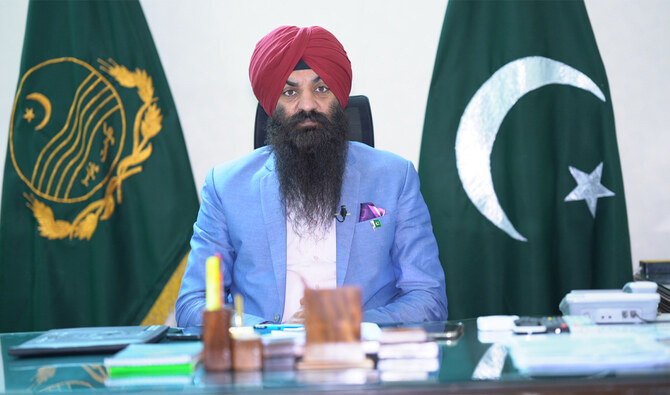

LAHORE: When Sardar Ramesh Singh Arora took oath as the provincial minister for minorities in Pakistan’s most populous Punjab province in March this year, he became the first Sikh to ever be appointed a minister in the country’s 77-year history.
But this was by no means a first for the 48-year-old development sector expert-turned-politician.
From 2013-18, Arora served as the first Sikh parliamentarian in the Punjab Assembly and in 2020 was elected for a second term on a seat reserved for minorities. This year, after Feb. 8 general elections, Arora was re-elected as an MP from Narowal — the home of Gurdwara Sri Kartarpur Sahib, the final resting place of Sikhism’s founder Guru Nanak — and began a third term in the Punjab assembly, this time as provincial minister for minorities. In 2008, he founded the Mojaz Foundation, which works to uplift the underprivileged and poor in Pakistan, and was recently also elected as chief of the Pakistan Sikh Gurudwara Parbandhak Committee (PSGPC).
A self-described “man of fate,” Arora says his rise to the echelons of political power in Pakistan’s most influential province stemmed from one decision his grandfather took in 1947: to stay in Pakistan following the partition of the Indian Subcontinent.
“It was fate that I was born here, that my family stayed, it was fate that we moved to one of the biggest minority-heavy districts of Pakistan, Narowal,” Arora said.
While Narowal is 99 percent Muslim, according to figures from the deputy commissioner’s office, many Sikhs, Christians and Hindus also live there.
“Before 2013 there was no member [of the Punjab assembly] from the Sikh community,” Arora said. “So, likewise this is the third time I’ve been a Punjab assembly member, and this is the first time in the history that someone from the Sikh faith is now a cabinet minister [in Pakistan].”
“PRIVILEGED MINORITY”
Arora, who worked for the World Bank’s poverty alleviation program before joining politics, has often had to fend off questions about coming from a “privileged minority,” with Sikhs widely believed to be better treated than other groups in Pakistan where the religion has an extensive heritage and history.
Many Sikhs see Pakistan as the place where their religion began: the founder of Sikhism, Guru Nanak, was born in 1469 in a small village, Nankana Sahib, near the eastern Pakistani city of Lahore.
“Particularly [talking] about the Sikh community and Sikh heritage in Pakistan, it brings me happiness to say that the bond between a Sikh and Pakistan is the same between flesh and bone,” the minister said.
“Because the Sikh faith had its origins in, the faith started in [present-day] Pakistan from Nakana Sahib [and] Kartarpur Sahib [in Narowal district] is the founder’s last resting place, so a Sikh coming to Pakistan feels very safe here.”
Arora did not comment on the killings of Sikhs in recent years by suspected militants, particularly in the northwestern province of Khyber Pakhtunkhwa, but said the Sikh community was a “privileged minority” while other groups who were not so well-treated had “rightful reservations.”
“They have valid demands which the government has to resolve, and we are working on resolving them,” Arora added. “Minorities are the crown I wear on my head, and protecting minorities is the precedent our government needs to set.”
Listing the achievements of the Punjab government in the five months since the new administration was sworn in, the minister said the minority affairs department had seen a 188 percent increase in its budget, with the minority development fund increased from Rs1.5 million to Rs2.5 billion. Grants for religious festivals of minority groups had increased almost 600 percent, Arora said.
“This means that we are standing with our minorities, we look after them,” he argued.
“The worship places that had fallen to landgrabbers, for a long time now, whether it was the Christian community, the Hindu community and some gurudwaras [Sikh temples], we had those freed, so we are determined and committed that in Punjab we are going to protect our minorities.”
In June this year, the Punjab government also approved the Sikh Marriage Act, which had been championed by Arora for years.
“Today, the Sikh marriage act [2018] rules are in place, we are trying to implement them, we are trying to enact the Hindu personal laws as well, we are working on Christian personal laws,” he said.
“Hindu marriage act has been passed in the national assembly, the rules of business are almost in place, we have started working on implementation. My own department has a five-year road map we are working toward.”
On Aug. 11, celebrated in Pakistan since 2009 as National Minorities Day, the Punjab Assembly called a special session to commemorate minorities “for their services to and love for Pakistan.”
Even at that session, Arora pointed out, the problems of minorities were spoken about openly rather than brushed under the rug:
“[We] discussed a way out from those situations, because we are focused on addressing the reservations that minorities have, and the rightful demands they make of the state.”
“UNITED IN OUR RESPONSE”
Arora, the ‘ambassador-at-large’ for the Kartarpur Corridor, a visa-free passage for Indian Sikh pilgrims to travel to the final resting place of Guru Nanak in Pakistan, said he was working so more people would come from the neighboring country.
“We have declared on-arrival visas for Sikhs, or Christians or other minorities, we want people to come to Pakistan,” he said.
Asked about his message for Pakistanis on the nation’s 78th Independence Day, he warned that there were “external forces” working to destabilize the country, including through terror attacks.
“We have to be unified in our response,” Arora said, wishing Pakistanis on the anniversary of the country’s independence.
“Our narrative [has always been], Pakistan’s narrative has been, peace, love and prosperity. We have to establish that clearly, going forward … I’d like to invite everyone to join us in making this a peace loving, independent and successful Pakistan.”